Cosmic rays tagged posts

A Neutrino Portrait of our Galaxy reveals High-Energy Particles from within the Milky Way

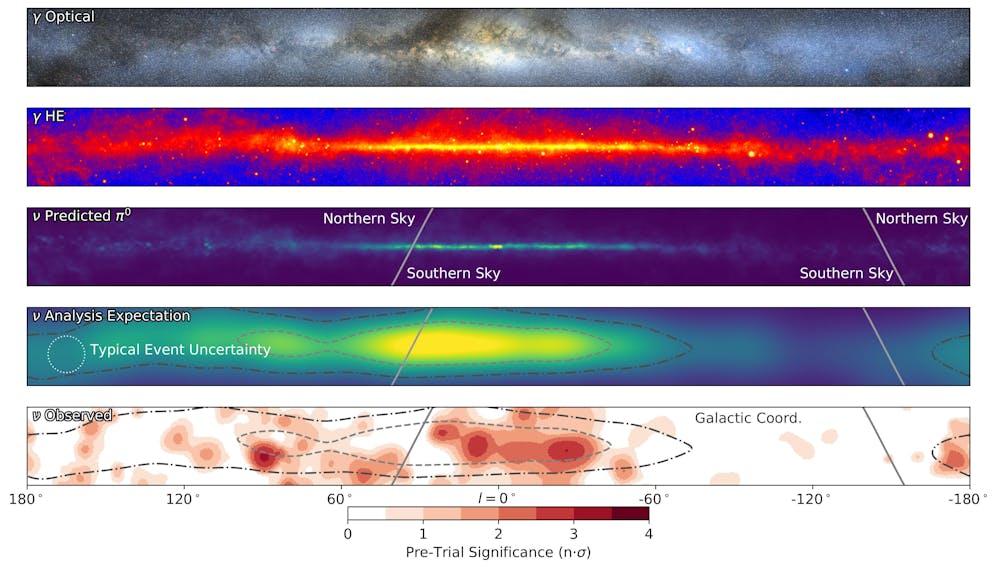
Five views of the Milky Way: the top two bands show visible light and gamma rays, while the lower three show expected and real neutrino results, plus a measure of the significance of neutrino events detected by IceCube. IceCube Collaboration

Our Milky Way galaxy is an awe-inspiring feature of the night sky, viewable with the naked eye as a hazy band of stars stretching from horizon to horizon.

For the first time, the IceCube Neutrino Observatory in Antarctica has produced an image of the Milky Way using neutrinos—tiny, ghost-like astronomical messengers.

In research published June 29 in the journal Science, the IceCube Collaboration—an international group of more than 350 scientists—presents evidence of high-energy neutrino emission coming from the Milky Way.

We have not...

Read More

Astronomers find Cosmic Rays driving Galaxy’s Winds

Credit: Institute for Research in Fundamental Sciences- IPM & European Southern Observatory (ESO)

Astronomers using the National Science Foundation’s Karl G. Jansky Very Large Array (VLA) have discovered an important new clue about how galaxies put the brakes on vigorous episodes of star formation. Their new study of the neighboring galaxy M33 indicates that fast-moving cosmicray electrons can drive winds that blow away the gas needed to form new stars.

Such winds are responsible for slowing the rate of star formation as galaxies evolve over time. However, shock waves from supernova explosions and energetic, black hole-powered jets of material coming from galactic cores have been considered the primary drivers of those winds...

Read More

Astronomers confirm Star Wreck as Source of Extreme Cosmic Particles

This sequence compares Fermi results in three energy ranges. Pulsar J2229+6114 is the brilliant source at the top, the northern tip of supernova remnant G106.3+2.7 (outlined in green). In each energy range, the sequence first shows the number of gamma rays and then the excess amounts compared with expectations from a model of the background. Brighter colors indicate greater numbers of gamma rays or excess amounts. At the highest energies, a new source of gamma rays emerges, produced when protons accelerated by the supernova’s shock wave strike a nearby gas cloud.
Credit: NASA/Fermi/Fang et al. 2022

Astronomers have long sought the launch sites for some of the highest-energy protons in our galaxy...

Read More

Nova Outbursts are apparently a source for Cosmic Rays

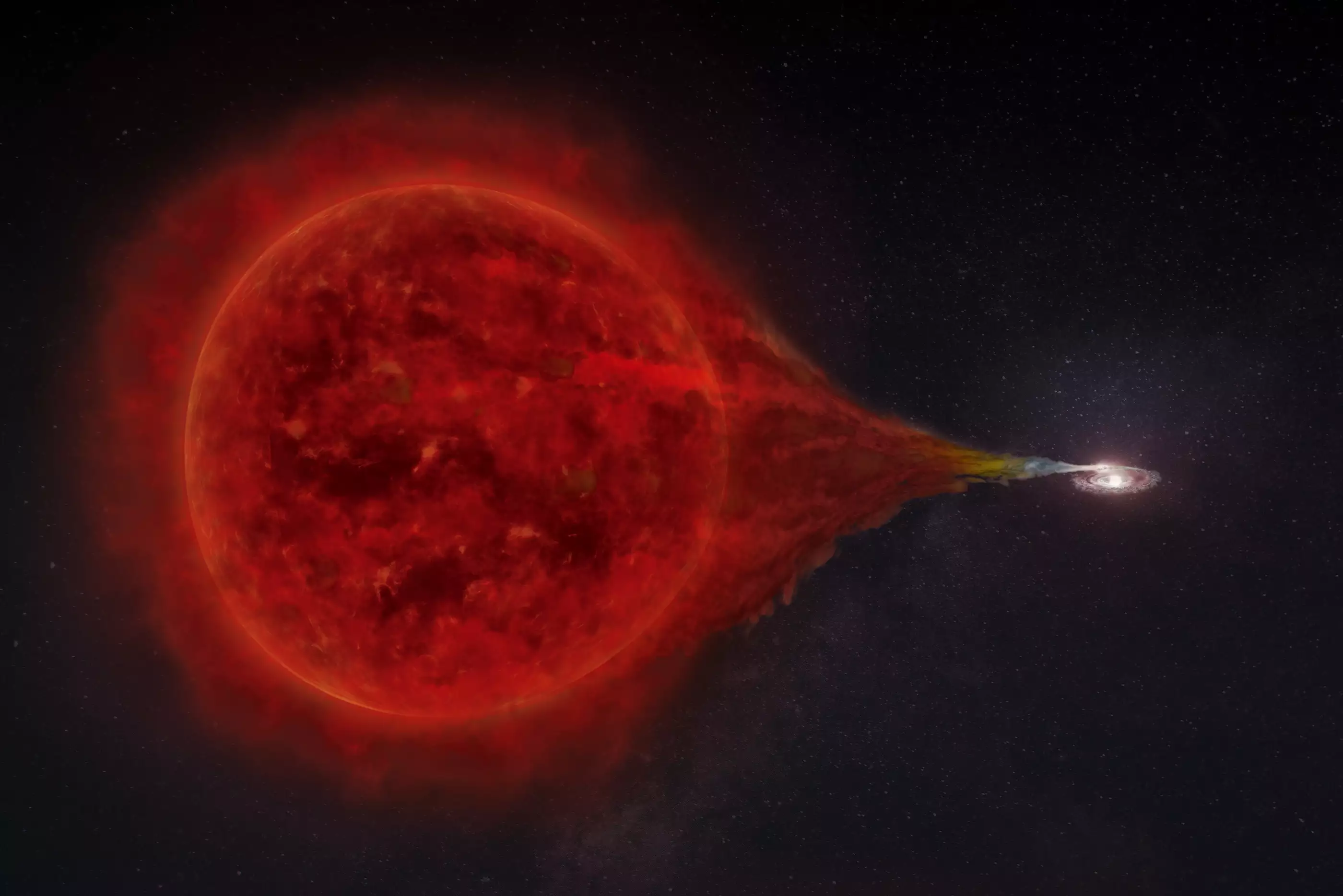
The binary star system RS Ophiuchi: Matter flows from the red giant onto the white dwarf. The newly added stellar envelopes explode in a bright nova about every 15 years.
© superbossa.com / MPP

The MAGIC telescopes have observed the nova RS Ophiuchi shining brightly in gamma rays at extremely high energy. The Gamma rays emanate from protons that are accelerated to very high energies in the shock front following the explosion. This suggests that novae are also a source of the ubiquitous cosmic radiation in the universe which consists mainly of protons rich in energy, which race through space at almost the speed of light.

Light on, light off — this is how one could describe the behavior of the nova, which goes by the name RS Ophiuchi (RS Oph)...

Read More