Astronomers have revealed the sharpest image ever captured of a filament in the cosmic web — the enormous hidden structure connecting galaxies across the Universe. The glowing strand stretches 3 million light-years and links two galaxies from nearly 12 billion years ago...
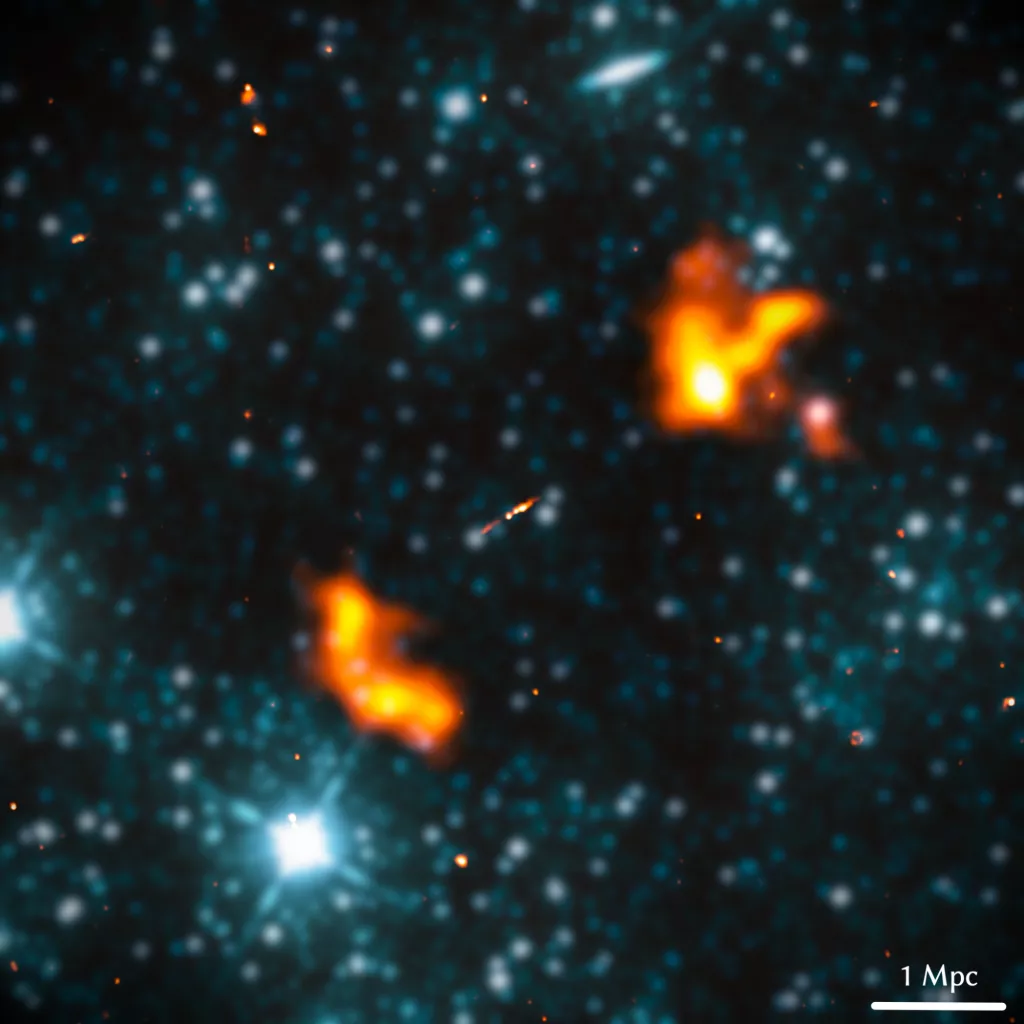
A joint radio-infrared view of Alcyoneus, a radio galaxy with a projected proper length of 5.0 megaparsecs. Researchers superimposed images from the LOFAR Two-meter Sky Survey (LoTSS), shown in orange, with images from the Wide-field Infrared Survey Explorer (WISE), shown in blue. (Image credit: Martijn Oei et al.)
By a stroke of luck, a team led by Dutch Ph.D. student Martijn Oei has discovered a radio galaxy of at least 16 million light-years long. The pair of plasma plumes is the largest structure made by a galaxy known thus far. The finding disproves some long-kept hypotheses about the growth of radio galaxies.
A supermassive black hole lurks in the center of many galaxies, which slows down the birth of new stars and therefore strongly influences the lifecycle of the galaxy as a...
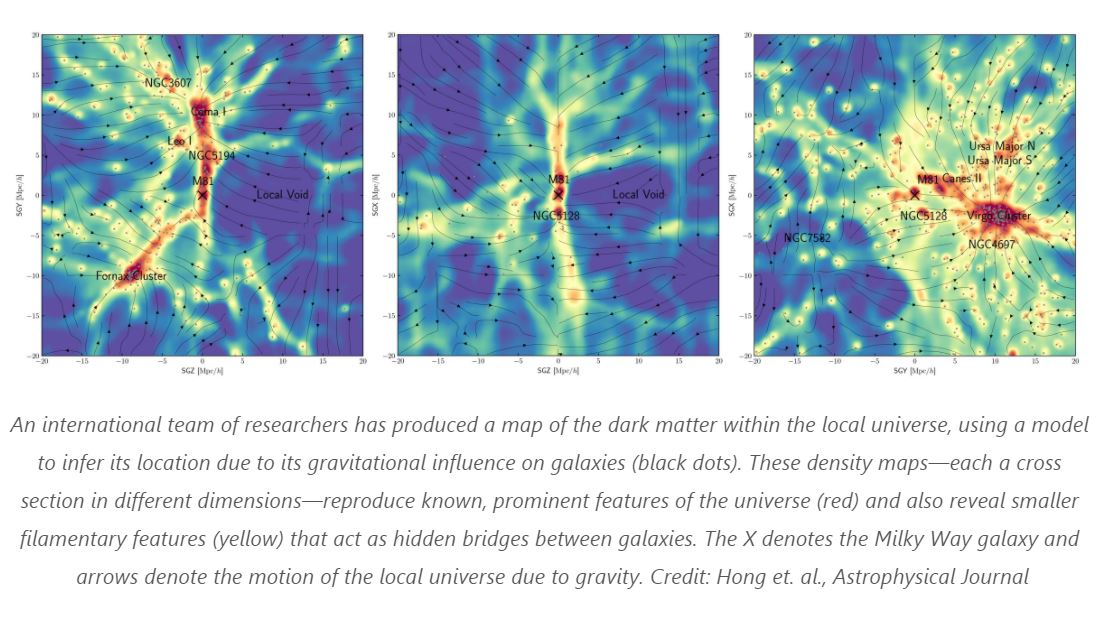
A new map of dark matter in the local universe reveals several previously undiscovered filamentary structures connecting galaxies. The map, developed using machine learning by an international team including a Penn State astrophysicist, could enable studies about the nature of dark matter as well as about the history and future of our local universe.
Dark matter is an elusive substance that makes up 80% of the universe. It also provides the skeleton for what cosmologists call the cosmic web, the large-scale structure of the universe that, due to its gravitational influence, dictates the motion of galaxies and other cosmic material. However, the distribution of local dark matter is currently unknown because it cannot be measured directly...
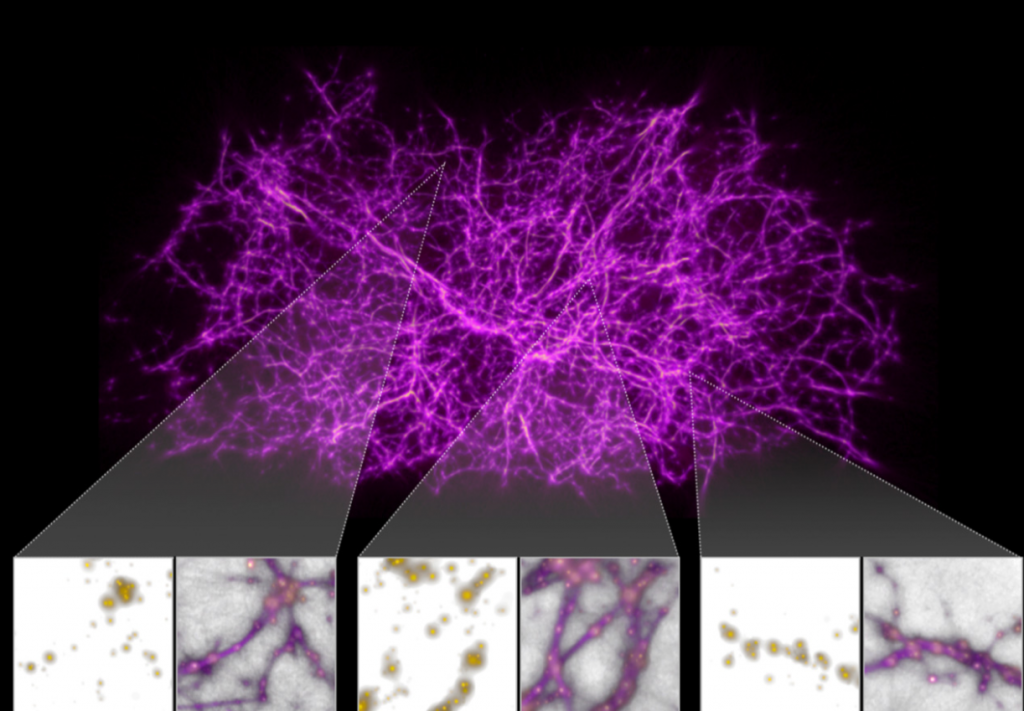
This intricate filamentary network (above) is a reconstruction of the cosmic web created by feeding data on the locations and masses of 37,000 galaxies into an algorithm based on the growth patterns of a slime mold. The images below are expanded views of small regions, showing the underlying galaxies on the left and, on the right, the filaments of the cosmic web superimposed on the galaxies.
The problem-solving prowess of a simple slime mold has been harnessed to trace the large-scale structure of the universe. A computational approach inspired by the growth patterns of a bright yellow slime mold has enabled a team of astronomers and computer scientists at UC Santa Cruz to trace the filaments of the cosmic web that connects galaxies throughout the universe.





Recent Comments