
Curiosity Mars rover tagged posts

Curiosity Mars rover discovers field of honeycomb textures

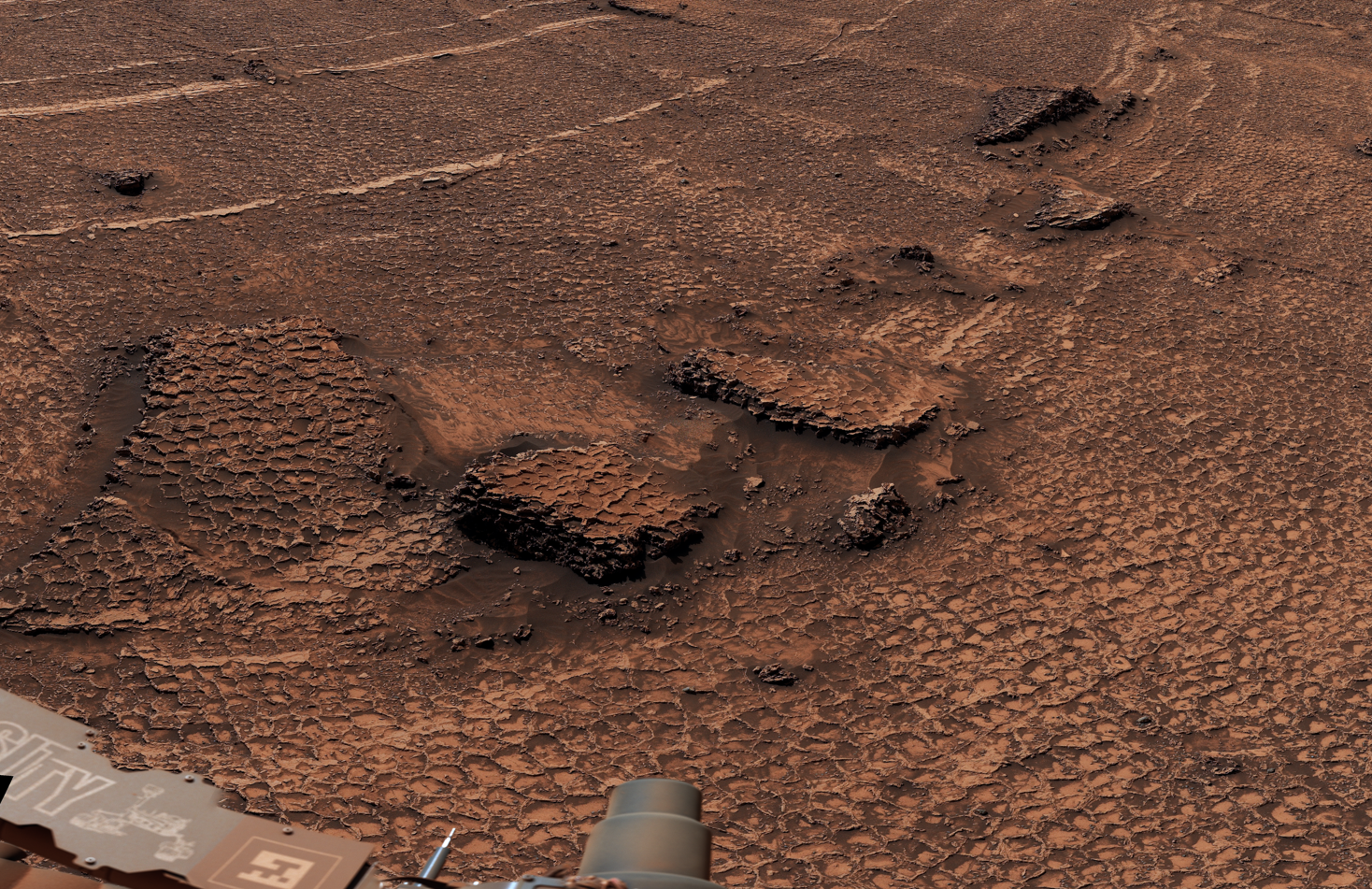
NASA’s Curiosity rover captures a rocky, reddish Martian landscape filled with polygonal fractures.
A close-up of the polygon fractures discovered by NASA’s Curiosity Mars rover highlights their honeycomb-like textures
NASA/JPL-Caltech/MSSS

As NASA’s Curiosity rover recently began climbing a Martian valley nicknamed “Valle Grande,” it sent back images that were a familiar sight to mission scientists: honeycomb-like textures called polygonal fractures, each about 1.5–3 inches (4–8 centimeters) across. The mission has spotted small patches of these geometric shapes several times before, but nothing at the scale discovered in Valle Grande.

In a 360-degree panorama that the rover captured on June 19 and 20, the 4,930th and 4,931st Martian days, or sols, of the mission, the polygonal shapes spread in all directions for as far as the rover can see...

Read More
Explosive Volcanic Eruption Produced Rare Mineral on Mars

NASA's Mars Curiosity rover
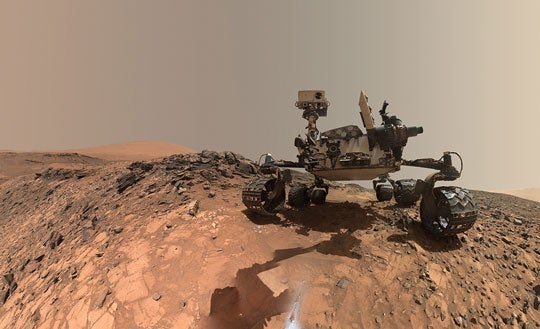
NASA’s Curiosity Mars rover snapped this low-angle self-portrait at the site where it drilled into a rock July 30, 2015, producing a powder (visible in foreground) that was later confirmed to contain the rare mineral tridymite. (Image courtesy of NASA/JPL-Caltech/MSSS)

Researchers publish scenario that explains 2016 discovery by NASA’s Curiosity rover. Planetary scientists from Rice University, NASA’s Johnson Space Center and the California Institute of Technology have an answer to a mystery that’s puzzled the Mars research community since NASA’s Curiosity rover discovered a mineral called tridymite in Gale Crater in 2016.

Tridymite is a high-temperature, low-pressure form of quartz that is extremely rare on Earth, and it wasn’t immediately clear how a concentrated chunk of it ended...

Read More

NASA Rover findings Point to a more Earth-like Martian past

This scene shows NASA's Curiosity Mars rover at a location called "Windjana," where the rover found rocks containing manganese-oxide minerals, which require abundant water and strongly oxidizing conditions to form. Credit: NASA/JPL-Caltech/MSSS

This scene shows NASA’s Curiosity Mars rover at a location called “Windjana,” where the rover found rocks containing manganese-oxide minerals, which require abundant water and strongly oxidizing conditions to form. Credit: NASA/JPL-Caltech/MSSS

Chemicals found in Martian rocks by Curiosity Mars rover suggest Mars once had more oxygen in its atmosphere than it does now. Researchers found high levels of manganese oxides by using a laser-firing instrument on the rover. This hint of more oxygen in Mars’ early atmosphere adds to other Curiosity findings – such as evidence about ancient lakes – revealing how Earth-like our neighboring planet once was.

This research also adds important context to other clues about atmospheric oxygen in Mars’ past...

Read More