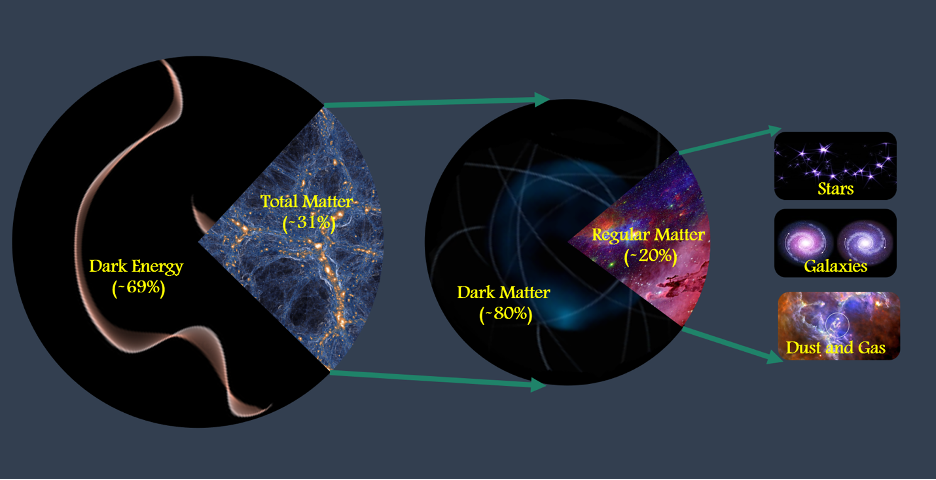
The team determined that matter makes up about 31% of the total amount of matter and energy in the universe. Cosmologists believe about 20% of the total matter is made of regular — or “baryonic” matter — which includes stars, galaxies, atoms, and life, while about 80% is made of dark matter, whose mysterious nature is not yet known but may consist of some as-yet-undiscovered subatomic particle. (UCR/Mohamed Abdullah)
A top goal in cosmology is to precisely measure the total amount of matter in the universe, a daunting exercise for even the most mathematically proficient. A team led by scientists at the University of California, Riverside, has now done just that
Reporting in the Astrophysical Journal, the team determined that matter makes up 31% of the total amount of matter ...
Scientists know dark matter exists because of its interaction via gravity with visible matter like stars and planets.
Scientists have identified a sub-atomic particle that could have formed the ‘dark matter’ in the Universe during the Big Bang. Nuclear physicists are putting forward a new candidate for dark matter – a particle they recently discovered called the d-star hexaquark.
Up to 80% of the Universe could be dark matter, but despite many decades of study, its physical origin has remained an enigma. While it cannot be seen directly, scientists know it exists because of its interaction via gravity with visible matter like stars and planets. Dark matter is composed of particles that do not absorb, reflect or emit light.
Now, nuclear physicists at the University of York are p...
This image from the Hubble Space Telescope shows lensing of distant galaxies by gravity. UC Davis astronomers are using this phenomenon to learn more about the properties of dark matter.
Warm, cold, just right? Physicists at the University of California, Davis are taking the temperature of dark matter, the mysterious substance that makes up about a quarter of our universe.
We have very little idea of what dark matter is and physicists have yet to detect a dark matter particle. But we do know that the gravity of clumps of dark matter can distort light from distant objects. Chris Fassnacht, a physics professor at UC Davis and colleagues are using this distortion, called gravitational lensing, to learn more about the properties of dark matter.
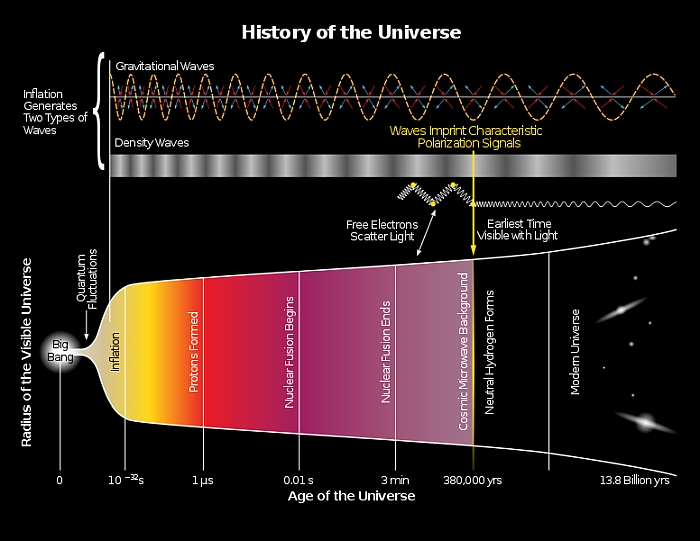
Dark matter, which researchers believe make up about 80% of the universe’s mass, is one of the most elusive mysteries in modern physics. What exactly it is and how it came to be is a mystery, but a new Johns Hopkins University study now suggests that dark matter may have existed before the Big Bang. The study, published August 7 in Physical Review Letters, presents a new idea of how dark matter was born and how to identify it with astronomical observations.
“The study revealed a new connection between particle physics and astronomy. If dark matter consists of new particles that were born before the Big Bang, they affect the way galaxies are distributed in the sky in a unique way...







Recent Comments