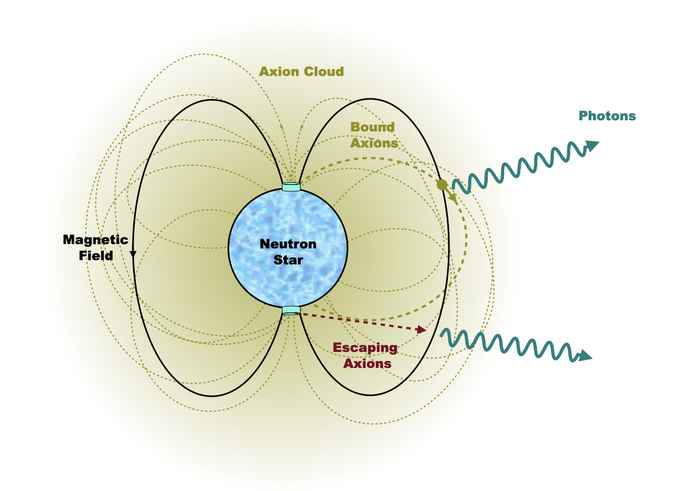
An axion cloud around a neutron star. While some axions escape the star’s gravitational pull, many remain bound to the star and over a long period of time form a cloud surrounding it. The interaction with the neutron star’s strong magnetic field causes some axions to convert into photons – light that we can eventually detect with our telescopes on Earth.
Physicists show that neutron stars may be shrouded in clouds of ‘axions’ — and that these clouds can teach us a lot. A team of physicists from the universities of Amsterdam, Princeton and Oxford have shown that extremely light particles known as axions may occur in large clouds around neutron stars...
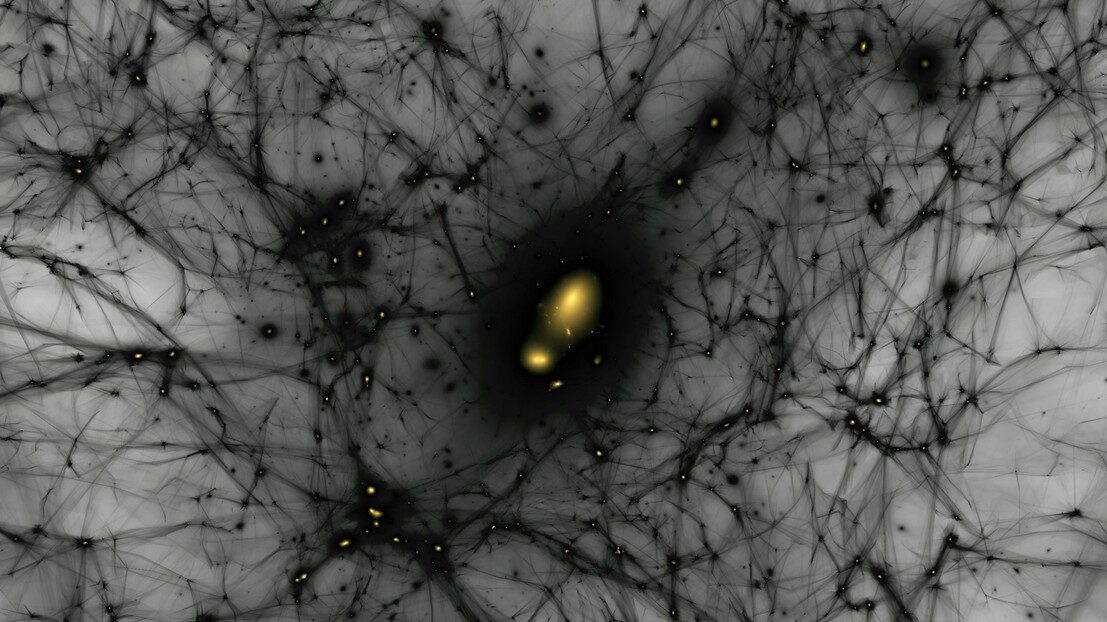
An AI-powered tool can distinguish dark matter’s elusive effects from other cosmic phenomena, which could bring us closer to unlocking the secrets of dark matter.
Dark matter is the invisible force holding the universe together – or so we think. It makes up around 85% of all matter and around 27% of the universe’s contents, but since we can’t see it directly, we have to study its gravitational effects on galaxies and other cosmic structures. Despite decades of research, the true nature of dark matter remains one of science’s most elusive questions.
According to a leading theory, dark matter might be a type of particle that barely interacts with anything else, except through gravity...
This artist’s concept shows what happened when two massive clusters of galaxies, collectively known as MACS J0018.5, collided: The dark matter in the galaxy clusters (blue) sailed ahead of the associated clouds of hot gas, or normal matter (orange). Both dark matter and normal matter feel the pull of gravity, but only the normal matter experiences additional effects like shocks and turbulence that slow it down during collisions.Credit: W.M. Keck Observatory/Adam Makarenko
The research provides a unique look at how this matter decoupling proceeds. Astronomers have untangled a messy collision between two massive clusters of galaxies in which the clusters’ vast clouds of dark matter have decoupled from the so-called normal matter...
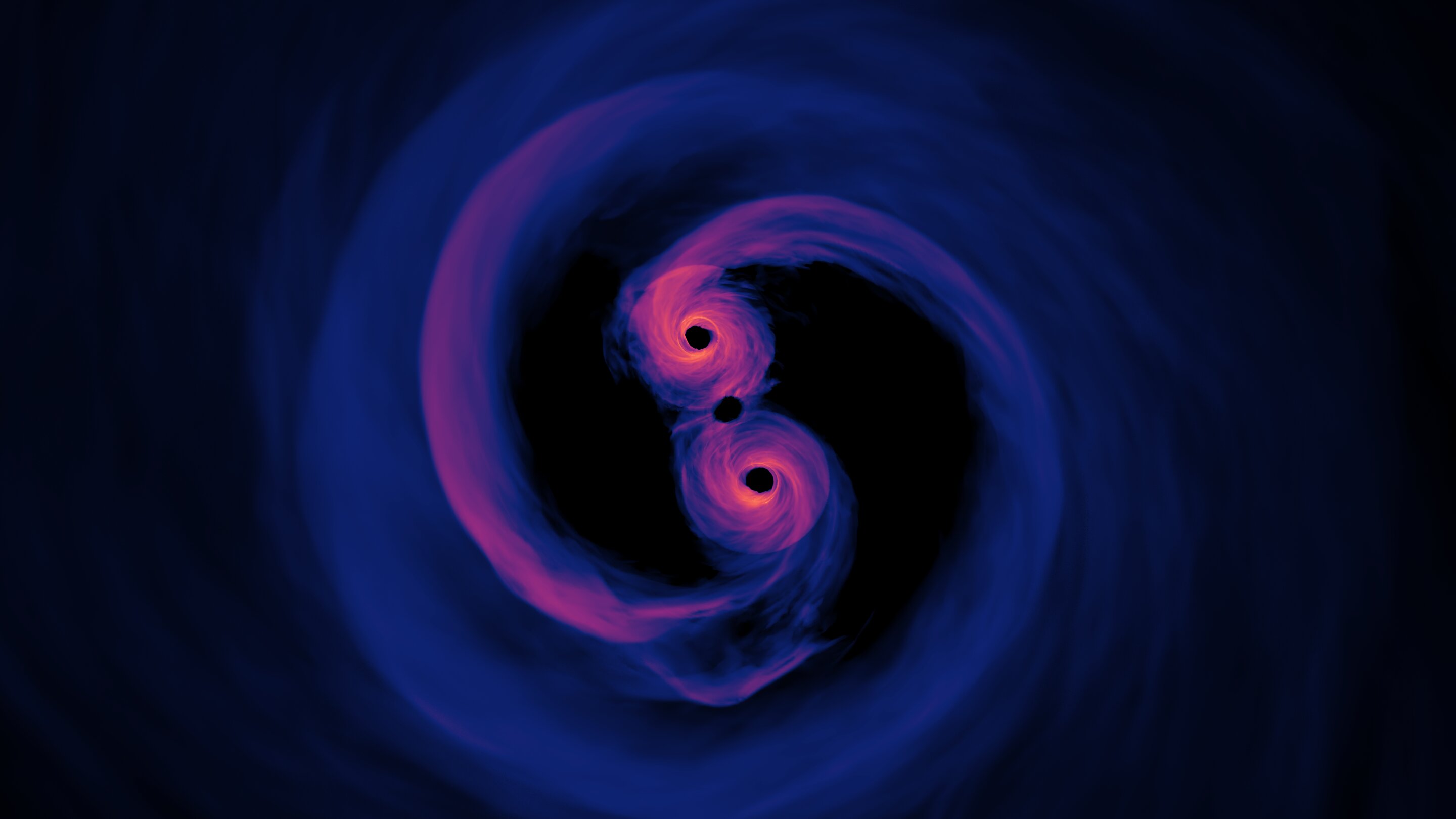
Simulation of the light emitted by a supermassive black hole binary system where the surrounding gas is optically thin (transparent). Viewed from 0 degrees inclination, or directly above the plane of the disk. The emitted light represents all wavelengths. Credit: NASA’s Goddard Space Flight Center/Scott Noble; simulation data, d’Ascoli et al. 2018
Researchers have found a link between some of the largest and smallest objects in the cosmos: supermassive black holes and dark matter particles.
Their new calculations reveal that pairs of supermassive black holes (SMBHs) can merge into a single larger black hole because of previously overlooked behavior of dark matter particles, proposing a solution to the longstanding “final parsec problem” in astronomy.






Recent Comments