dark matter tagged posts

New Measurements of Galaxy Rotation lean toward Modified Gravity as an explanation for Dark Matter

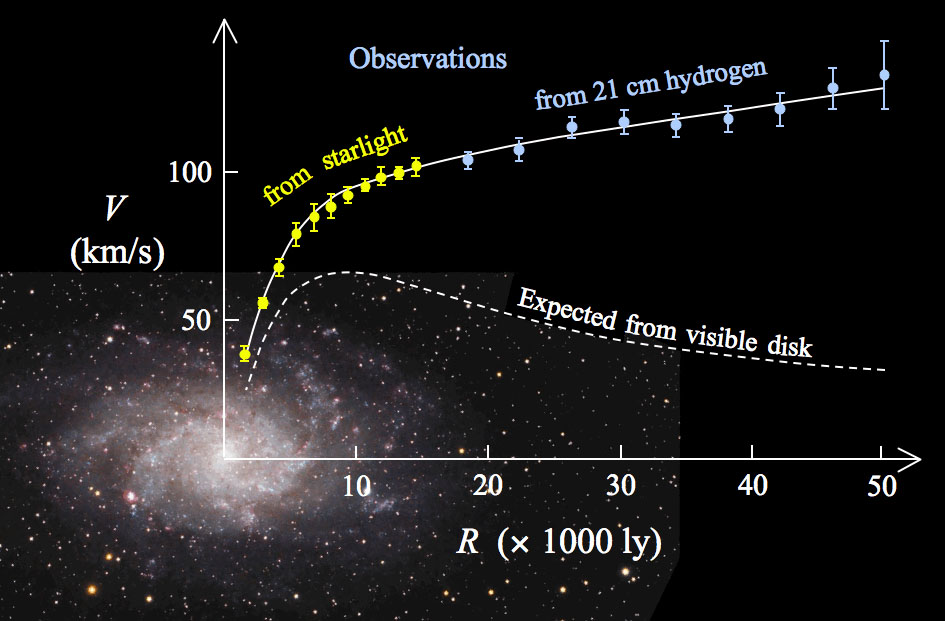
Rotation curve of the typical spiral galaxy M 33 (yellow and blue points with errorbars) and the predicted one from distribution of the visible matter (white line). The discrepancy between the two curves is accounted for by adding a dark matter halo surrounding the galaxy. Credit: Public domain / Wikipedia

Although dark matter is a central part of the standard cosmological model, it’s not without its issues. There continue to be nagging mysteries about the stuff, not the least of which is the fact that scientists have found no direct particle evidence of it.

Despite numerous searches, we have yet to detect dark matter particles. So some astronomers favor an alternative, such as modified Newtonian dynamics (MoND) or modified gravity model...

Read More

Antihelium Nuclei as Messengers from the Depths of the Galaxy

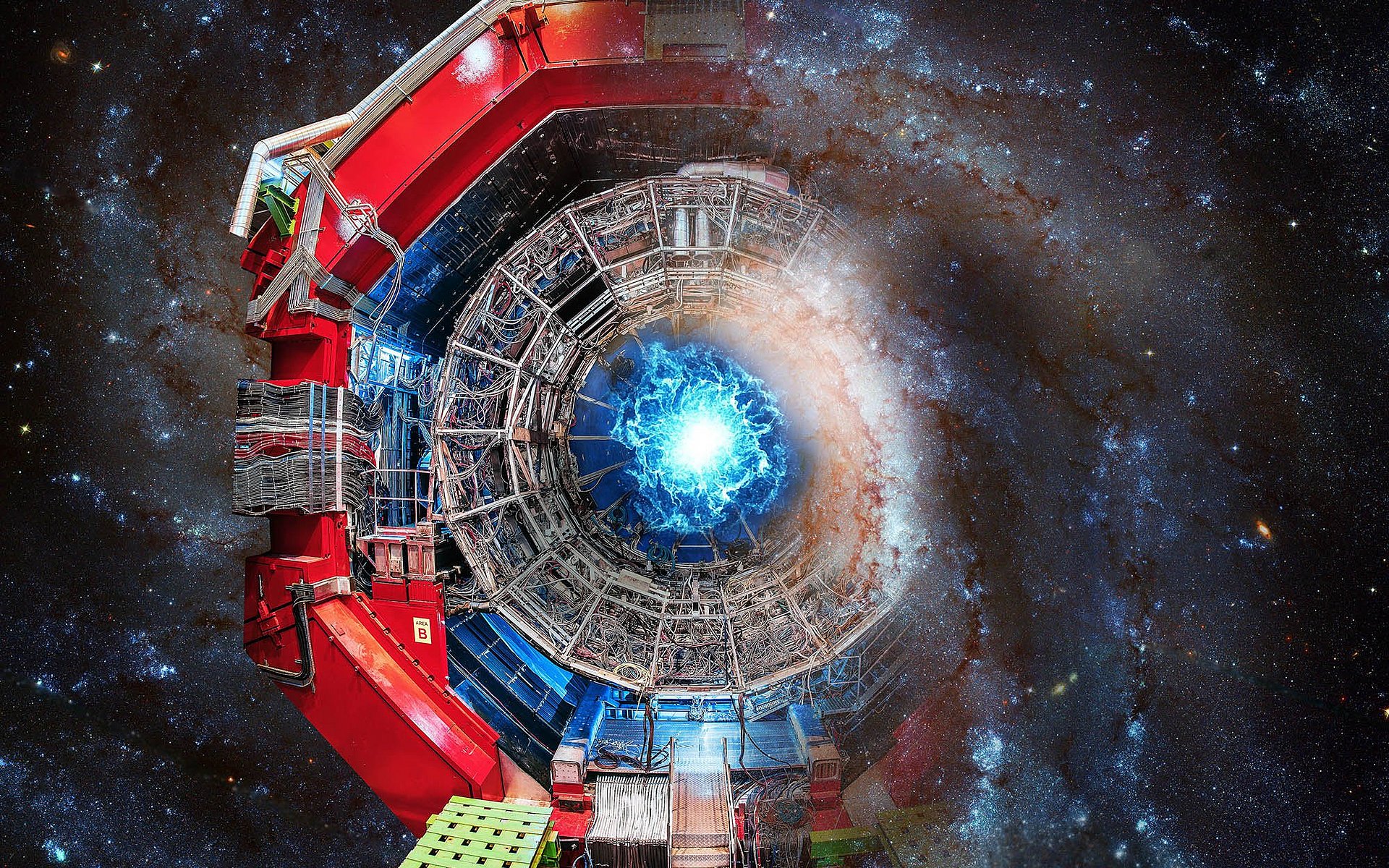
Artistic illustration of antihelium annihilation in the  ALICE detector at CERN as well as in the universe.
Artistic illustration of antihelium annihilation in the ALICE detector at CERN as well as in the universe.

New findings lay the foundation for the search for dark matter. How are galaxies born, and what holds them together? Astronomers assume that dark matter plays an essential role. However, as yet it has not been possible to prove directly that dark matter exists. A research team including Technical University of Munich (TUM) scientists has now measured for the first time the survival rate of antihelium nuclei from the depths of the galaxy – a necessary prerequisite for the indirect search for Dark Matter.

Many things point to the existence of dark matter...

Read More

Shedding New Light on Dark Matter

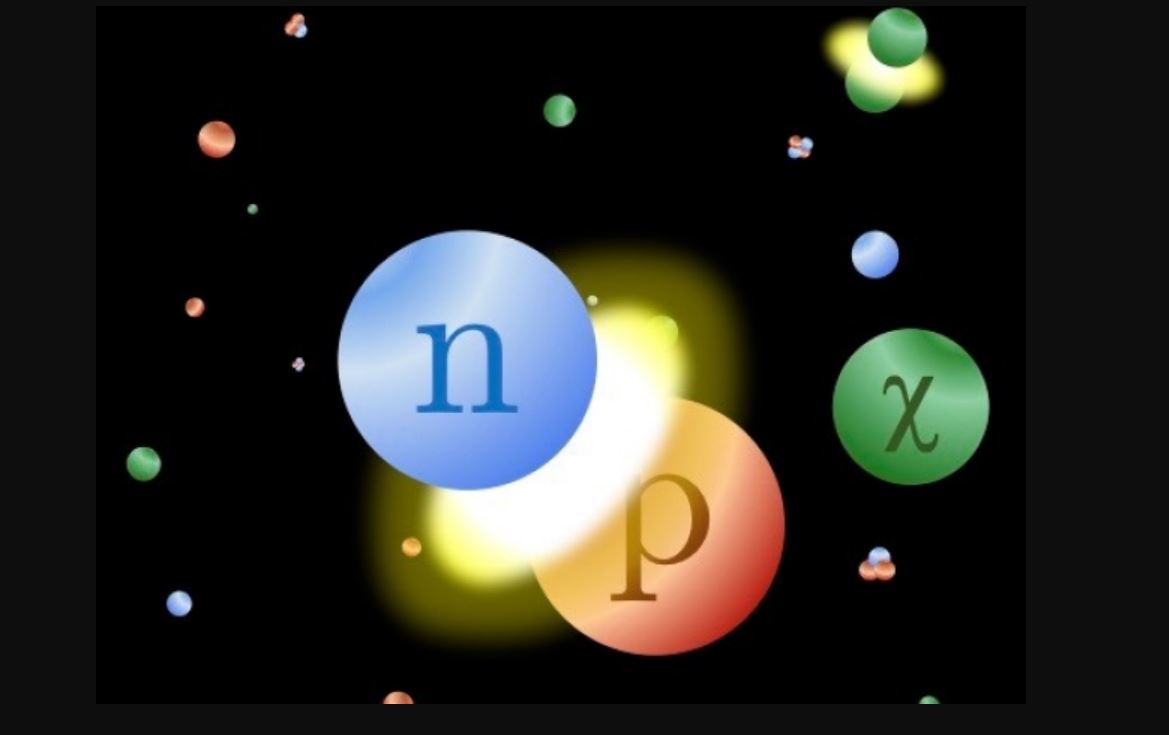
An artist’s rendition of big bang nucleosynthesis, the early universe period in which protons “p” and neutrons “n” combine to form light elements. The presence of dark matter “χ” changes how much of each element will form. Image courtesy of Cara Giovanetti/New York University

Analysis offers new means to predict ‘cosmological signatures’ for models of dark matter. A team of physicists has developed a method for predicting the composition of dark matter – invisible matter detected only by its gravitational pull on ordinary matter and whose discovery has been long sought by scientists.

Its work, which appears in the journal Physical Review Letters, centers on predicting “cosmological signatures” for models of dark matter with a mass between that of the electron and the proton...

Read More

Are Black Holes and Dark Matter the same?

“Black holes of different sizes are still a mystery,” Hasinger explained. “We don’t understand how supermassive black holes could have grown so huge in the relatively short time available since the universe existed.”

Proposing an alternative model for how the universe came to be, a team of astrophysicists suggests that all black holes — from those as tiny as a pin head to those covering billions of miles — were created instantly after the Big Bang and account for all dark matter.

That’s the implication of a study by astrophysicists at the University of Miami, Yale University, and the European Space Agency that suggests that black holes have existed since the beginning of the universe and that these primordial black holes could be as-of-yet unexplained dark matter...

Read More