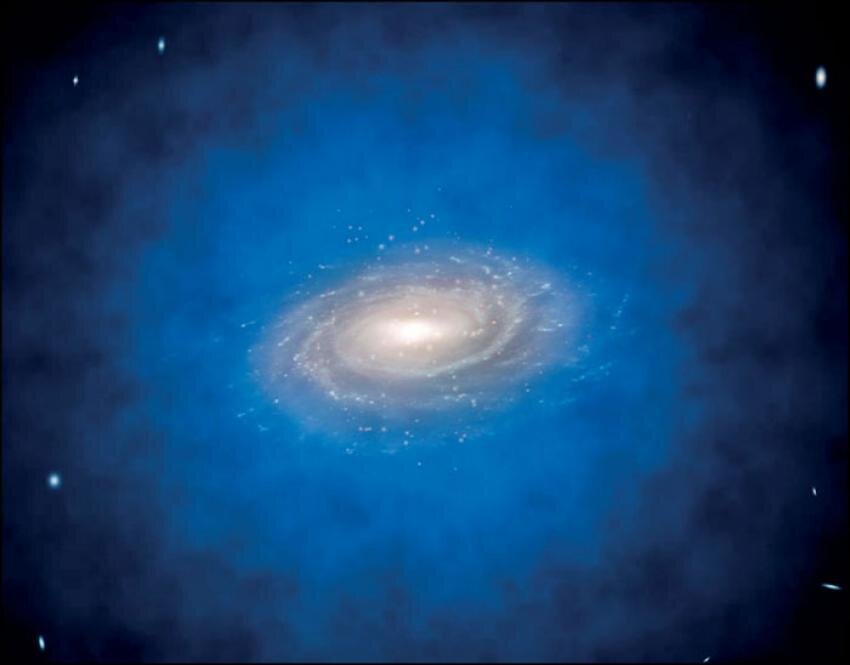
Artist’s impression of a spiral galaxy embedded in a larger distribution of invisible dark matter, known as a dark matter halo (colored in blue). Studies looking at the formation of dark matter haloes have suggested that each halo could harbor a very dense nucleus of dark matter, which may potentially mimic the effects of a central black hole, or eventually collapse to form one. Credit ESO/L. Calçada, CC BY 4.0
A new theoretical study has proposed a novel mechanism for the creation of supermassive black holes from dark matter. The international team find that rather than the conventional formation scenarios involving ‘normal’ matter, supermassive black holes could instead form directly from dark matter in high density regions in the centers of galaxies...
The Milky Way is surrounded by dozens of dwarf galaxies that are thought to be relics of the very first galaxies in the universe. Among the most primitive of these galactic fossils is Tucana II—an ultrafaint dwarf galaxy that is about 50 kiloparsecs, or 163,000 light years, from Earth.
Now MIT astrophysicists have detected stars at the edge of Tucana II, in a configuration that is surprisingly far from its center but nevertheless caught up in the tiny galaxy’s gravitational pull. This is the first evidence that Tucana II hosts an extended dark matter halo—a region of gravitationally bound matter that the researchers calculated to be three to five times more massive than scientists had estimated...
Scientists have calculated the mass range for Dark Matter – and it’s tighter than the science world thought. Their findings – due to be published in Physics Letters B in March – radically narrow the range of potential masses for Dark Matter particles, and help to focus the search for future Dark Matter-hunters. The University of Sussex researchers used the established fact that gravity acts on Dark Matter just as it acts on the visible universe to work out the lower and upper limits of Dark Matter’s mass.
The results show that Dark Matter cannot be either ‘ultra-light’ or ‘super-heavy’, as some have theorised, unless an as-yet undiscovered force also acts upon it.
The team used the assumption that the only force acting on Dark Matter is gravity, an...
An artistic rendering of the XMM-Newton (X-ray Multi-Mirror Mission) space telescope. A study of archival data from the XMM-Newton and the Chandra X-ray space telescopes found evidence of high levels of X-ray emission from the nearby Magnificent Seven neutron stars, which may arise from the hypothetical particles known as axions. (Credits: D. Ducros, ESA/XMM-Newton, CC BY-SA 3.0 IGO)
Researchers say they may have found proof of theorized axions, and possibly dark matter, around group of neutron stars. A new study, led by a theoretical physicist at the U.S...
Recent Comments