



Earth’s Magnetic field tagged posts
Earth’s magnetic field creates a previously undetected pocket of protection from radiation on the moon
March 27, 2026,
 Astronomy/Space
Surprising discovery shows a strong link between Earth’s magnetic field and atmospheric oxygen levels
June 20, 2025,
Astronomy/Space
Every breath we take in contains 21% oxygen, the gas that makes life on Earth possible. Oxygen, in its combined oxide state, has always been abundant in Earth’s crust, but elemental diatomic oxygen became part of our atmosphere around 2.4 to 2.5 billion years ago as a gift from cyanobacteria, which triggered the Great Oxidation Event and breathed life into Earth.
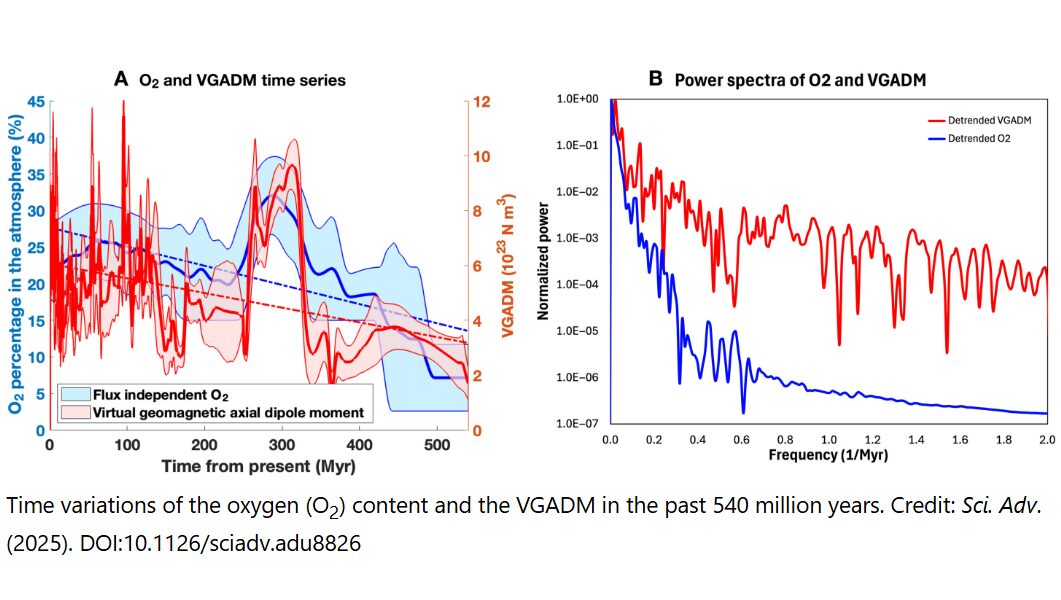
A joint venture between NASA Goddard Space Flight Center and the University of Leeds discovered that the Earth’s magnetic field strength and atmospheric oxygen levels over the past 540 years have seemed to spike and dip at the same time, showing a strong, statistically significant correlation between the two.
This correlation could arise from unexpected connections between geophysical processes in Earth’s deep interior,...
Read MoreMapping the Milky Way’s Magnetic Field in 3D
April 29, 2024,
Physics, Astronomy/Space
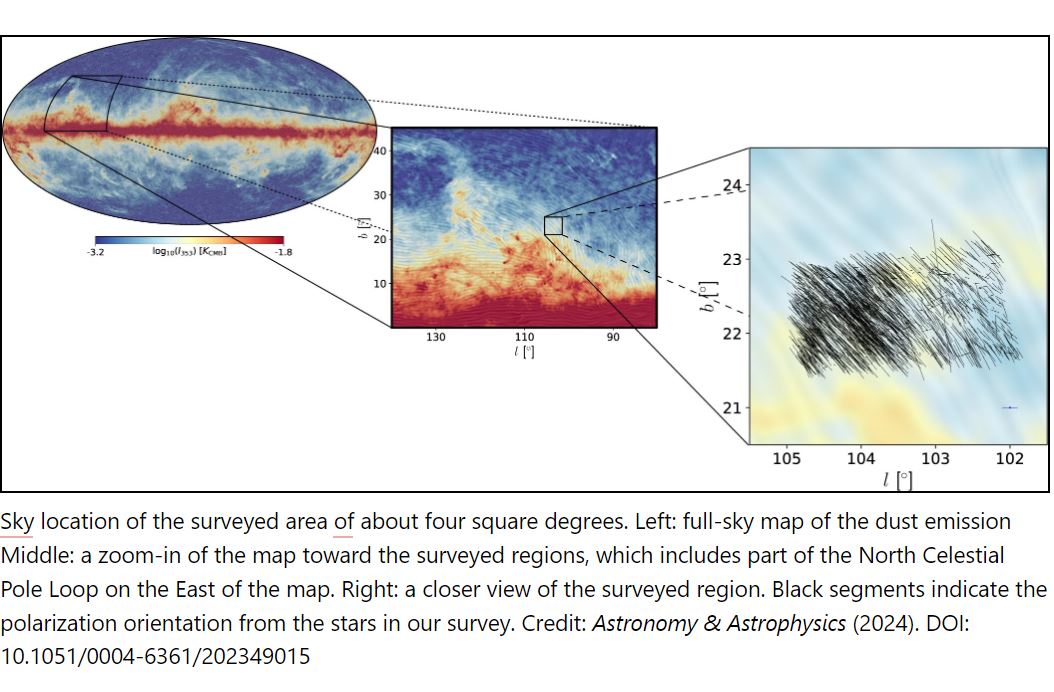
We are all very familiar with the concept of the Earth’s magnetic field. It turns out that most objects in space have magnetic fields but it’s quite tricky to measure them. Astronomers have developed an ingenious way to measure the magnetic field of the Milky Way using polarized light from interstellar dust grains that align themselves to the magnetic field lines. A new survey has begun this mapping process and has mapped an area that covers the equivalent of 15 times the full moon.
Many people will remember experiments in school with iron filings and bar magnets to unveil their magnetic field. It’s not quite so easy to capture the magnetic field of the Milky Way though. The new method to measure the field relies upon the small dust grains which permeate space between the stars.
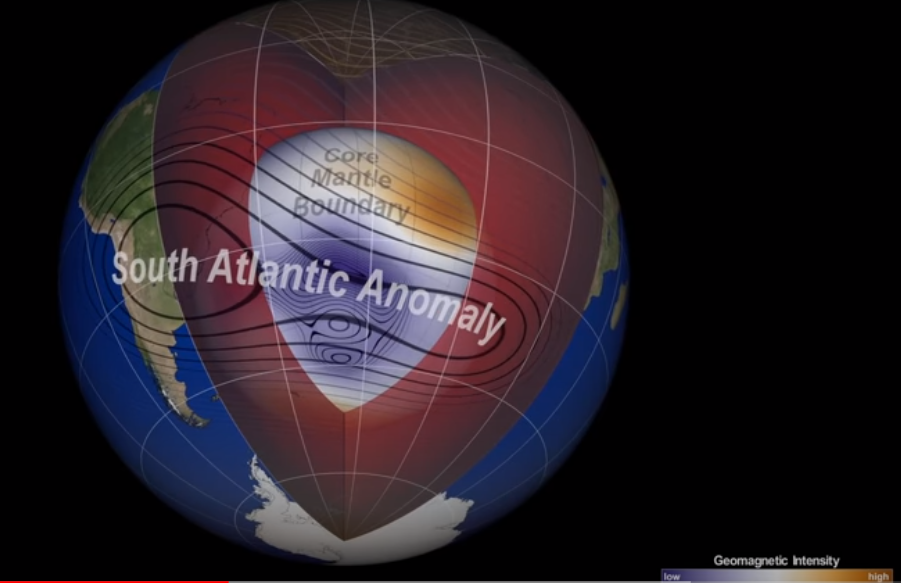
...Read MoreResearchers track slowly splitting ‘Dent’ in Earth’s Magnetic Field
August 19, 2020,
Astronomy/Space, Environment/Geology

Recent Comments