
Earth’s twin tagged posts

Venus ate its moon: How Earth’s ‘twin’ could have swallowed a rocky satellite

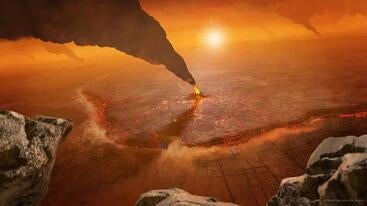
Illustration of corona erupting in the southern hemisphere of Venus
Illustration depicts active volcanism in Venus’ southern hemisphere.
(NASA/JPL-Caltech/Peter Rubin)

Scientists have long speculated why Venus, with a size, mass and structure similar to Earth’s, doesn’t have a moon. New UC Riverside research shows that our hungry twin likely swallowed it.

In the past, scientists theorized that Venus possibly had a moon that was hit by something massive, obliterating it. Other theories centered on the idea that Venus never underwent a collision that formed a moon in the first place.

The new research, published in The Astrophysical Journal, shows that neither theory fits.

“My study shows Venus didn’t require a catastrophe to arrive at what we can see today,” said UCR astrophysicist and lead author Stephen Kane...

Read More

Venus’s turbulent atmosphere

1. The atmospheric superrotation at the upper clouds of Venus. While the superrotation is present in both day and night sides of Venus, it seems more uniform in the day (AKATSUKI-UVI image at 360 nm, right side), while in the night this seems to become more irregular and unpredictable (composite of Venus Express/VIRTIS images ar 3.8 μm, left). Credit: JAXA, ESA, J. Peralta (JAXA) and R. Hueso (UPV/EHU) 2. Examples of new types of cloud morphology discovered on the night side of Venus thanks to Venus Express (ESA) and the infrared telescope IRTF (NASA): stationary waves (Venus Express, up-left corner), "net" patterns (IRTF, up-right), mysterious filaments (Venus Express, down-left) and dynamical instabilities (Venus Express, down-right). CREDIT ESA, NASA, J. Peralta (JAXA) and R. Hueso (UPV/EHU)

1. The atmospheric superrotation at the upper clouds of Venus. While the superrotation is present in both day and night sides of Venus, it seems more uniform in the day (AKATSUKI-UVI image at 360 nm, right side), while in the night this seems to become more irregular and unpredictable (composite of Venus Express/VIRTIS images ar 3.8 μm, left). Credit: JAXA, ESA, J. Peralta (JAXA) and R. Hueso (UPV/EHU)
2. Examples of new types of cloud morphology discovered on the night side of Venus thanks to Venus Express (ESA) and the infrared telescope IRTF (NASA): stationary waves (Venus Express, up-left corner), “net” patterns (IRTF, up-right), mysterious filaments (Venus Express, down-left) and dynamical instabilities (Venus Express, down-right).
CREDIT: ESA, NASA, J. Peralta (JAXA) and R...

Read More