
Episodic memory tagged posts

Researchers develop ‘hierarchical AI agent’ that tackles complex errands with ease

ETRI develops
Hierarchical AI Agent. Credit: Electronics and Telecommunications Research Institute (ETRI)

Korean researchers have developed a hierarchical AI technology that autonomously plans even complex, long-horizon tasks. The development of this hierarchical task-planning AI technology, which reduces hallucinations and doubles the success rate, is expected to help robots and agents carry out long-term missions.

The Electronics and Telecommunications Research Institute (ETRI) developed the hierarchical task-planning artificial intelligence (AI) technology “ReAcTree,” which autonomously divides tasks requiring complex and lengthy procedures into subgoals and carries them out, and presented it at AAMAS 2026, one of the world’s premier conferences in the AI agent field.

This research achievem...

Read More
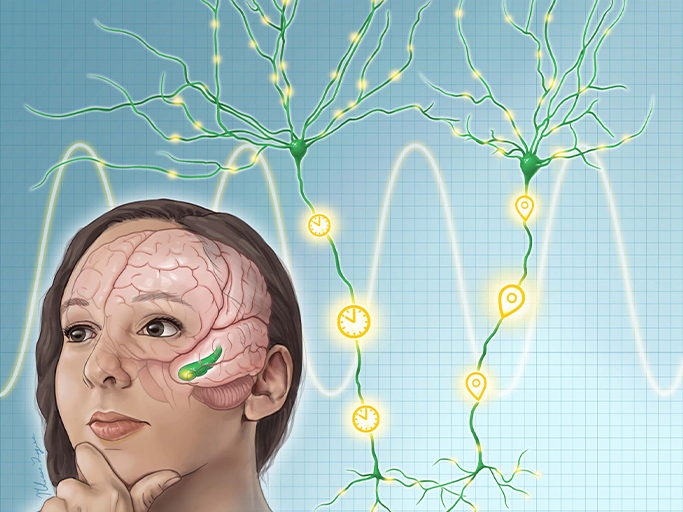
How the Brain Remembers Right Place, Right Time

Hippocampal neurons create spatial and temporal “maps” of our world. Brain waves called “theta rhythms” help organize the activity of these neurons. A study by Bradley Lega, M.D., and colleagues determined how a group of neurons known as time cells allow the brain to correctly mark the order of events and assist in memory.
Illustration by Melissa Logies

Two studies led by UT Southwestern researchers shed new light on how the brain encodes time and place into memories. The findings, published recently in PNAS and Science, not only add to the body of fundamental research on memory, but could eventually provide the basis for new treatments to combat memory loss from conditions such as traumatic brain injury, TBI, or Alzheimer’s disease.

About a decade ago, a group of neurons kno...

Read More

What is your Memory Style?

Two brain slices show different memory traits. Credit: Rotman Research Institute

Two brain slices show different memory traits. Credit: Rotman Research Institute

Tendency to remember episodic details vs facts is reflected in intrinsic brain patterns. Why is it that some people have richly detailed recollection of past experiences (episodic memory), while others tend to remember just the facts without details (semantic memory)?

A research team from the Rotman Research Institute at Baycrest Health Sciences has shown for the first time that these different ways of experiencing the past are associated with distinct brain connectivity patterns that may be inherent to the individual and suggest a life-long ‘memory trait’.

“For decades, nearly all research on memory and brain function has treated people as the same, averaging across individuals,” said lead investigator Dr...

Read More

Eating Sweet Foods causes the Brain to form a Memory of a Meal that may control eating habits

orosensory stimulation produced by consuming a sweetened solution and possibly the hedonic value of that sweet stimulation induces synaptic plasticity in dHC CA1 neurons in an experience-dependent manner. Collectively, these findings are consistent with our hypothesis that dHC neurons form a memory of a meal.

Orosensory stimulation produced by consuming a sweetened solution and possibly the hedonic value of that sweet stimulation induces synaptic plasticity in dHC CA1 neurons in an experience-dependent manner. Collectively, these findings are consistent with our hypothesis that dHC neurons form a memory of a meal.

Neurons in the dorsal hippocampus, the part of the brain that is critical for episodic memory, are activated by consuming sweets. Episodic memory is the memory of autobiographical events experienced at a particular time and place.

In the study, a meal consisting of a sweetened solution, either sucrose or saccharin, significantly increased the expression of the synaptic plasticity marker called activity-regulated cytoskeleton-associated protein (Arc) in dorsal hippocampal neurons in ra...

Read More