
exoplanet tagged posts

Astronomers Have Found The First Evidence For Tectonic Activity on an Exoplanet

main article image
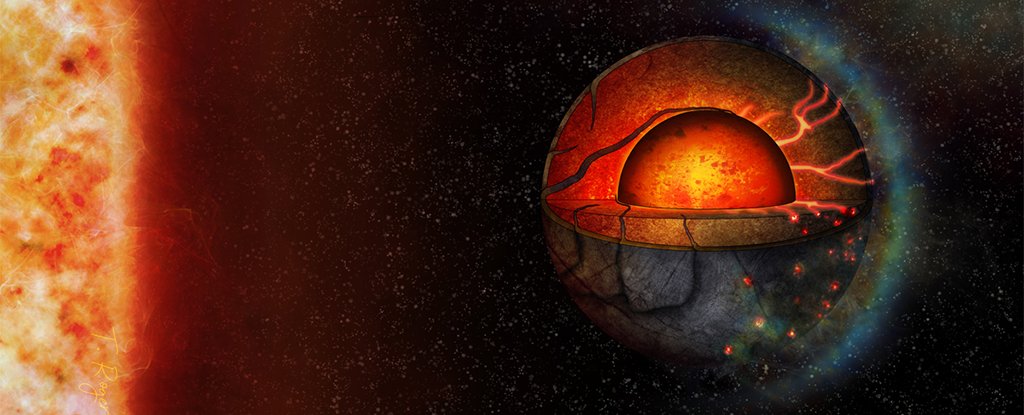
Artist’s illustration of LHS 3844b. (University of Bern / Thibaut Roger)

That evidence is a set of advanced simulations based on observations of the rocky planet LHS 3844b, which is slightly larger than Earth. Importantly for this particular piece of research, it doesn’t look as though the exoplanet has an atmosphere.

That leaves half of LHS 3844b permanently exposed to its sun and could mean temperatures of up to roughly 800 degrees Celsius (1,472 degrees Fahrenheit) on the ‘daytime’ side, and about minus 250 degrees Celsius (minus 418 degrees Fahrenheit) on the ‘night-time’ side.”We thought that this severe temperature contrast might affect material flow in the planet’s interior,” says astronomer Tobias Meier, from the University of Bern in Switzerland.

Based on phase curve o...

Read More

Newly discovered Exoplanet Dethrones former king of Kepler-88 planetary system

An artist’s illustration of the Kepler-88 planetary system. CREDIT: W. M. KECK OBSERVATORY/ADAM MAKARENKO

Our solar system has a king. The planet Jupiter, named for the most powerful god in the Greek pantheon, has bossed around the other planets through its gravitational influence. With twice the mass of Saturn, and 300 times that of Earth, Jupiter’s slightest movement is felt by all the other planets. Jupiter is thought to be responsible for the small size of Mars, the presence of the asteroid belt, and a cascade of comets that delivered water to young Earth.

Do other planetary systems have gravitational gods like Jupiter?

A team of astronomers led by the University of Hawaii Institute for Astronomy (UH IfA) has discovered a planet three times the mass of Jupiter in a distant ...

Read More

Exoplanet apparently Disappears in Latest Hubble Observations

This diagram simulates what astronomers, studying Hubble Space Telescope observations, taken over several years, consider evidence for the first-ever detection of the aftermath of a titanic planetary collision in another star system. The color-tinted Hubble image on the left is of a vast ring of icy debris encircling the star Fomalhaut, located 25 light-years away. The star is so brilliant that a black occulting disk is used to block out its glare so that the dust ring can be photographed. In 2008, astronomers saw what they thought was the first direct image of a planet orbiting far from the star. However, by 2014, the planet candidate faded below Hubble’s detection...
Read More

New Hot Jupiter marks the 1st collaborative Exoplanet discovery

WASP167bKELT13b. Credit: Image courtesy of Keele University

WASP167bKELT13b. Credit: Image courtesy of Keele University

Researchers led by a team at Keele University have discovered a new ‘Hot Jupiter’ exoplanet. The new giant planet was jointly discovered by a WASP/KELT survey collaboration, marking the first time an exoplanet has been discovered between two planet search groups. The exoplanet, WASP-167b/ KELT-13b, is several times more massive than Jupiter and orbits its parent star every two days. Its host star, WASP-176/KELT-13, is one of the hottest and most rapidly rotating stars known to host such a planet.

The Wide Angle Search for Planets (WASP) and the Kilodegree Extremely Little Telescope (KELT) exoplanet surveys observed the host star between 2006 and 2013 using the WASP-South telescope and the KELT-South telescope at the South African ...

Read More