
exoplanets tagged posts

Combination of Space-Based and Ground-Based Telescopes Reveals more than 100 Exoplanets

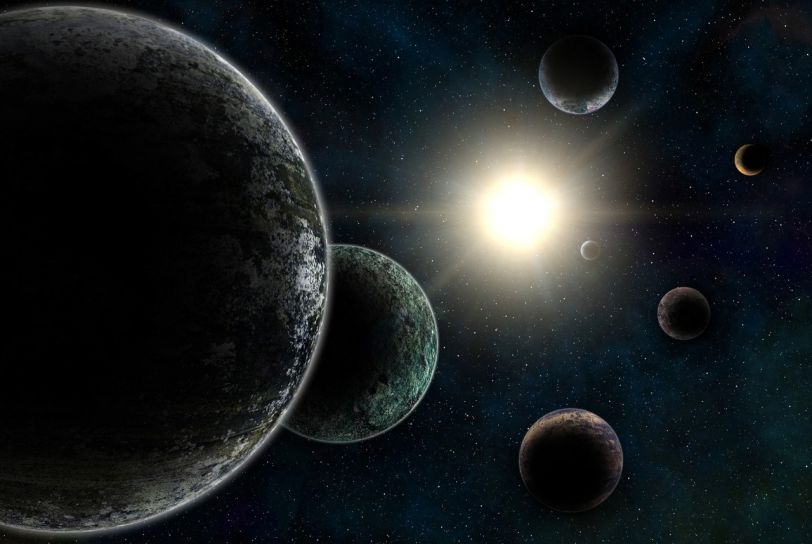
This is an artist's impression of the planets orbiting K2-187. Credit: NASA/JPL-Caltech/R. Hurt, T. Pyle (IPAC), UTokyo/J. Livingston

This is an artist’s impression of the planets orbiting K2-187.
Credit: NASA/JPL-Caltech/R. Hurt, T. Pyle (IPAC), UTokyo/J. Livingston

An international team of astronomers using a combination of ground and space based telescopes have reported more than 100 extrasolar planets (here after, exoplanets) in only three months. These planets are quite diverse and expected to play a large role in developing the research field of exoplanets and life in the Universe.

Exoplanets, planets that revolve around stars other than the Sun, have been actively researched in recent years. One of the reasons is the success of the Kepler Space Telescope, which launched in 2009 to search for exoplanets...

Read More

More clues that Earth-like Exoplanets are indeed Earth-like

The artist's concept depicts Kepler-186f. Image credit: NASA Ames/JPL-Caltech/T. Pyle

The artist’s concept depicts Kepler-186f. Image credit: NASA Ames/JPL-Caltech/T. Pyle

Researchers suggest that two Earth-like exoplanets (Kepler-3186f and 62f) have very stable axial tilts, much like the Earth, making it likely that each has regular seasons and a stable climate. A new study from the Georgia Institute of Technology provides new clues indicating that an exoplanet 500 light-years away is much like Earth.

Kepler-186f is the first identified Earth-sized planet outside the solar system orbiting a star in the habitable zone. This means it’s the proper distance from its host star for liquid water to pool on the surface. The Georgia Tech study used simulations to analyze and identify the exoplanet’s spin axis dynamics...

Read More

NASA’s Kepler Confirms 100+ Exoplanets during its K2 mission

Image montage showing the Maunakea Observatories, Kepler Space Telescope, and night sky with K2 Fields and discovered planetary systems (dots) overlaid. An international team of scientists discovered more than 100 planets based on images from Kepler operating in the 'K2 Mission'. The team confirmed and characterized the planets using a suite of telescopes worldwide, including four on Maunakea (the twin telescopes of Keck Observatory, the Gemini­North Telescope, and the Infrared Telescope Facility). The planet image on the right is an artist's impression of a representative planet. Credit: Karen Teramura (UHIfA) based on night sky image of the ecliptic plane by Miloslav Druckmüller and Shadia Habbal, and Kepler Telescope and planet images by NASA.

Image montage showing the Maunakea Observatories, Kepler Space Telescope, and night sky with K2 Fields and discovered planetary systems (dots) overlaid. An international team of scientists discovered more than 100 planets based on images from Kepler operating in the ‘K2 Mission’. The team confirmed and characterized the planets using a suite of telescopes worldwide, including four on Maunakea (the twin telescopes of Keck Observatory, the Gemini­North Telescope, and the Infrared Telescope Facility). The planet image on the right is an artist’s impression of a representative planet. Credit: Karen Teramura (UHIfA) based on night sky image of the ecliptic plane by Miloslav Druckmüller and Shadia Habbal, and Kepler Telescope and planet images by NASA.

An international team has discovered and ...

Read More

‘Pale Orange Dot’: Early Earth’s Haze may give clue to Habitability Elsewhere in Space

An image of Saturn’s haze-shrouded moon Titan taken by the Cassini spacecraft. The UW-based Virtual Planetary Laboratory studied records of the haze on early Earth to see how such atmospheric conditions might affect an exoplanet, or one beyond our solar system. They found that such a haze might show the world is habitable, or that life itself is present. Credit: NASA

An image of Saturn’s haze-shrouded moon Titan taken by the Cassini spacecraft. The UW-based Virtual Planetary Laboratory studied records of the haze on early Earth to see how such atmospheric conditions might affect an exoplanet, or one beyond our solar system. They found that such a haze might show the world is habitable, or that life itself is present. Credit: NASA

An atmospheric haze around a faraway planet – like the one which probably shrouded and cooled the young Earth – could show that the world is potentially habitable, or even be a sign of life itself. In new research, UW doctoral student Giada Arney and team chose to study Earth in its Archean era 2 ½ billion years back, because it is, as Arney said, “the most alien planet we have geochemical data for.”

The work builds on geol...

Read More