
extra-embryonic tissues tagged posts

Expanding Ability of Stem Cells to Regrow Any Tissue Type

Human EPS cells (green) can be detected in both the embryonic part (left) and extra-embryonic parts (placenta and yolk sac, right) of a mouse embryo. Credit: Salk Institute

Human EPS cells (green) can be detected in both the embryonic part (left) and extra-embryonic parts (placenta and yolk sac, right) of a mouse embryo. Credit: Salk Institute

What totipotent stem cells can do that pluripotent ones can’t do, however, is develop into tissues that support the embryo, like the placenta. These are called extra-embryonic tissues, and are vital in development and healthy growth. Now, scientists at the Salk Institute, in collaboration with researchers from Peking University, in China, are reporting their discovery of a chemical cocktail that enables cultured mouse and human stem cells to do just that: generate both embryonic and extra-embryonic tissues...

Read More
Scientists Reprogram Embryonic Stem Cells to Expand their Potential Cell Fates

normal and totipotent-like ES cells

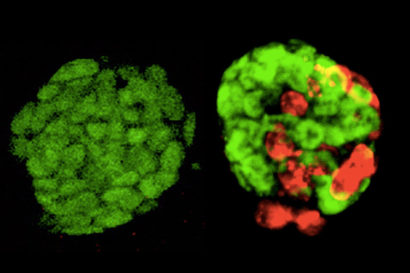
While typical embryonic stem cells (left) are unable to make tissues like the placenta, which allow the embryo to communicate with the mother, blocking a microRNA unleashes the potential to make these extra-embryonic tissues (red cells, right). (Lin He image)

UC Berkeley researchers have found a way to reprogram mouse embryonic stem cells so that they exhibit developmental characteristics resembling those of fertilized eggs, or zygotes. These “totipotent-like” stem cells are able to generate not only all cell types within a developing embryo, but also cell types that facilitate nutrient exchange between the embryo and the mother For now, the new stem cell lines will help scientists understand the first molecular decisions made in the early embryo...

Read More