
extreme debris disks tagged posts

Webb provides crash course on planet-shattering collisions

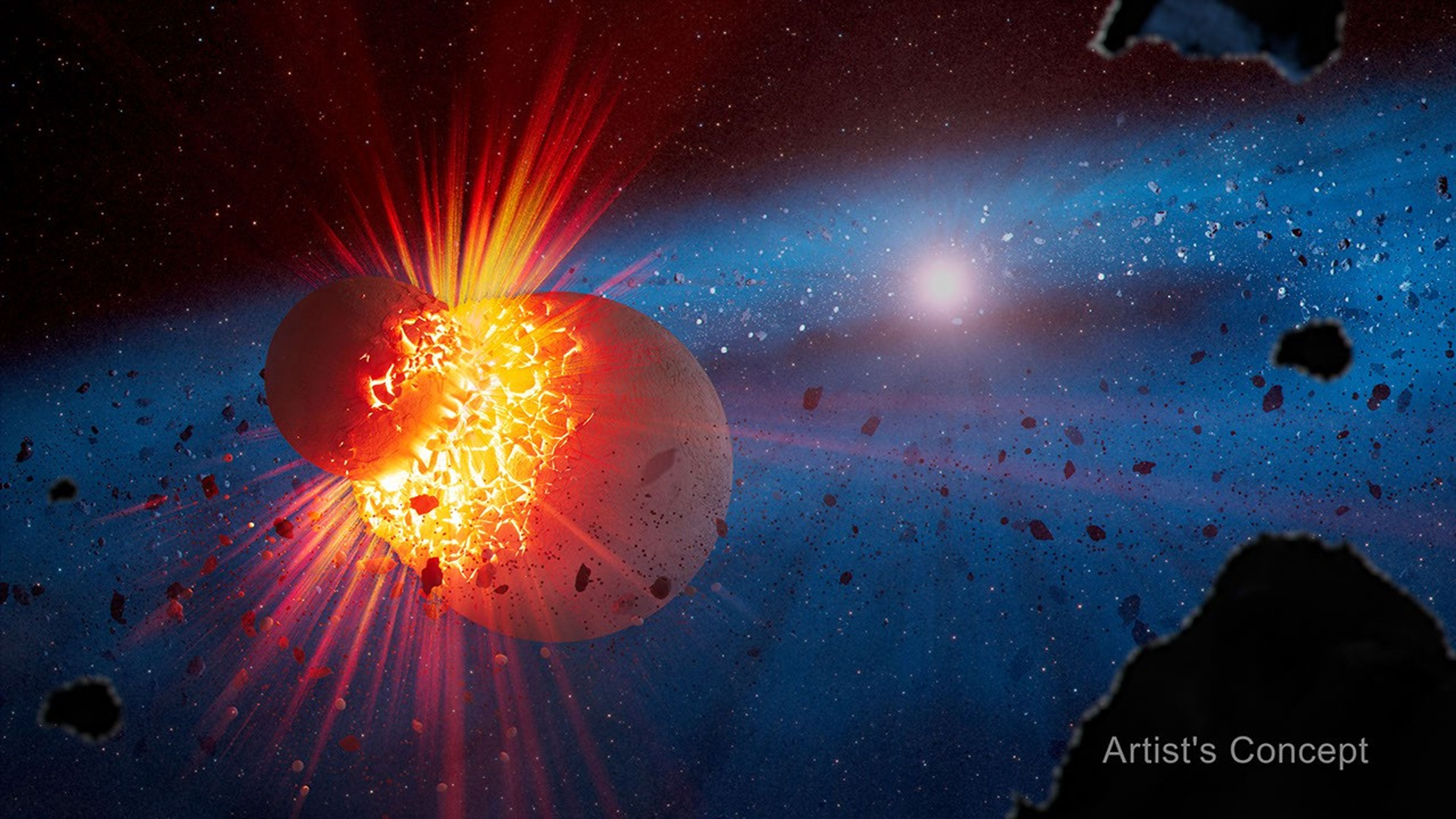
Artist’s concept of a star and its debris disk against the black background of space. The star is in the background, right of center, and depicted as a small, luminous sphere. The debris disk is a large blue ring that encircles the star. The debris disk is angled toward the viewer, so that the portion nearest to the viewer extends beyond the bottom frame of the illustration. Many dark, rocky fragments are scattered throughout the debris disk. In the foreground, toward the left, is a small planetary embryo colliding into the left side of a larger spherical object. The impact site glows bright yellow and orange and has a mottled appearance, as though chunks of both colliding bodies are breaking up and being destroyed. Orange-yellow streams of vapor extend outward from the collision area. Behind the debris disk and its star are many small stars in the background. A label in the bottom right corner reads “Artist’s Concept.”
The types of collisions within young stellar systems known as extreme debris disks are relevant to scientists’ understanding of our own solar system, which is thought to have undergone similar impact events that created our Moon and shaped Earth’s initial state.
Artwork: NASA, ESA, CSA, Joseph Olmsted (STScI)

In the early history of our solar system, scientists theorize that a Mars-sized object called Theia smashed into the infant Earth, vaporizing massive amounts of rock and blasting it into space. Some of that material coalesced into the moon, where NASA’s Artemis program is returning humans, preparing for Mars and shaping the future of space exploration.

That long-ago, violent collision reshaped our home planet...

Read More