FRB tagged posts

New radio burst method helps locate universe’s missing ordinary matter

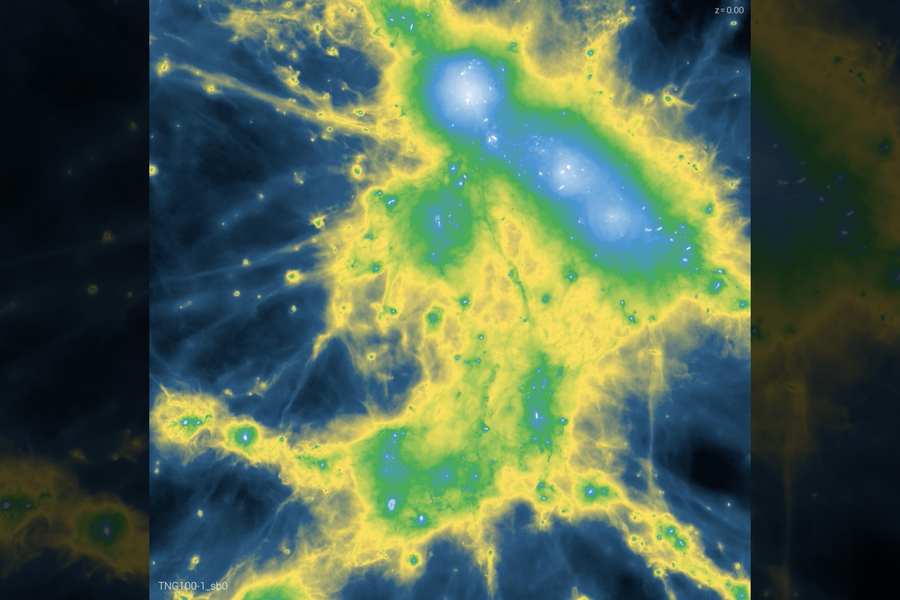
Gas distribution around galaxies
Caption: Simulated gas distribution (blue, green, and yellow colors) around galaxies (white dots on the image). The study finds that gas in our Universe extends farther from galaxies than most simulations predict, indicating strong activity from galaxies that have expelled gas away from galaxy groups.
Credit: IllustrisTNG

Stars and galaxies make up much of the universe’s ordinary, observable matter. But for decades, scientists have wrestled with a cosmic conflict: There should be much more.

Physicists have good estimates of how much matter was present in the early universe. Shortly after the Big Bang, roughly 83% of all matter in the universe was composed of invisible dark matter, with ordinary matter making up the rest...

Read More
Astronomer uses ‘China Sky Eye’ to reveal binary origin of fast radio bursts

Astronomer uses 'China Sky Eye' to reveal binary origin of fast radio bursts
Credit: Y. Liu, X. Yang, Y.F. Liang, W.L. Zhang and Y. Li (PMO)

An international team of astronomers, including researchers from the Department of Physics at The University of Hong Kong (HKU), has uncovered the first decisive evidence that at least some fast radio burst (FRB) sources—brief but powerful flashes of radio waves from distant galaxies—reside in binary stellar systems. This means the FRB source is not an isolated star, as previously assumed, but part of a binary stellar system in which two stars orbit each other.

Using the Five-hundred-meter Aperture Spherical Telescope (FAST) located in Guizhou, also known as the “China Sky Eye,” the team detected a distinctive signal that reveals the presence of a nearby companion star orbiting the FRB source.

The discovery, publ...

Read More

‘Starquakes’ could Explain Mystery Signals

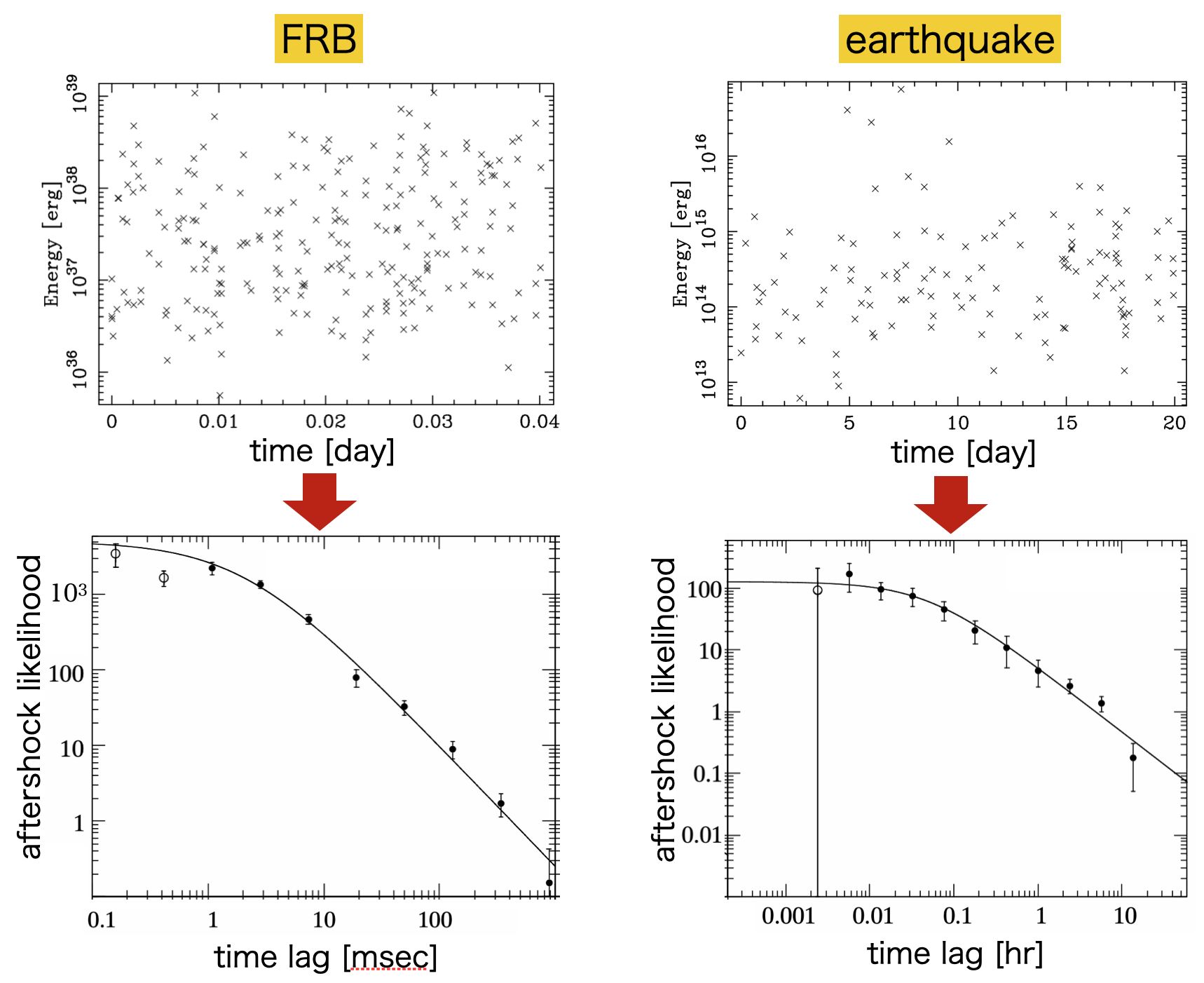
Two scatter charts and two line graphs
Comparing FRBs and earthquakes. The researchers analyzed the time and energy distribution of FRB and earthquake events, and by plotting the aftershock likelihood as a function of time lag, they found that the two are very similar. ©2023 T. Totani & Y. Tsuzuki

Fast radio bursts from distant neutron stars resemble earthquakes rather than solar flares. Fast radio bursts, or FRBs, are an astronomical mystery, with their exact cause and origins still unconfirmed. These intense bursts of radio energy are invisible to the human eye, but show up brightly on radio telescopes. Previous studies have noted broad similarities between the energy distribution of repeat FRBs, and that of earthquakes and solar flares...

Read More

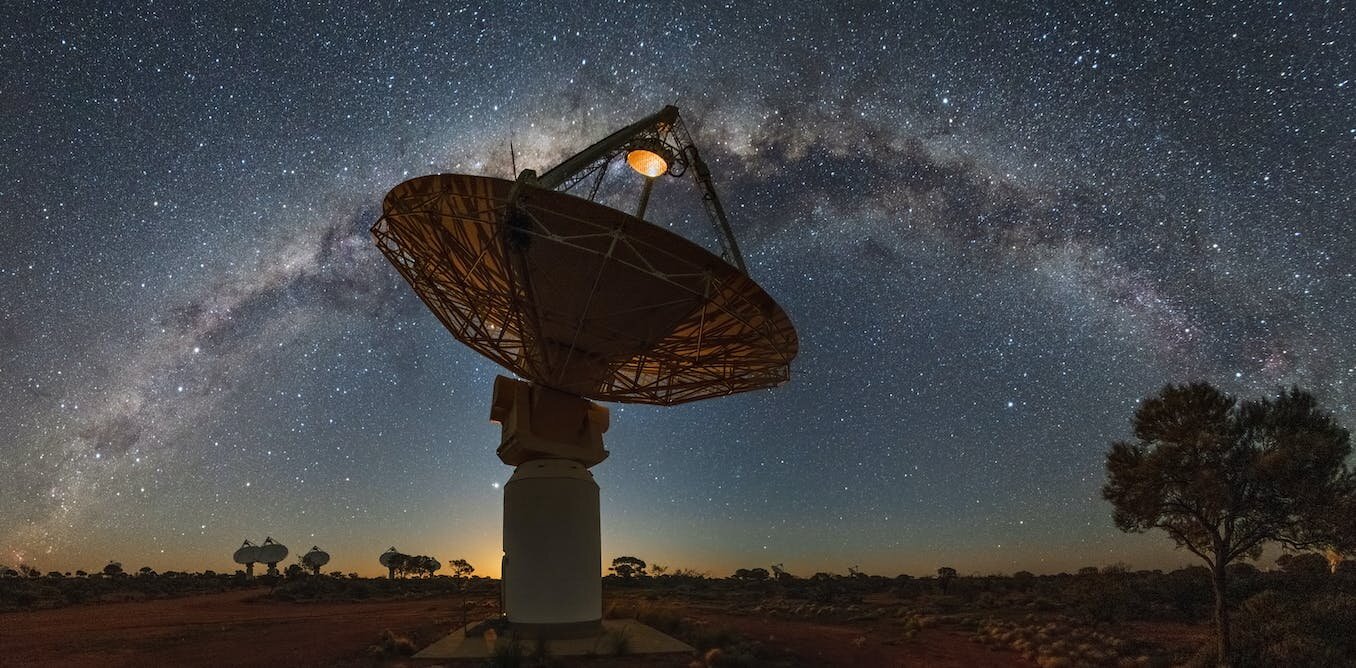
For the first time, astronomers have linked a mysterious Fast Radio Burst with Gravitational Waves

For the first time, astronomers have linked a mysterious fast radio burst with gravitational waves
Credit: ASKAP, CSIRO

We have just published evidence in Nature Astronomy for what might be producing mysterious bursts of radio waves coming from distant galaxies, known as fast radio bursts or FRBs.

Two colliding neutron stars—each the super-dense core of an exploded star—produced a burst of gravitational waves when they merged into a “supramassive” neutron star. We found that two and a half hours later they produced an FRB when the neutron star collapsed into a black hole.

Or so we think. The key piece of evidence that would confirm or refute our theory—an optical or gamma-ray flash coming from the direction of the fast radio burst—vanished almost four years ago. In a few months, we might get another chance to find out if we are correct.

Brief and powerful
FRBs are in...

Read More