
Gaia tagged posts

Gaia reveals that most Milky Way Companion Galaxies are Newcomers to our Corner of Space

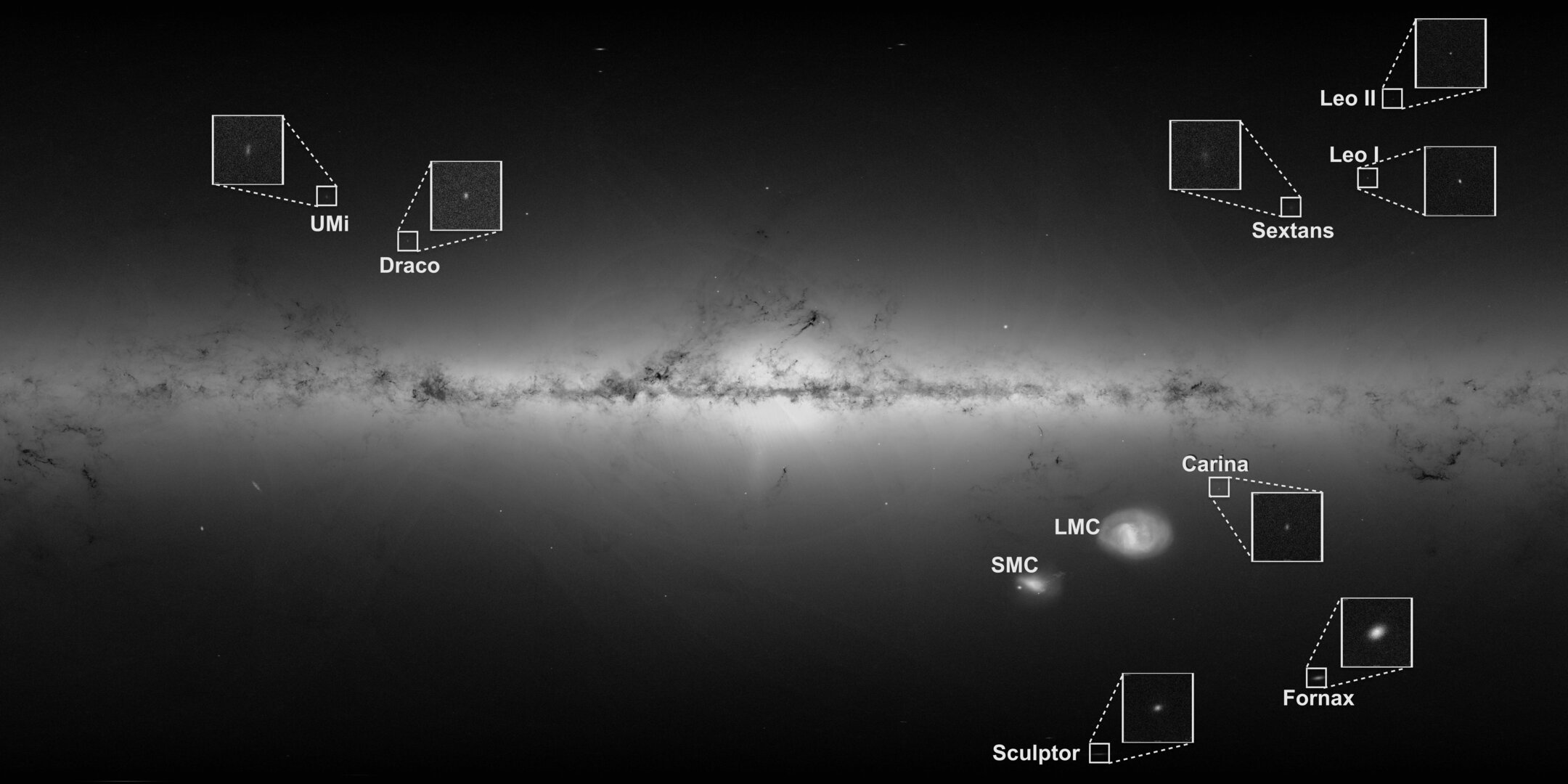
Dwarf galaxies around the Milky Way

Data from ESA’s Gaia mission is re-writing the history of our galaxy, the Milky Way. What had traditionally been thought of as satellite galaxies to the Milky Way are now revealed to be mostly newcomers to our galactic environment.

A dwarf galaxy is a collection of between thousand and several billion stars. For decades it has been widely believed that the dwarf galaxies that surround the Milky Way are satellites, meaning that they are caught in orbit around our galaxy, and have been our constant companions for many billions of years. Now the motions of these dwarf galaxies have been computed with unprecedented precision thanks to data from Gaia’s early third data release and the results are surprising.

François Hammer, Observatoire de Paris—Un...

Read More

Gaia starts Mapping the Galactic Bar in the Milky Way

This colour chart, superimposed on an artistic representation of the galaxy, shows the distribution of 150 million stars in the Milky Way probed using data from the second release of ESA’s Gaia mission in combination with infrared and optical surveys, with orange/yellow hues indicating greater density of stars. Most of these stars are red giants. While the majority of charted stars are located closer to the Sun (the larger orange/yellow blob in the lower part of the image), a large and elongated feature populated by many stars is also visible in the central region of the galaxy: this is the first geometric indication of the galactic bar. Credit: ESA/Gaia/DPAC, A. Khalatyan (AIP) & StarHorse Team; mapa artístic de la Galaxia: NASA/JPL-Caltech/R. Hurt (SSC/Caltech)

The first direct ...

Read More

Tidal Rails: The beginning of the end of an Open Star Cluster

Image of the Hyades, the star cluster closest to the Sun.
Credit: NASA, ESA, and STScI

Researchers verify this phenomenon using Gaia data from the Hyades. In the course of their life, open star clusters continuously lose stars to their surroundings. The resulting swath of tidal tails provides a glimpse into the evolution and dissolution of a star cluster. Thus far only tidal tails of massive globular clusters and dwarf galaxies have been discovered in the Milky Way system. In open clusters, this phenomenon existed only in theory. Researchers at Heidelberg University have now finally verified the existence of such a tidal tail in the star cluster closest to the Sun, the Hyades. An analysis of measurements from the Gaia satellite led to the discovery.

Open star clusters are collections o...

Read More

A Bridge of Stars Connects 2 Dwarf Galaxies

Pale white veils and the narrow bridge between the clouds represent the distribution of the RR Lyrae stars. Credit: V Belokurov, D Erkal, A Mellinger

Pale white veils and the narrow bridge between the clouds represent the distribution of the RR Lyrae stars. Credit: V Belokurov, D Erkal, A Mellinger

The Magellanic Clouds, the 2 largest satellite galaxies of the Milky Way, appear to be connected by a bridge stretching across 43,000 light years, according to an international team of astronomers led by researchers from the University of Cambridge. The discovery is based on the Galactic stellar census being conducted by the European Space Observatory, Gaia which scientists have been eagerly anticipating for 15 years. The first portion of information from the satellite was released 3 months ago and is freely accessible to everyone...

Read More