
galaxy merger tagged posts

Astrophysicists trace the origin of valuable metals in space, from colliding stars to merging galaxies

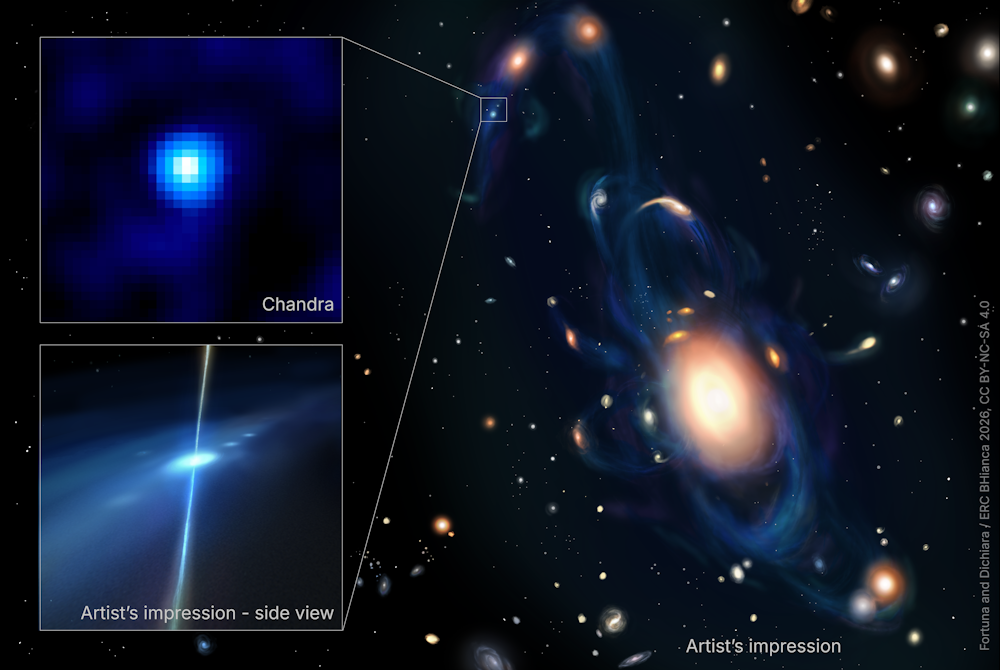
An illustration shows a galaxy merger, an event that leads to star collisions and the creation of valuable metals. Fortuna, Dichiara/ERC BHianca 2026, CC BY-NC-SA 4.0, CC BY-SA

Billions of light years away in a remote part of the universe, two neutron stars—the ultradense remnants of dead stars—collided. The catastrophic cosmic event sent light and particles, including a sudden flash of gamma rays, streaming through the universe. These gamma rays traveled for 8.5 billion years before reaching Earth.

In a new study, our team of astrophysicists examined this gamma-ray signal. We learned that the stellar collision it came from was likely caused by an even more catastrophic encounter—a merger between two galaxies.

This is the first time astronomers associated this type of sig...

Read More
Scientists find Pair of Black Holes Dining Together in Nearby Galaxy Merger

Credit: ALMA (ESO/NAOJ/NRAO); M. Weiss (NRAO/AUI/NSF)

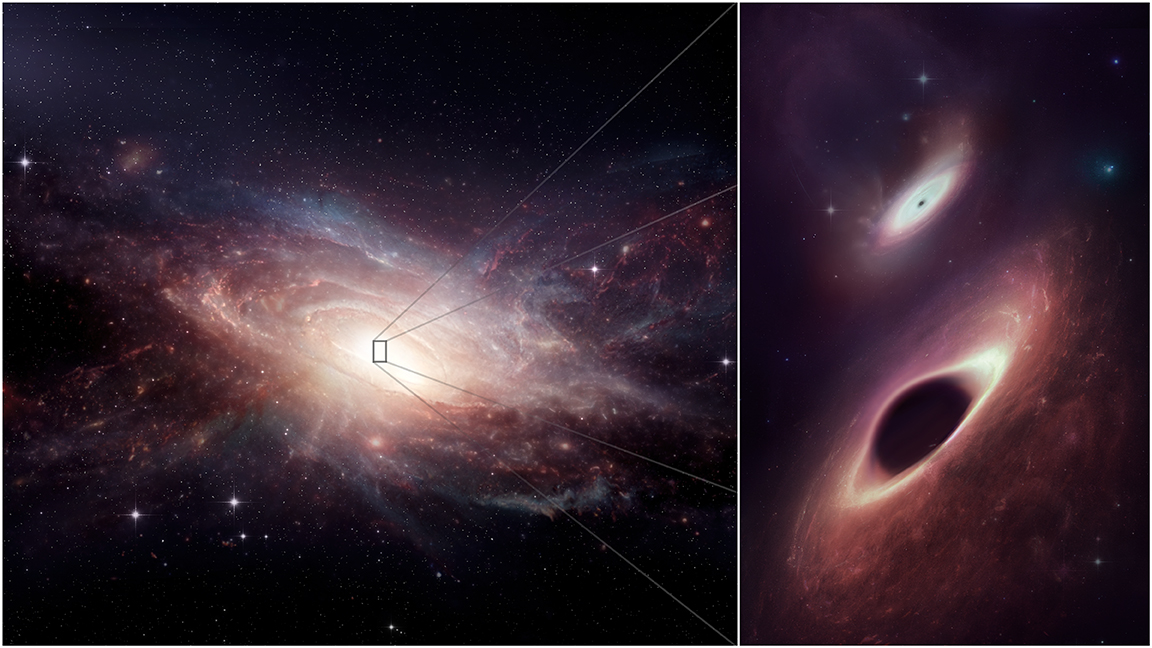
While studying a nearby pair of merging galaxies using the Atacama Large Millimeter/submillimeter Array (ALMA) – an international observatory co-operated by the U.S. National Science Foundation’s National Radio Astronomy Observatory (NRAO) – scientists discovered two supermassive black holes growing simultaneously near the center of the newly coalescing galaxy. These super-hungry giants are the closest together that scientists have ever observed in multiple wavelengths. What’s more, the new research reveals that binary black holes and the galaxy mergers that create them may be surprisingly commonplace in the Universe...

Read More

A Superwind Blown from the Heart of a Galaxy Tells the Tale of a Merger

Blue, green, and red colors are attributed to the B-band, R-band, and H-alpha (emission line from ionized hydrogen gas) images, respectively. The giant ionized gas blown out from the galaxy is seen in red. Credit: Hiroshima University / NAOJ

Blue, green, and red colors are attributed to the B-band, R-band, and H-alpha (emission line from ionized hydrogen gas) images, respectively. The giant ionized gas blown out from the galaxy is seen in red. Credit: Hiroshima University / NAOJ

Astronomers have revealed the detailed structure of a massive 300,000 light-yr long ionized gas outflow streaming from starburst galaxy NGC 6240. The light-collecting power and high spatial resolution of Subaru Telescope made it possible to study, for the first time, the complex structure of one of the largest known superwinds being driven by starbirth – and star death.

The term “starburst” indicates large-scale intensive star-forming activity, making a “starburst galaxy” one where starbirth is occurring on a grand scale...

Read More

Hubble views 2 Galaxies Merging

Image: Hubble views two galaxies merging

Galaxy NGC 6052, located around 230 million light-years away in the constellation of Hercules.

This image, taken with the Wide Field Planetary Camera 2 on board the NASA/ESA Hubble Space Telescope, shows the galaxy NGC 6052, located around 230 million light-years away in the constellation of Hercules. t would be reasonable to think of this as a single abnormal galaxy, and it was originally classified as such. However, it is in fact a “new” galaxy in the process of forming. Two separate galaxies have been gradually drawn together, attracted by gravity, and have collided. We now see them merging into a single structure.

As the merging process continues, individual stars are thrown out of their original orbits and placed onto entirely new paths, some very distant from the region of the collis...

Read More