
Gamma-ray burst tagged posts

Not just for finding planets: Exoplanet-hunter TESS telescope spots bright Gamma-ray Burst

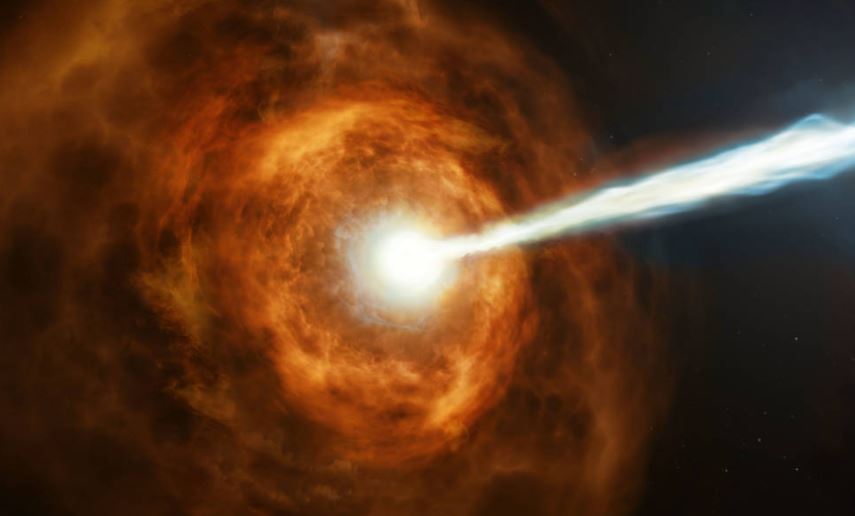
Credits: NASA, ESA and M. Kornmesser

NASA has a long tradition of unexpected discoveries, and the space program’s TESS mission is no different. SMU astrophysicist and her team have discovered a particularly bright gamma-ray burst using a NASA telescope designed to find exoplanets — those occurring outside our solar system — particularly those that might be able to support life.

It’s the first time a gamma-ray burst has been found this way.

Gamma-ray bursts are the brightest explosions in the universe, typically associated with the collapse of a massive star and the birth of a black hole. They can produce as much radioactive energy as the sun will release during its entire 10-billion-year existence.

Krista Lynne Smith, an assistant professor of physics at Southern Methodist Uni...

Read More

Astronomers make 1st Detection of Polarized Radio Waves in Gamma Ray Burst jets

Black hole illustration (stock image).
Credit: © cosmicvue / Adobe Stock

Good fortune and cutting-edge scientific equipment have allowed scientists to observe a Gamma Ray Burst jet with a radio telescope and detect the polarisation of radio waves within it for the first time – moving us closer to an understanding of what causes the universe’s most powerful explosions.

Gamma Ray Bursts (GRBs) are the most energetic explosions in the universe, beaming out mighty jets which travel through space at over 99.9% the speed of light, as a star much more massive than our sun collapses at the end of its life to produce a black hole.

Studying the light from Gamma Ray Burst jets as we detect it travelling across space is our best hope of understanding how these powerful jets are formed, but...

Read More

All in the family: Kin of Gravitational Wave source discovered

This image provides three different perspectives on GRB150101B, the first known cosmic analogue of GW170817, the gravitational wave event discovered in 2017. At center, an image from the Hubble Space Telescope shows the galaxy where GRB150101B took place. At top right, two X-ray images from NASA's Chandra X-ray observatory show the event as it appeared on January 9, 2015 (left), with a jet visible below and to the left; and a month later, on February 10, 2015 (right), as the jet faded away. The bright X-ray spot is the galaxy's nucleus. Credit: NASA/CXC

This image provides three different perspectives on GRB150101B, the first known cosmic analogue of GW170817, the gravitational wave event discovered in 2017. At center, an image from the Hubble Space Telescope shows the galaxy where GRB150101B took place. At top right, two X-ray images from NASA’s Chandra X-ray observatory show the event as it appeared on January 9, 2015 (left), with a jet visible below and to the left; and a month later, on February 10, 2015 (right), as the jet faded away. The bright X-ray spot is the galaxy’s nucleus.
Credit: NASA/CXC

Kilonovae – immense cosmic explosions that produce silver, gold and platinum – may be more common than thought...

Read More

LIGO’s Twin Black Holes might have been Born inside a Single Star

On Sept. 14, 2015, LIGO detected gravitational waves from two merging black holes, shown here in this artist's conception. The Fermi space telescope detected a burst of gamma rays 0.4 seconds later. New research suggests that the burst occurred because the two black holes lived and died inside a single, massive star. Credit: Swinburne Astronomy Production

On Sept. 14, 2015, LIGO detected gravitational waves from two merging black holes, shown here in this artist’s conception. The Fermi space telescope detected a burst of gamma rays 0.4 seconds later. New research suggests that the burst occurred because the two black holes lived and died inside a single, massive star. Credit: Swinburne Astronomy Production

On Sept14, 2015, Laser Interferometer Gravitational-wave Observatory (LIGO) detected gravitational waves from the merger of 2 black holes 29 and 36 times the mass of the Sun. Such an event is expected to be dark, but the Fermi Space Telescope detected a gamma-ray burst just a fraction of a second after LIGO’s signal...

Read More