
gamma-ray tagged posts

Astrophysicists trace the origin of valuable metals in space, from colliding stars to merging galaxies

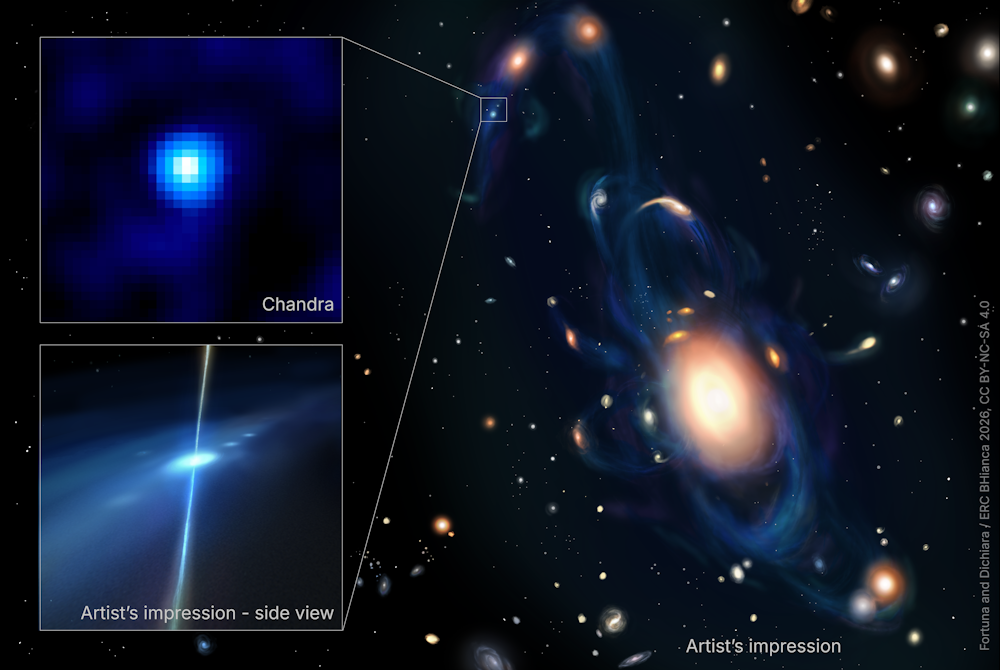
An illustration shows a galaxy merger, an event that leads to star collisions and the creation of valuable metals. Fortuna, Dichiara/ERC BHianca 2026, CC BY-NC-SA 4.0, CC BY-SA

Billions of light years away in a remote part of the universe, two neutron stars—the ultradense remnants of dead stars—collided. The catastrophic cosmic event sent light and particles, including a sudden flash of gamma rays, streaming through the universe. These gamma rays traveled for 8.5 billion years before reaching Earth.

In a new study, our team of astrophysicists examined this gamma-ray signal. We learned that the stellar collision it came from was likely caused by an even more catastrophic encounter—a merger between two galaxies.

This is the first time astronomers associated this type of sig...

Read More
Astronomers confirm Star Wreck as Source of Extreme Cosmic Particles

This sequence compares Fermi results in three energy ranges. Pulsar J2229+6114 is the brilliant source at the top, the northern tip of supernova remnant G106.3+2.7 (outlined in green). In each energy range, the sequence first shows the number of gamma rays and then the excess amounts compared with expectations from a model of the background. Brighter colors indicate greater numbers of gamma rays or excess amounts. At the highest energies, a new source of gamma rays emerges, produced when protons accelerated by the supernova’s shock wave strike a nearby gas cloud.
Credit: NASA/Fermi/Fang et al. 2022

Astronomers have long sought the launch sites for some of the highest-energy protons in our galaxy...

Read More

Unveiling a Century-old Mystery: Where the Milky Way’s Cosmic Rays come from

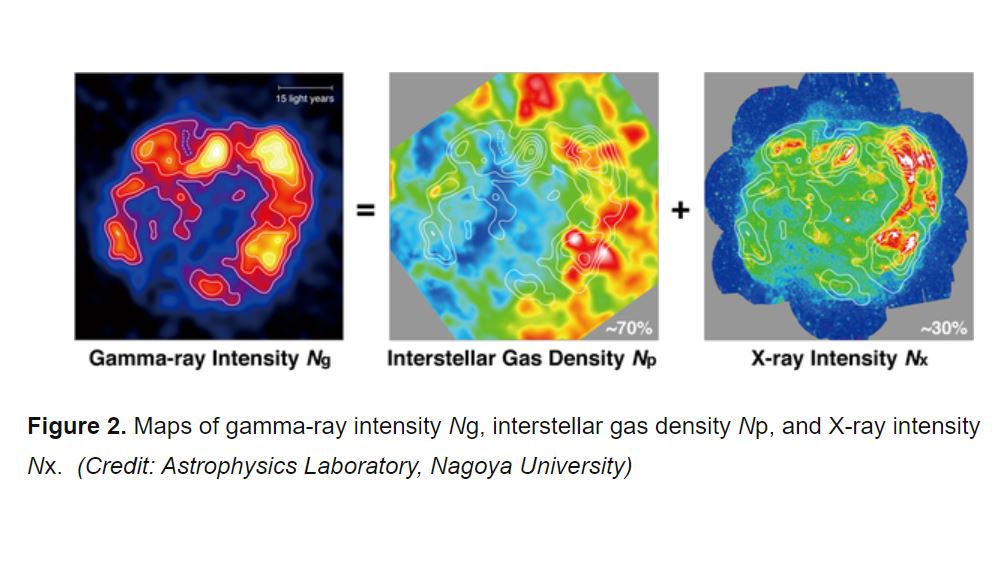
Astronomers have succeeded for the first time in quantifying the proton and electron components of cosmic rays in a supernova remnant. At least 70% of the very-high-energy gamma rays emitted from cosmic rays are due to relativistic protons, according to the novel imaging analysis of radio, X-ray, and gamma-ray radiation. The acceleration site of protons, the main components of cosmic rays, has been a 100-year mystery in modern astrophysics, this is the first time that the amount of cosmic rays being produced in a supernova remnant has been quantitatively shown and is an epoch-making step in the elucidation of the origin of cosmic rays.

The origin of cosmic rays, the particles with the highest energy in the universe, has been a great mystery since their discovery in 1912...

Read More