
geomagnetic storm tagged posts

Risks of solar storms may be underestimated, warn researchers

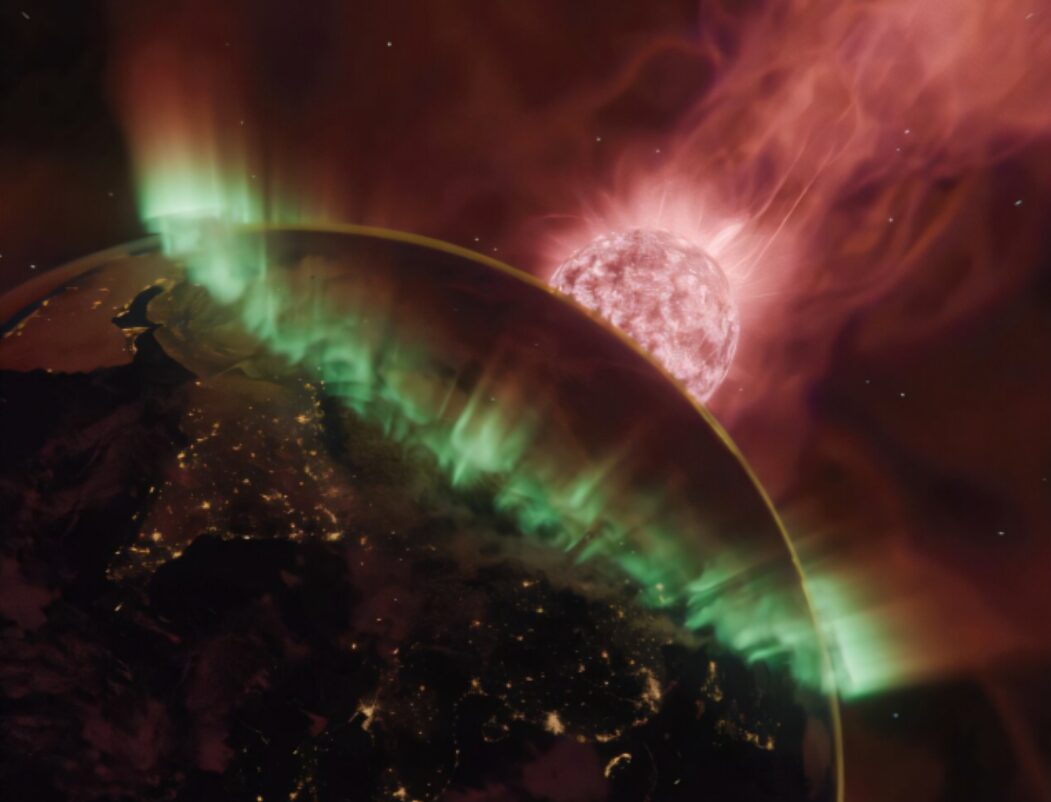
Illustration of solar wind streaming from a fuming sun drives auroras bright enough to be seen far from the poles, a dazzling signature of an extreme geomagnetic storm. Credit: Nithin Sivadas NASA Goddard Space Flight Center

The effects of extreme space weather may be larger than previously thought, research in the journal Nature reveals. The paper, titled “Regression to the mean can explain saturation of geomagnetic storms,” is led by Dr. Nithin Sivadas of NASA’s Goddard Space Flight Center and co-authored by Dr. Maria Walach from Lancaster University.

Space weather—caused by fluctuating electric fields in Earth’s magnetic field and upper atmosphere—can affect technologies on and around Earth in several ways...

Read More
Sun unleashes monster solar storm: Rare G4 alert issued for earth

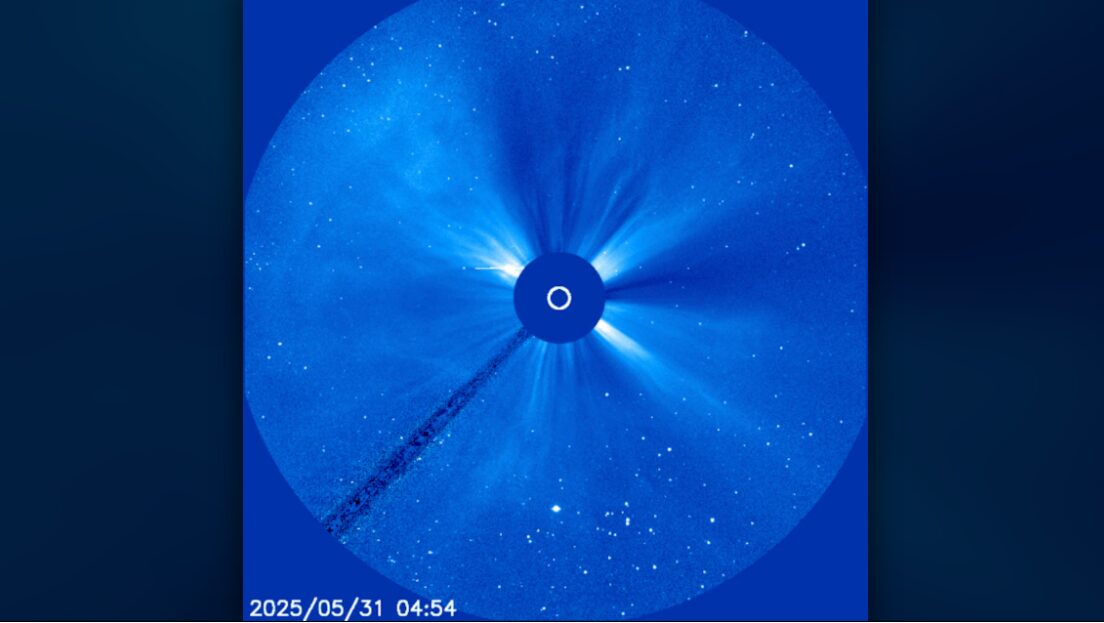
A violent solar eruption on May 31 launched a coronal mass ejection (CME) hurtling toward Earth, triggering a rare G4-level geomagnetic storm alert. Captured in real-time by U.S. Naval Research Laboratory instruments, this cosmic blast has the potential to disrupt satellites, communications, and military systems.

Local weather alerts are familiar warnings for potentially dangerous conditions, but an alert that puts all of Earth on warning is rare.

On May 31, U.S. Naval Research Laboratory’s (NRL) space-based instrumentation captured real-time observations of a powerful Coronal Mass Ejection (CME) that erupted from the Sun initiating a “severe geomagnetic storm” alert for Earth.

“Our observations demonstrated that the eruption was a so-called ‘halo CME,’ meaning it was Earth-d...

Read More

Crack Discovered in Earth’s Magnetic Shield

The GRAPES-3 muon telescope, the largest and most sensitive cosmic ray monitor recorded a burst of galactic cosmic rays that indicated a crack in the Earth's magnetic shield. Credit: TIFR

The GRAPES-3 muon telescope, the largest and most sensitive cosmic ray monitor recorded a burst of galactic cosmic rays that indicated a crack in the Earth’s magnetic shield. Credit: TIFR

The GRAPES-3 muon telescope located at TIFR’s Cosmic Ray Laboratory in Ooty recorded a burst of galactic cosmic rays of about 20 GeV, on 22 June 2015 lasting for 2 hours. The burst occurred when a giant cloud of plasma ejected from the solar corona, and moving with a speed of about 2.5 million km/h struck our planet, causing a severe compression of Earth’s magnetosphere from 11 to 4 times the radius of Earth. It triggered a severe geomagnetic storm that generated aurora borealis, and radio signal blackouts in many high latitude countries.

Earth’s magnetosphere extends over a radius of a million kilometers...

Read More

A Perfect Sun-Storm solves a mystery

Visualization of Earth's magnetic environment, with the magnetic field as a protective shield, generated by the strong internal magnetic field in Earth's core (for more see the end of the press release). Credit: Martin Rother/GFZ

Visualization of Earth’s magnetic environment, with the magnetic field as a protective shield, generated by the strong internal magnetic field in Earth’s core.. Credit: Martin Rother/GFZ

A geomagnetic storm on 1/17/13, provided unique observations that finally resolved a long-standing scientific problem. For decades, scientists had asked how particles hitting Earth’s magnetosphere were lost. A likely mechanism involved certain electromagnetic waves scattering particles into Earth’s atmosphere. More recently, another mechanism was proposed that caused particles to be lost in interplanetary space...

Read More