
gravitational lenses tagged posts

Largest 2D map of the universe helps scientists discover new gravitational lenses

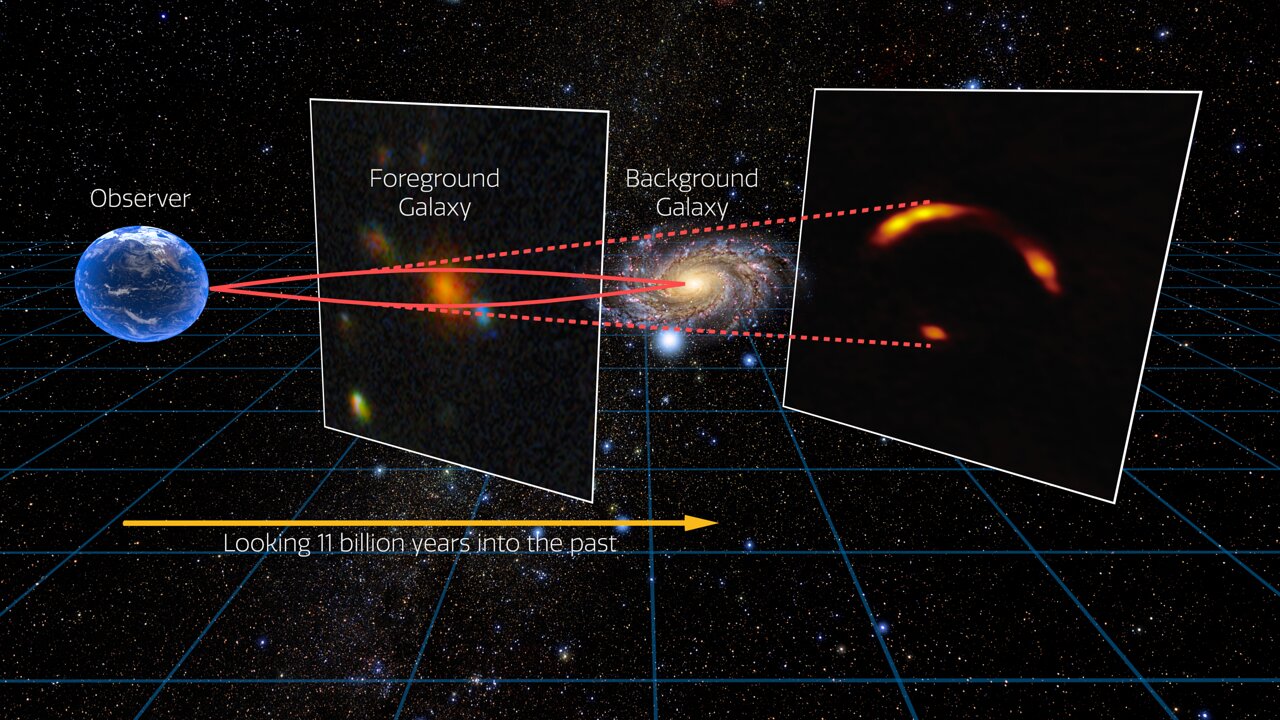
Gravitational lensing infographic
This infographic shows how the gravitational lensing effect works: when a very massive foreground galaxy bends spacetime, acting as a cosmic magnifying glass that enlarges and distorts the image of a more distant galaxy behind it.
Credit: International Gemini Observatory/NOIRLab/NSF/AURA/ALMA (ESO/NAOJ/NRAO)/R. Proctor

Using data from the DESI Legacy Imaging Surveys, with help from artificial intelligence, an international team of scientists has discovered 70 new gravitational lenses—rare cosmic alignments that act as natural magnifying glasses. The new lenses further expand one of the largest collections of confirmed lenses to date and will allow scientists to study dark matter, galaxy evolution and the structure of the universe.

In August 2026, the DESI Legacy Imaging Surveys tea...

Read More

Artificial Intelligence Analyzes Gravitational Lenses 10 million Times Faster

Neural Nets and Gravitational Lenses

KIPAC scientists have for the first time used artificial neural networks to analyze complex distortions in spacetime, called gravitational lenses, demonstrating that the method is 10 million times faster than traditional analyses. (Greg Stewart/SLAC National Accelerator Laboratory)

Brain-mimicking ‘neural networks’ can revolutionize the way astrophysicists analyze their most complex data. Researchers from the Department of Energy’s SLAC National Accelerator Laboratory and Stanford University have for the first time shown that neural networks – a form of artificial intelligence — can accurately analyze the complex distortions in spacetime known as gravitational lenses 10 million times faster than traditional methods...

Read More

‘Space Warps’ and other Citizen Science Projects reap major dividends for Astrophysics

The Zooniverse citizen science project Space Warps recently reported that its online volunteers have helped to discover 29 new gravitational lenses.

The Zooniverse citizen science project Space Warps recently reported that its online volunteers have helped to discover 29 new gravitational lenses, and 30 other possible lenses from the Canada France Hawaii Telescope Legacy Survey. Not only are these important discoveries in their own right but they also prove just how good citizen scientists are at hunting down unusual objects. Credit; http://www.ox.ac.uk/news/science-blog/hunting-%E2%80%98halos%E2%80%99-universe-0

Thanks to the Internet, amateur volunteers known as “citizen scientists” can readily donate their time and effort to science–in fields ranging from medicine to zoology to astrophysics...

Read More