
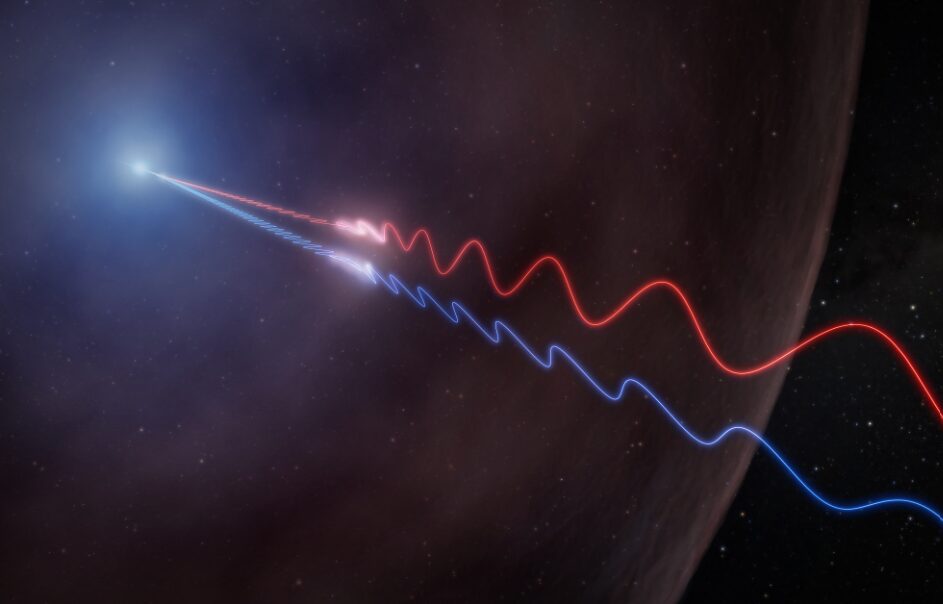
Credit: NSF/AUI/NSF NRAO/M.Weiss
Astronomers have made a series of landmark observations of one of the universe’s most violent events. Using the U.S...
Read More

July 15, 2026,
 Astronomy/Space
Astronomers have made a series of landmark observations of one of the universe’s most violent events. Using the U.S...
Read More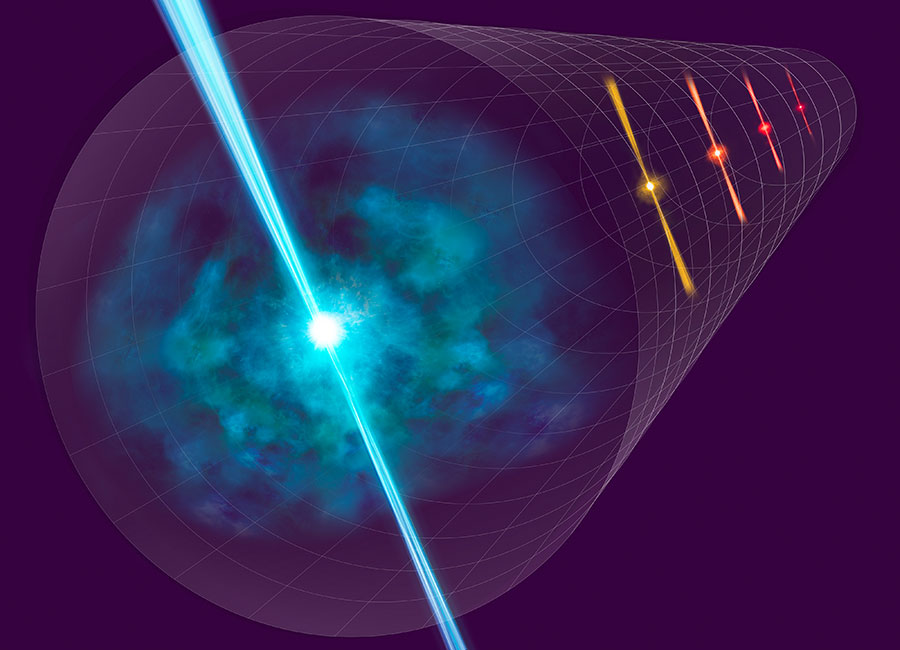
An international team of 23 researchers led by Maria Dainotti, Assistant Professor at the National Astronomical Observatory of Japan (NAOJ), has analyzed archive data for powerful cosmic explosions from the deaths of stars and found a new way to measure distances in the distant Universe.
With no landmarks in space, it is very difficult to get a sense of depth. One technique astronomers use is to look for “standard candles,” objects or events where the underlying physics dictate that the absolute brightness (what you would see if you were right next to it) is always the same...
Read More
September 16, 2018,
Uncategorized

Aftermath of the merger of two neutron stars. Ejecta from an initial explosion formed a shell around the black hole formed from the merger. A jet of material propelled from a disk surrounding the black hole first interacted with the ejecta material to form a broad “cocoon.” Later, the jet broke through to emerge into interstellar space, where its extremely fast motion became apparent.
Credit: Sophia Dagnello, NRAO/AUI/NSF
Jet appeared to move 4X faster than light. The supersharp radio ‘vision’ of a continent-wide collection of radio telescopes has answered an outstanding question about the aftermath of a merger of two neutron stars...
Read More
September 15, 2015,
Astronomy/Space

Gamma ray bursts (GRBs) – flashes of high-energy light occur about once a day, randomly, from around the sky – the brightest events in the known universe. While a burst is underway, it is many millions of times brighter than an entire galaxy. Astronomers are anxious to decipher their nature not only because of their dramatic energetics, but also because their tremendous brightness enables them to be seen across cosmological distances and times, providing windows into the young universe.
GRB 130427A tops the charts as one of the brightest ever seen.
There appear to be 2 general types of GRBs: those associated with the deaths of massive stars, and ones believed to originate from the coalescence of 2 extreme objects (neutron stars or black holes) that had been orbiting each other in a binary...

Recent Comments