Gut microbiome tagged posts

New Study puts Gut Microbiome at the Center of Parkinson’s Disease Pathogenesis

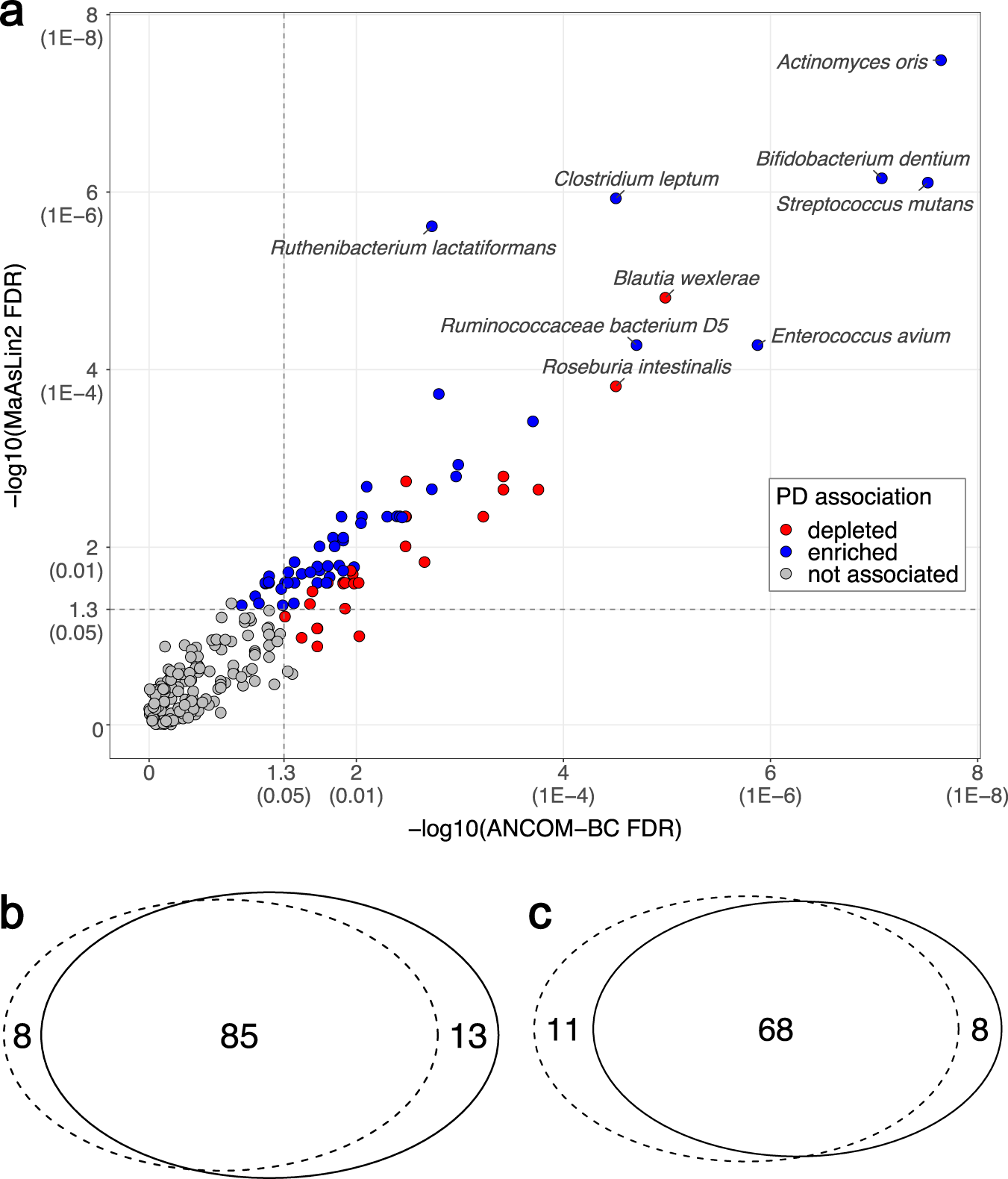
Fig. 2
 PD-associated species nominated by consensus of MaAsLin2 and ANCOM-BC. Analysis included N = 724 biologically independent samples from 490 PD and 234 neurologically healthy control (NHC) subjects. a 257 species (denoted by circles in the plot) were tested in microbiome-wide association study (MWAS) with two statistical methods: MaAsLin2 and ANCOM-BC. The results are shown according to significance (−log10 of the FDR) achieved by MaAslin2 (Y-axis) vs ANCOM-BC (X-axis). Corresponding untransformed FDR values are provided in parentheses on the X and Y axes for easier interpretation. 84 species were nominated as PD-associated, defined by FDR < 0.05 by one method and FDR≤0.1 by the other: 68 achieved FDR < 0.05 by both methods, 10 achieved ANCOM-BC MaAsLin2 FDR < 0.05 by MaAsLin2 and FDR≤0...
Read More

Nanomaterial influences Gut Microbiome and Immune system Interactions

Decorative image
A new study by researchers at Karolinska Institutet shows that the aryl hydrocarbon receptor (AhR) in intestinal epithelial cells senses the nanomaterial graphen oxide and activates specific immune cells known as innate lymphoid cells. Illustration by Getty Images.

The nanomaterial graphene oxide — which is used in everything from electronics to sensors for biomolecules — can indirectly affect the immune system via the gut microbiome, as shown in a new study on zebrafish by researchers at Karolinska Institutet in Sweden. The findings are reported in the journal Nature Nanotechnology.

“This shows that we must factor the gut microbiome into our understanding of how nanomaterials affect the immune system,” says the paper’s corresponding author Bengt Fadeel, professor at the Institute o...

Read More

The Gut Microbiome’s Supersized Role in Shaping Molecules in our Blood

Metabolites associated with both genetics and the microbiome. (A) The 20 metabolites with the highest total R² that were significantly associated with both host genetics and the microbiome. Blue and green colored bars denote individual R² values in genetics-only and microbiome-only regression models, respectively. Gray bars denote R² values from regression using joined genetics and microbiome data. 0.9% of the variance in butyrylcarnitine plasma abundance was explained by microbial features (i.e. too little to be visible in the barplot). (B) R² values obtained by either adding individual contributions of genetics and the microbiome (additive) or by performing a joint regression (joint). The difference between the two groups indicates a small, but nonetheless significant, overlap in variance explained by genetics and the microbiome. However, the variances explained by host genetics and the microbiome were largely additive. Stars denote significance (*** -p<0.001).
Metabolites associated with both genetics and the microbiome. (A) The 20 metabolites with the highest total R² that were significantly associated with both host genetics and the microbiome. Blue and green colored bars denote individual R² values in genetics-only and microbiome-only regression models, respectively. Gray bars denote R² values from regression using joined genetics and microbiome data. 0.9% of the variance in butyrylcarnitine plasma abundance was explained by microbial features (i.e. too little to be visible in the barplot). (B) R² values obtained by either adding individual contributions of genetics and the microbiome (additive) or by performing a joint regression (joint)...
Read More

Scientists Characterize the Imbalanced Gut Bacteria of Patients with Myocardial Infarction, Angina and Heart Failure

In two publications in Nature Medicine, a European-Israeli team of researchers show how major disturbances occur in the gut microbiome of patients suffering from heart disease. Given this latest evidence from microbiome research, one of the senior lead researchers, Professor Oluf Pedersen from the University of Copenhagen, calls for stronger and more focused public health initiatives to prevent or delay these common diseases that are a leading cause of premature death worldwide through plant-based and energy-controlled diet, avoidance of smoking and compliance with daily exercise.

The human gut contains trillions of bacteria, collectively called the gut microbiome, which may have positive and negative effects on human health...

Read More