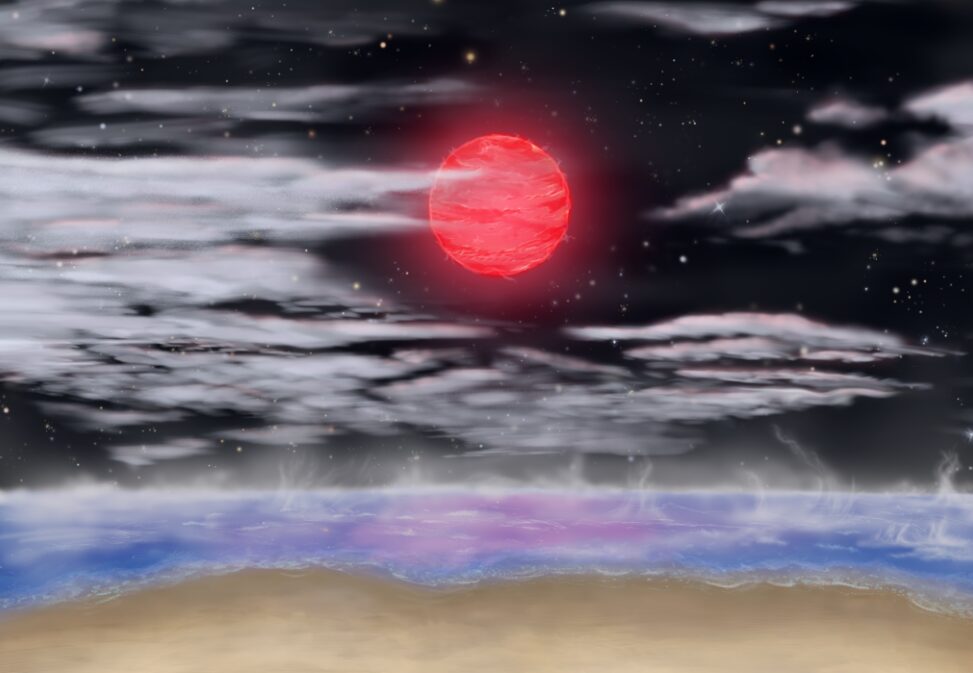
Artist’s conception of the view from the surface of the habitable-zone super-Earth exoplanet GJ 3378b. The planet has a minimum mass just over twice that of Earth and orbits its star at a distance that causes it to receive almost the same amount of starlight as Earth does. The planet joins a growing population of potential hosts for life in the nearby universe. Image credit: Nikolai Berman/UC Irvine.
Using the Hobby-Eberly Telescope at McDonald Observatory, astronomers have taken a closer look at a nearby exoplanet and discovered it may be more Earth-like than previously thought. The planet, known as GJ 3378b, orbits a small, cool star called a red dwarf...
This artist’s concept shows what exoplanet Kepler-1649c could look like on its surface. The planet is the closest to Earth in size and temperature found yet in data from the Kepler space telescope. Credit: NASA/Ames Research Center/Daniel Rutter
While the star it orbits is much smaller than our Sun, it gets about 75 percent of the sunlight Earth does. A team of transatlantic scientists, using reanalyzed data from NASA’s Kepler space telescope, has discovered an Earth-size exoplanet orbiting in its star’s habitable zone, the area around a star where a rocky planet could support liquid water.
Scientists discovered this planet, called Kepler-1649c, when looking through old observations from Kepler, which the agency retired in 2018...






Recent Comments