
habitable zone tagged posts

Earth-like Biospheres on other Planets may be Rare

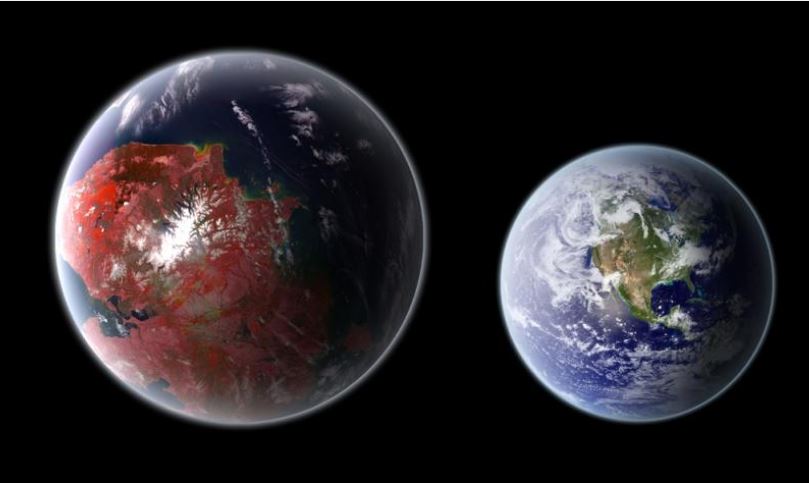
An artistic representation of the potentially habitable planet Kepler 422-b (left), compared with Earth (right).
Credit
Ph03nix1986 / Wikimedia Commons
Licence type
Attribution-ShareAlike (CC BY-SA 4.0)

A new analysis of known exoplanets has revealed that Earth-like conditions on potentially habitable planets may be much rarer than previously thought. The work focuses on the conditions required for oxygen-based photosynthesis to develop on a planet, which would enable complex biospheres of the type found on Earth. The study is published today in Monthly Notices of the Royal Astronomical Society.

The number of confirmed planets in our own Milky Way galaxy now numbers into the thousands...

Read More
Geology helps Astronomers find Habitable Planets

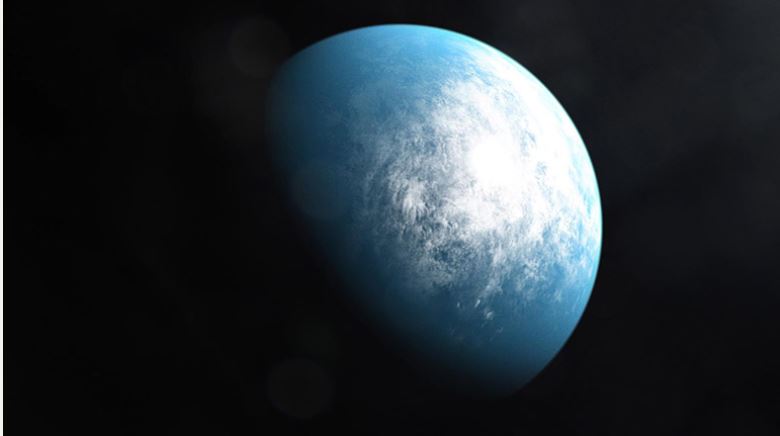
UBCO’s Brendan Dyck is using his geology expertise about planet formation to help identify other planets that might support life. Image Credit: NASA/Goddard Space Flight Center.

Findings will help better identify Earth-like planets that could sustain life. Astronomers have identified more than 4,000, and counting, confirmed exoplanets – planets orbiting stars other than the sun – but only a fraction have the potential to sustain life.

Now, new research from UBC’s Okanagan campus is using the geology of early planet formation to help identify those that may be capable of supporting life.

“The discovery of any planet is pretty exciting, but almost everyone wants to know if there are smaller Earth-like planets with iron cores,” says Dr...

Read More

Presence of Airborne Dust could signify Increased Habitability of Distant Planets

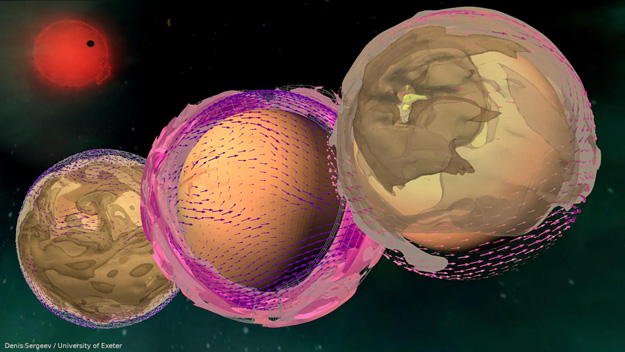
A visualization of three computer simulations of terrestrial exoplanets, showing winds (arrows) and airborne dust (color scale), with an M-dwarf host star in the background. Created by Denis Sergeev, STFC funded postdoctoral researcher at the University of Exeter. CREDIT Denis Sergeev/ University of Exeter

Scientists have expanded our understanding of potentially habitable planets orbiting distant stars by including a critical climate component – the presence of airborne dust.

The researchers suggest that planets with significant airborne dust – similar to the world portrayed in the classic sci-fi Dune – could be habitable over a greater range of distances from their parent star, therefore increasing the window for planets capable of sustaining life.

The team from the University ...

Read More

Life could be Evolving right now on Nearest Exoplanets

The intense radiation environments around nearby M stars could favor habitable worlds resembling younger versions of Earth.
Credit: Jack O’Malley-James/Cornell University

Rocky, Earth-like planets orbiting our closest stars could host life, according to a new study that raises the excitement about exoplanets. When rocky, Earth-like planets were discovered orbiting in the habitable zone of some of our closest stars, excitement skyrocketed – until hopes for life were dashed by the high levels of radiation bombarding those worlds.

Proxima-b, only 4.24 light years away, receives 250 times more X-ray radiation than Earth and could experience deadly levels of ultraviolet radiation on its surface...

Read More