Hayabusa2 tagged posts

Asteroid Ryugu’s dust reveals nitrogen’s slow concentration into complex molecules

Ancient asteroid dust reveals nitrogen's slow concentration into complex molecules
Revealing nitrogen-bearing compounds in the sample returned from Ryugu. Credit: Toru Matsumoto et al.

Nitrogen is a key ingredient in the biomolecules that form the building blocks of life. Yet as an unbonded gas, it is far more likely to drift into space than to lock itself into solid compounds, making it difficult for astronomers to trace its journey to Earth in the distant past.

Through new research published in Nature Astronomy, a team led by Toru Matsumoto at Kyoto University has found some of the best evidence yet of how this journey happened, hidden inside grains of dust from the asteroid Ryugu.

Evidence across the solar system
Nitrogen-bearing compounds, particularly ammonia, have already been spotted on the dwarf planet Ceres and on several carbon-rich asteroids, hinting ...

Read More

Japan space probe skims asteroid in test for planetary defense

asteroid (Dimorphos)
This high-resolution view of Dimorphos was created by combining the final 10 full-frame images obtained by DART’s Didymos Reconnaissance and Asteroid Camera for Optical navigation (DRACO) and layering the higher-resolution images on top of the lower-resolution ones. Dimorphos is oriented so that its north pole is toward the top of the image. Credit: Public Domain

A Japanese space probe performed a flyby of a near-Earth asteroid on Sunday in a test mission for technology that could help protect the planet from space rocks.

The fridge-sized Hayabusa2 was due to fly within 800 meters (0...

Read More

Ryugu Asteroid Origins in the Solar Nebula Decoded by Carbonates

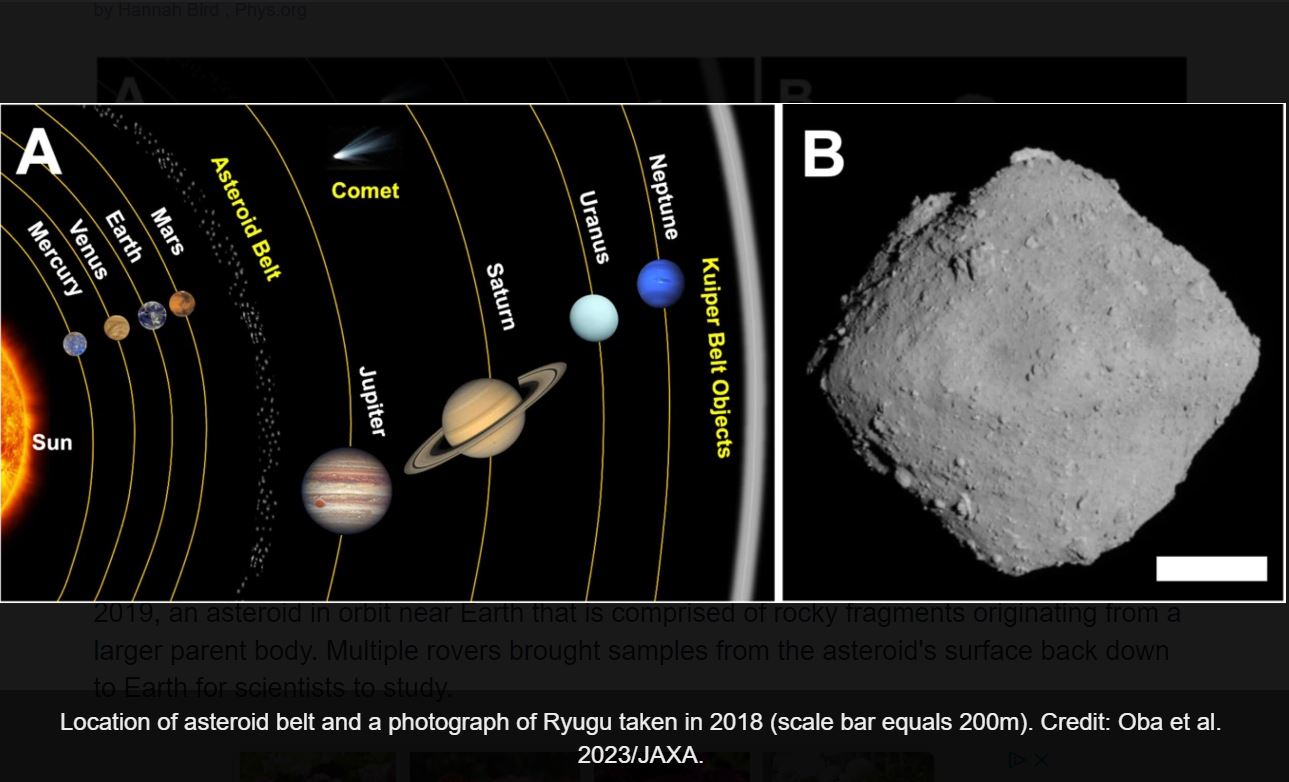
Japan’s Aerospace Exploration Agency sent the Hayabusa2 spacecraft to 162173 Ryugu in 2019, an asteroid in orbit near Earth that is comprised of rocky fragments originating from a larger parent body. Multiple rovers brought samples from the asteroid’s surface back down to Earth for scientists to study.

The samples are indicative of chemically primitive meteorites, similar to Ivuna-type chondrites, and contain particular chemical compounds that suggest the presence of water. In particular, alterations of the asteroid’s surface by water on the parent body, at estimated temperatures up to 150°C, produced secondary minerals (including phyllosilicates, carbonates, sulfides and oxides) and the researchers aimed to understand the timescale and conditions over which these changes occurred...

Read More

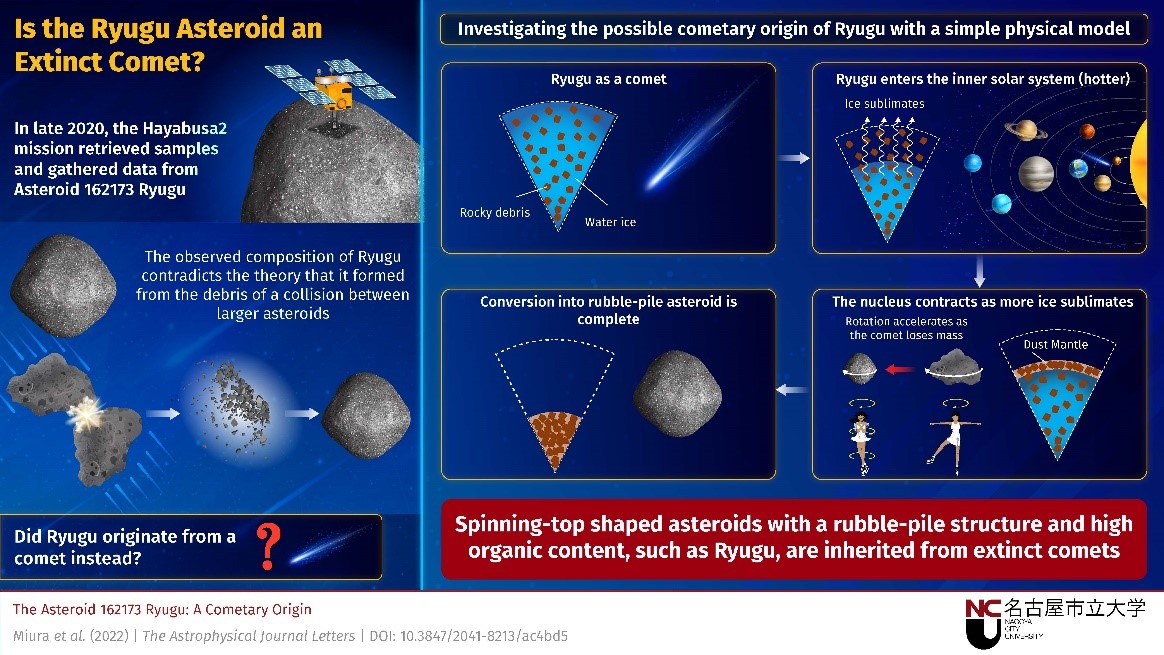
Could the Asteroid Ryugu be a Remnant of an Extinct Comet? Scientists now answer

Asteroids hold many clues about the formation and evolution of planets and their satellites. Understanding their history can, therefore, reveal much about our solar system. While observations made from a distance using electromagnetic waves and telescopes are useful, analyzing samples retrieved from asteroids can yield much more detail about their characteristics and how they may have formed. An endeavor in this direction was the Hayabusa mission, which, in 2010, returned to Earth after 7 years with samples from the asteroid Itokawa.

The successor to this mission, called Hayabusa2, was completed near the end of 2020, bringing back material from Asteroid 162173 “Ryugu,” along with a collection of images and data gathered remotely from close proximity...

Read More