heart failure tagged posts

One Cup of Leafy Green Vegetables a Day Lowers Risk of Heart Disease

See the source image
New ECU research has shown eating one cup of nitrate-rich vegetables each day significantly reduces the risk of heart disease

New Edith Cowan University (ECU) research has found that by eating just one cup of nitrate-rich vegetables each day people can significantly reduce their risk of heart disease.

The study investigated whether people who regularly ate higher quantities of nitrate-rich vegetables, such as leafy greens and beetroot, had lower blood pressure, and it also examined whether these same people were less likely to be diagnosed with heart disease many years later.

Cardiovascular diseases are the number one cause of death globally, taking around 17.9 million lives each year.

Researchers examined data from over 50,000 people residing in Denmark taking part in the...

Read More

A Weak Heart makes a Suffering Brain

Evidence of disturbed gene activity in the brain as a result of heart problems. Researchers at the German Center for Neurodegenerative Diseases (DZNE), the University Medical Center Göttingen (UMG) and the German Center for Cardiovascular Research (DZHK) come to this conclusion based on laboratory studies. They consider that they have found a possible cause for the increased risk of dementia in people with heart problems. In mice, a specific drug which is known to affect gene activity alleviated the mental deficits. The involved experts see these results as potential approaches for therapies. The study data are published in the scientific journal EMBO Molecular Medicine.

In Germany, about four million people are affected by what is called “heart failure”: Their heart muscle is too...

Read More

Astronauts experience Decrease in Blood Vessel function during Spaceflight

Astronauts aboard the International Space Station have decreased physical fitness because of a decrease in the way oxygen moves through the body, according to a Kansas State University kinesiology study.

Astronauts aboard the International Space Station have decreased physical fitness because of a decrease in the way oxygen moves through the body, according to a Kansas State University kinesiology study.

Astronauts aboard ISS have decreased physical fitness because of a decrease in the way oxygen moves through the body, according to a Kansas State University kinesiology study. Carl Ade, assistant professor of exercise physiology, and collaborators partnered with the Johnson Space Center to find that astronauts’ exercise capacity decreases between 30 and 50% in long-duration spaceflight because the heart and small blood vessels are not as effective at transporting oxygen to the working muscle.

“It is a dramatic decrease,” Ade said...

Read More

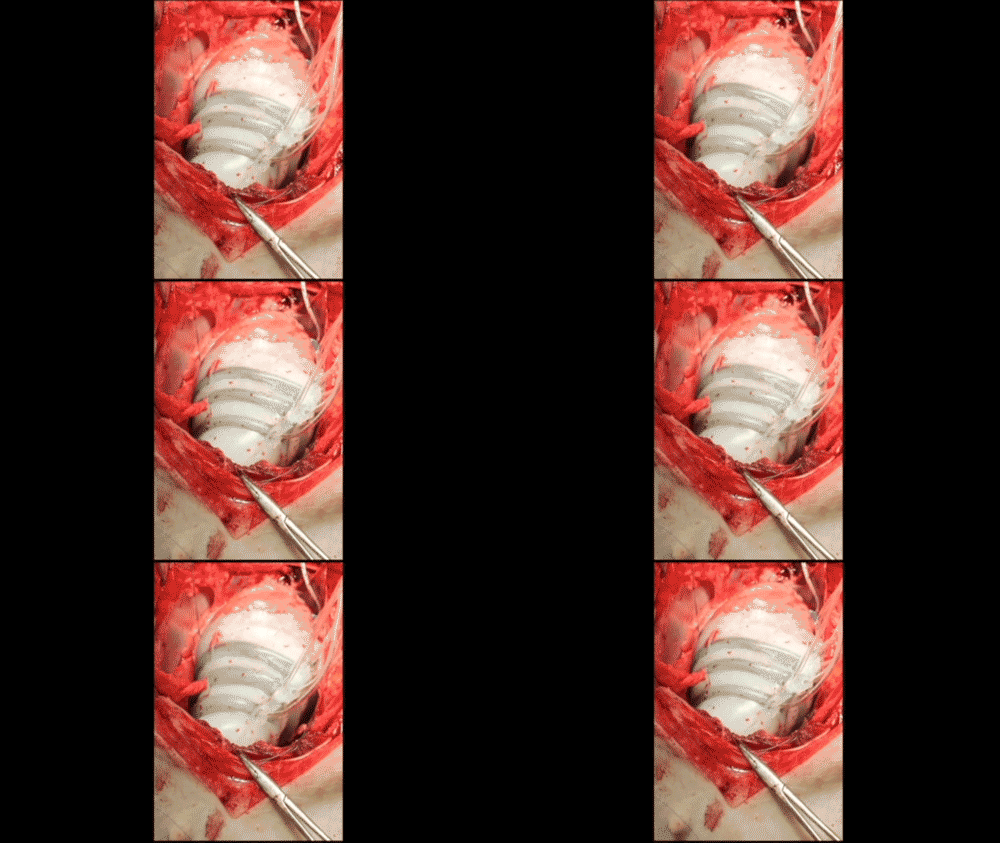
Soft Robot helps the Heart Beat

In vivo demonstration of cardiac assist in a porcine model of acute heart failure (Video courtesy of Ellen Rouche/Harvard SEAS)

In vivo demonstration of cardiac assist in a porcine model of acute heart failure (Video courtesy of Ellen Rouche/Harvard SEAS)

Harvard University and Boston Children’s Hospital researchers have developed a customizable soft robot that fits around a heart and helps it beat, potentially opening new treatment options for people suffering from heart failure. The soft robotic sleeve twists and compresses in synch with a beating heart, augmenting cardiovascular functions weakened by heart failure. Unlike currently available devices that assist heart function, Harvard’s soft robotic sleeve does not directly contact blood. This reduces the risk of clotting and eliminates the need for a patient to take potentially dangerous blood thinner medications...

Read More