Hot Jupiters tagged posts

Astronomers provide ‘Field Guide’ to Exoplanets known as Hot Jupiters

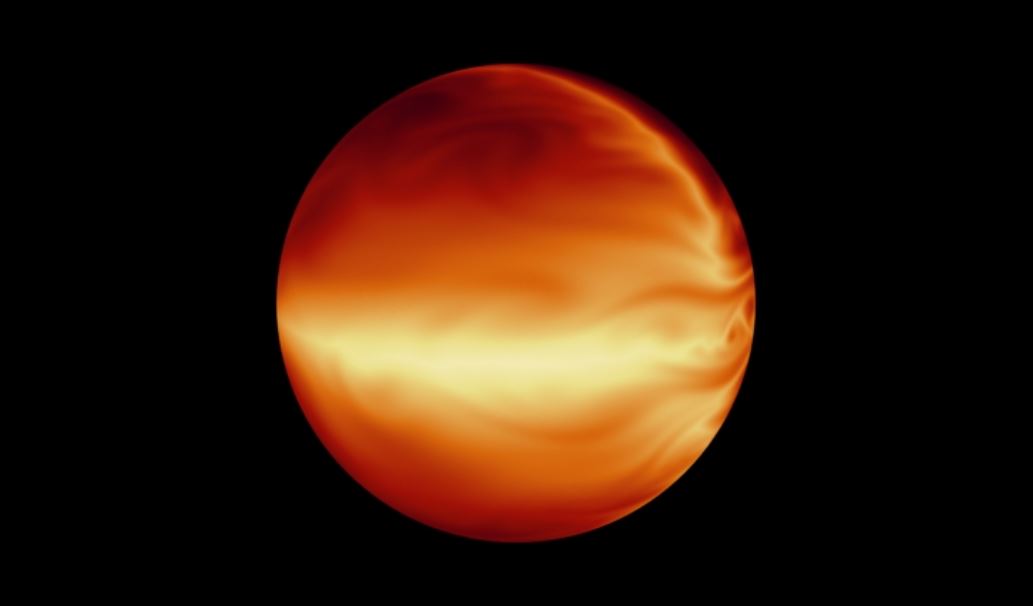
The turbulent atmosphere of a hot, gaseous planet known as HD 80606b is shown in this simulation based on data from NASA’s Spitzer Space Telescope. The planet spends most of its time far away from its star, but every 111 days, it swings extremely close to the star, experiencing a massive burst of heat. NASA/JPL-CalTech

Hot Jupiters — giant gas planets that race around their host stars in extremely tight orbits — have become a little bit less mysterious thanks to a new study combining theoretical modeling with observations by the Hubble Space Telescope.

While previous studies mostly focused on individual worlds classified as “hot Jupiters” due to their superficial similarity to the gas giant in our own solar system, the new study is the first to look at a broader population of the st...

Read More

A ‘Hot Jupiter’ with Unusual Winds

Artist’s concept shows the gaseous exoplanet CoRoT-2b with a westward hot spot in orbit around its host star. Credit: NASA/JPL-Caltech/T. Pyle (IPAC)

Artist’s concept shows the gaseous exoplanet CoRoT-2b with a westward hot spot in orbit around its host star. Credit: NASA/JPL-Caltech/T. Pyle (IPAC)

Puzzling finding raises new questions about atmospheric physics of giant planets. The hottest point on a gaseous planet near a distant star isn’t where astrophysicists expected it to be – a discovery that challenges scientists’ understanding of the many planets of this type found in solar systems outside our own. Unlike our familiar planet Jupiter, hot Jupiters circle astonishingly close to their host star – so close that it typically takes fewer than three days to complete an orbit. And one hemisphere of these planets always faces its host star, while the other faces permanently out into the dark.

Not surprisingly, the “day” side of the pl...

Read More

Newly discovered Twin Planets could solve Puffy Planet mystery

Newly discovered twin planets could solve puffy planet mystery

A Planet Inflated By Its Host Star. Upper left: Schematic of the K2-132 system on the main sequence. Lower left: Schematic of the K2-132 system now. The host star has become redder and larger, irradiating the planet more and thus causing it to expand. Sizes not to scale. Main panel: Gas giant planet K2-132b expands as its host star evolves into a red giant. The energy from the host star is transferred from the planet’s surface to its deep interior, causing turbulence and deep mixing in the planetary atmosphere. The planet orbits its star every 9 days and is located about 2000 light years away from us in the constellation Virgo. Credit: Karen Teramura, UH IfA

Since astronomers first measured the size of an extrasolar planet 17 years ago, they have struggled to answer the question: how did t...

Read More

Cosmic barbecue: Researchers spot 60 new ‘hot Jupiter’ candidates

The diagram above shows a hot Jupiter at various phases of its orbit. The sizes of the star and planet and the separations between them are to scale for a typical hot Jupiter. The amount of reflected starlight that is observed depends on the planet's position within its orbit and the inclination of the orbit with respect to the observer.

The diagram above shows a hot Jupiter at various phases of its orbit. The sizes of the star and planet and the separations between them are to scale for a typical hot Jupiter. The amount of reflected starlight that is observed depends on the planet’s position within its orbit and the inclination of the orbit with respect to the observer.

 
Yale researchers have identified 60 potential new “hot Jupiters” — highly irradiated worlds that glow like coals on a barbecue grill and are found orbiting only 1% of Sun-like stars. Hot Jupiters constitute a class of gas giant planets located so close to their parent stars that they take less than a week to complete an orbit. Second-year Ph.D...
Read More