
how stars form tagged posts

Radio telescopes help scientists map molecules in space and uncover where and how stars form

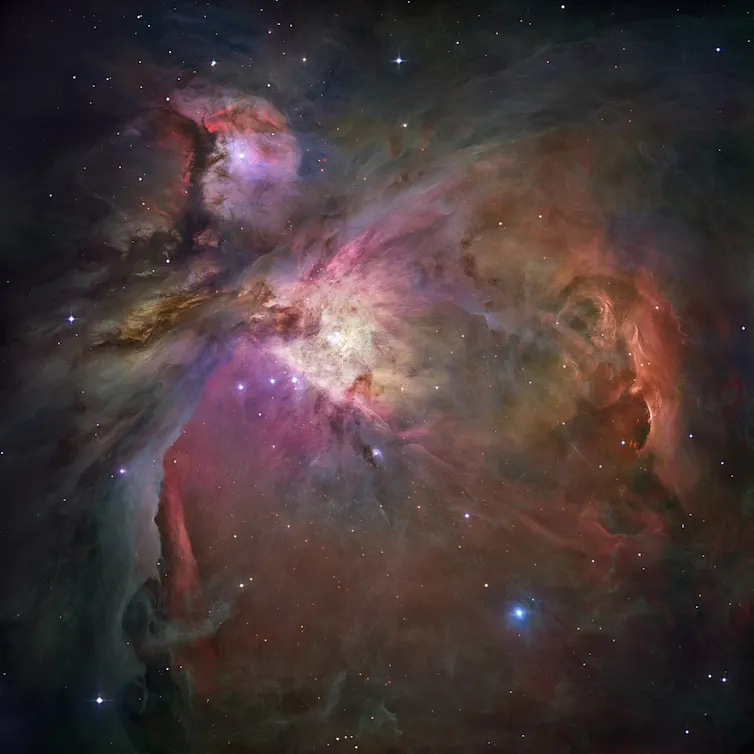
The Orion Nebula with pink and purple gas and brown dust.
The Orion Nebula, captured in visible light by the Hubble Space Telescope. NASA, ESA, M. Robberto (Space Telescope Science Institute/ESA) and the Hubble Space Telescope Orion Treasury Project Team

You may have heard the phrase “we are made of star-stuff.” This statement by the astronomer Carl Sagan refers to the fact that elements heavier than hydrogen and helium were forged in the centers of the first stars. But how does this star-stuff evolve into the chemistry of rocks, plants and people?

As an astrochemist and radio astronomer, I study the places in the universe where stars are born as interstellar laboratories. I’m interested in how simple ingredients come together to form bigger and bigger molecules, including those that are building blocks of life...

Read More
New Galaxy Sheds Light on How Stars Form

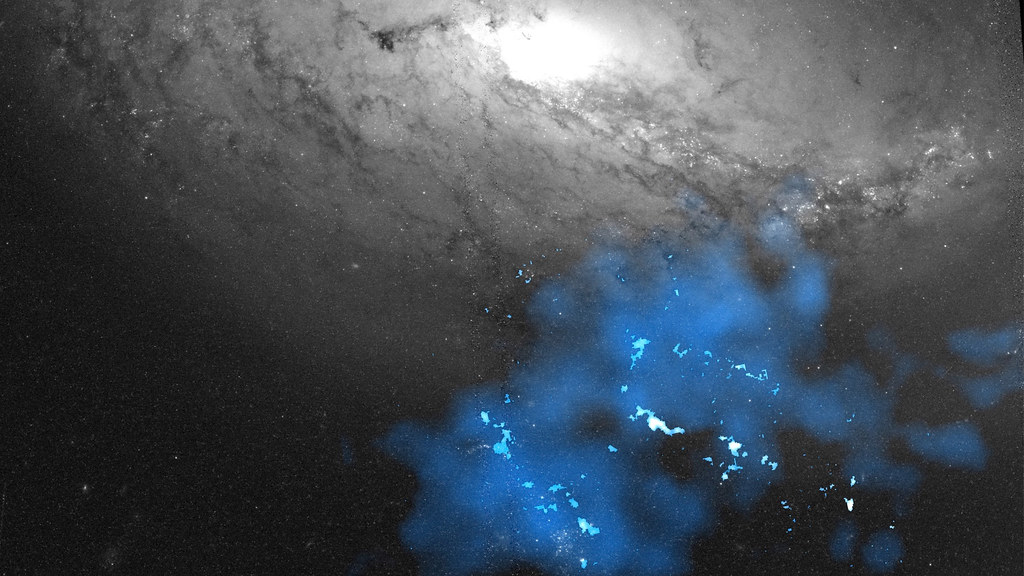
Image of galaxies
A tidal dwarf galaxy (blue) and a spiral galaxy (greyscale). The Milky Way is an example of a spiral galaxy. (Created from images taken by the Hubble Space Telescope and ALMA.)

A lot is known about galaxies. We know, for instance, that the stars within them are shaped from a blend of old star dust and molecules suspended in gas. What remains a mystery, however, is the process that leads to these simple elements being pulled together to form a new star.

But now an international team of scientists, including astrophysicists from the University of Bath in the UK and the National Astronomical Observatory (OAN) in Madrid, Spain have taken a significant step towards understanding how a galaxy’s gaseous content becomes organised into a new generation of stars.

Their findings have import...

Read More

First look at Gravitational Dance that drives Stellar Formation

Left: three color composite image of SDC13 where red, green and blue bands correspond to 70?m HIGAL (Molinari et al. 2010), 24?m Spitzer MIPSGAL (Carey et al. 2009) and 8?m Spitzer GLIMPSE (Churchwell et al. 2009) maps respectively. The four dark, filamentary arms are clearly visible. Right: Brand new, high resolution map of SDC13 tracing the internal dense ammonia gas revealing cores dotted along all the filaments. Credit: G. Williams et al. / University of Cardiff

Left: three color composite image of SDC13 where red, green and blue bands correspond to 70?m HIGAL (Molinari et al. 2010), 24?m Spitzer MIPSGAL (Carey et al. 2009) and 8?m Spitzer GLIMPSE (Churchwell et al. 2009) maps respectively. The four dark, filamentary arms are clearly visible. Right: Brand new, high resolution map of SDC13 tracing the internal dense ammonia gas revealing cores dotted along all the filaments. Credit: G. Williams et al. / University of Cardiff

Swirling motions in clouds of cold, dense gas have given, for the first time, an active insight into how gravity creates the compact cores from which stars form in the interstellar medium...

Read More

A Stellar Circle of Life

The stellar nursery Cygnus X-3.

Cygnus X-3 is an X-ray binary where a compact source is pulling material away from a massive companion star. Chandra’s high-resolution X-ray vision revealed a cloud of gas and dust that is a separated by a very small distance from Cygnus X-3. This gas cloud, dubbed the “Little Friend,” is a Bok globule, the first ever detected in X-rays and the most distant one ever discovered. Astronomers detected jets produced by the “Little Friend”, showing that a star is forming inside it. Credits: X-ray: NASA/CXC/SAO/M.McCollough et al, Radio: ASIAA/SAO/SMA

A snapshot of the stellar life cycle has been captured in a new portrait from NASA’s Chandra X-ray Observatory and the Smithsonian’s Submillimeter Array (SMA)...

Read More