Hubble tagged posts

NASA’s Hubble watches Jupiter’s Great Red Spot Behave Like a Stress Ball

Astronomers have observed Jupiter’s legendary Great Red Spot (GRS), an anticyclone large enough to swallow Earth, for at least 150 years. But there are always new surprises — especially when NASA’s Hubble Space Telescope takes a close-up look at it.

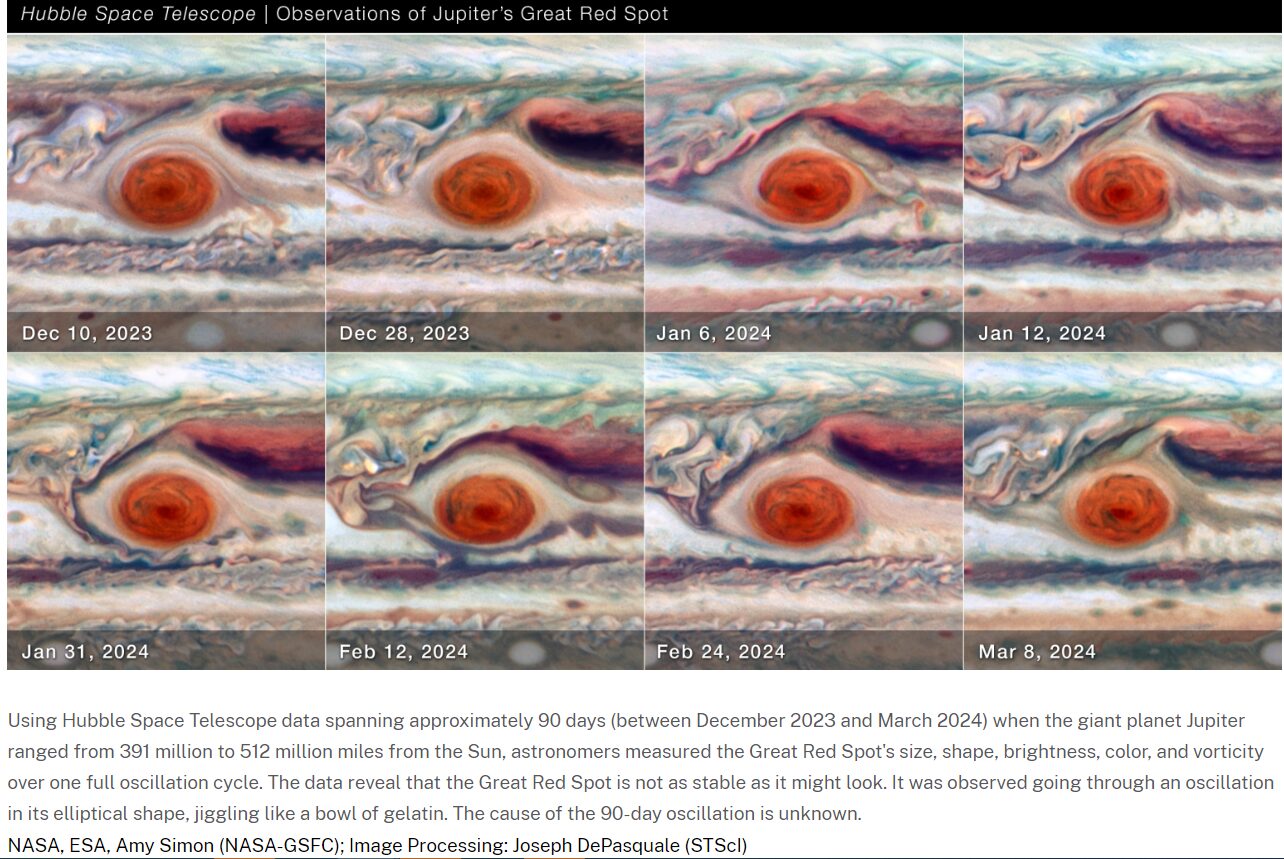
Hubble’s new observations of the famous red storm, collected 90 days between December 2023 to March 2024, reveal that the GRS is not as stable as it might look. The recent data show the GRS jiggling like a bowl of gelatin. The combined Hubble images allowed astronomers to assemble a time-lapse movie of the squiggly behavior of the GRS.

“While we knew its motion varies slightly in its longitude, we didn’t expect to see the size oscillate...

Read More
Hubble Views the Dawn of a Sun-like Star

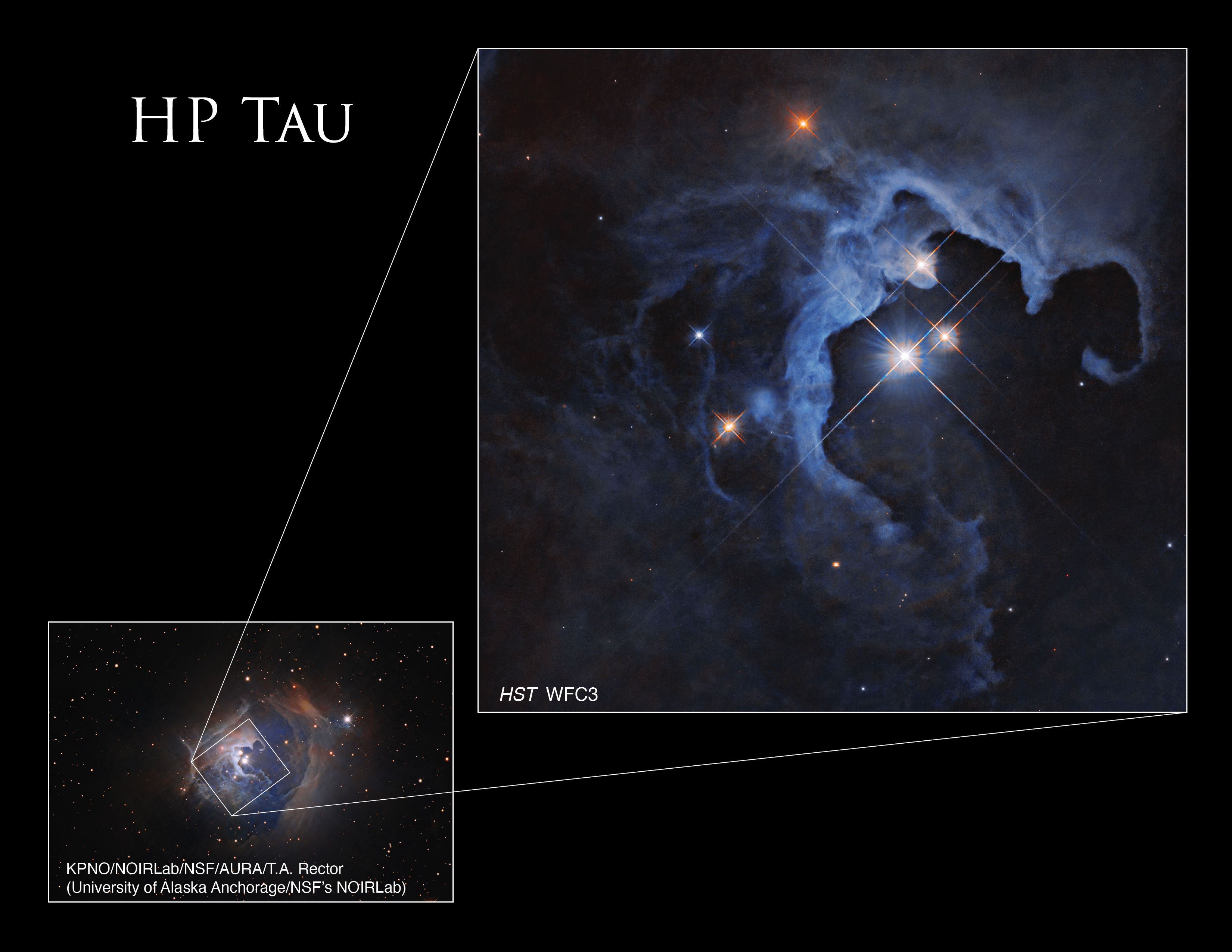
Large image at upper right: Three bright stars with diffraction spikes shine near the center-right of the image, illuminating nearby clouds that glow in pale blue. The clouds darken at the edges of the image, and are dotted with smaller stars, some also with diffraction spikes. Small inset image in the lower-left corner: A colorful nebula or gas cloud. A white square outlines the area of the nebula that Hubble image captures.

Looking like a glittering cosmic geode, a trio of dazzling stars blaze from the hollowed-out cavity of a reflection nebula in this new image from NASA’s Hubble Space Telescope. The triple-star system is made up of the variable star HP Tau, HP Tau G2, and HP Tau G3. HP Tau is known as a T Tauri star, a type of young variable star that hasn’t begun nuclear fusion yet but is beginning to evolve into a hydrogen-fueled star similar to our Sun. T Tauri stars tend to be younger than 10 million years old ― in comparison, our Sun is around 4.6 billion years old ― and are often found still swaddled in the clouds of dust and gas from which they formed.

As with all variable stars, HP Tau’s brightness changes over time.

T Tauri stars are known to have both periodic and random fluctuation...

Read More

Hubble Sights a Galaxy with ‘Forbidden’ Light

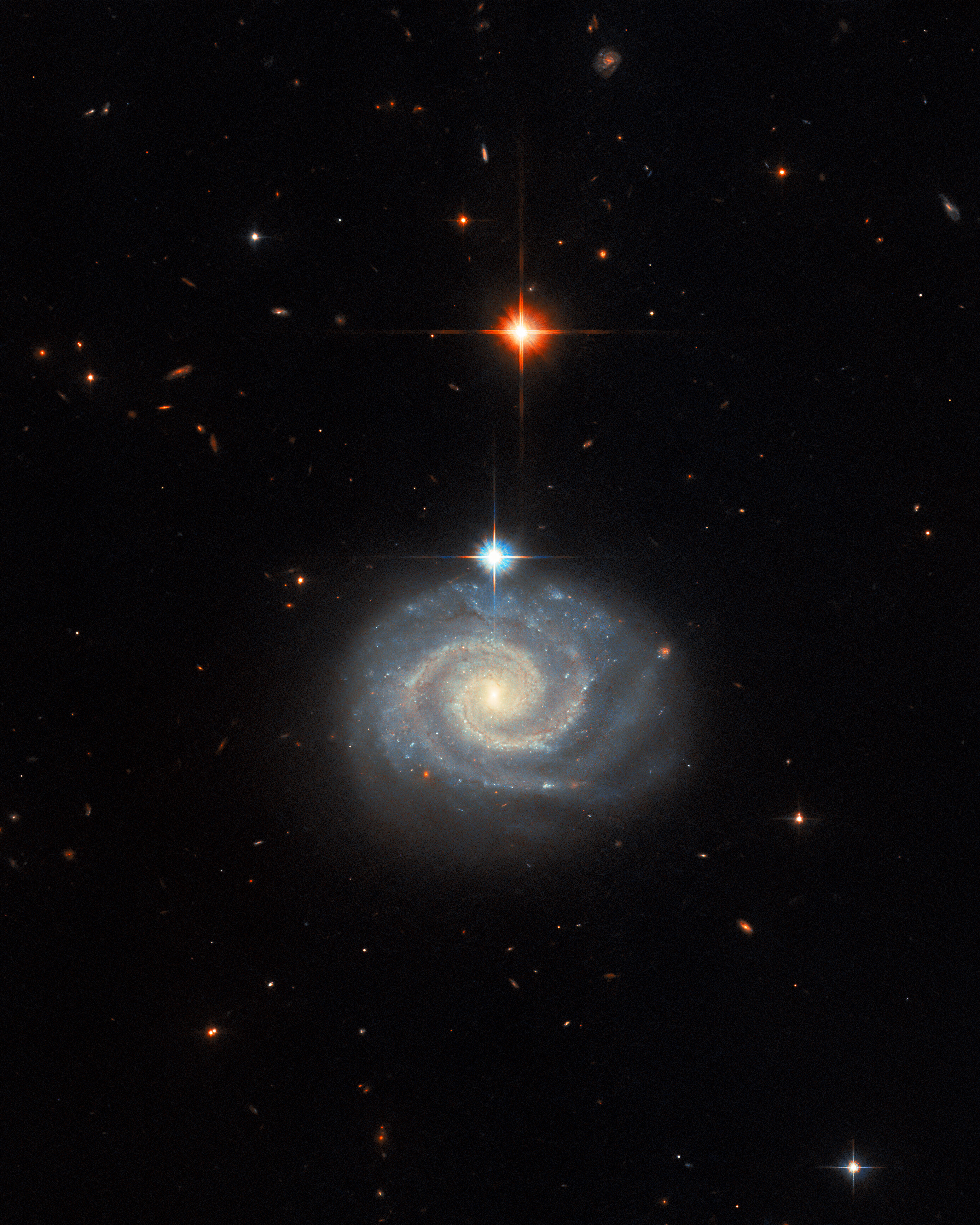
A spiral galaxy. It appears to be almost circular and seen face-on, with two prominent spiral arms winding out from a glowing core. It is centered in the frame as if a portrait. Most of the background is black, with only tiny, distant galaxies, but there are two large bright stars in the foreground, one blue and one red, directly above the galaxy.
This NASA Hubble Space Telescope image features a bright spiral galaxy known as MCG-01-24-014, which is located about 275 million light-years from Earth.
ESA/Hubble & NASA, C. Kilpatrick

This whirling image features a bright spiral galaxy known as MCG-01-24-014, which is located about 275 million light-years from Earth. In addition to being a well-defined spiral galaxy, MCG-01-24-014 has an extremely energetic core known as an active galactic nucleus (AGN) and is categorized as a Type-2 Seyfert galaxy.

Seyfert galaxies, along with quasars, host one of the most common subclasses of AGN...

Read More

Unexpected Chemistry reveals Cosmic Star Factories´ Secrets

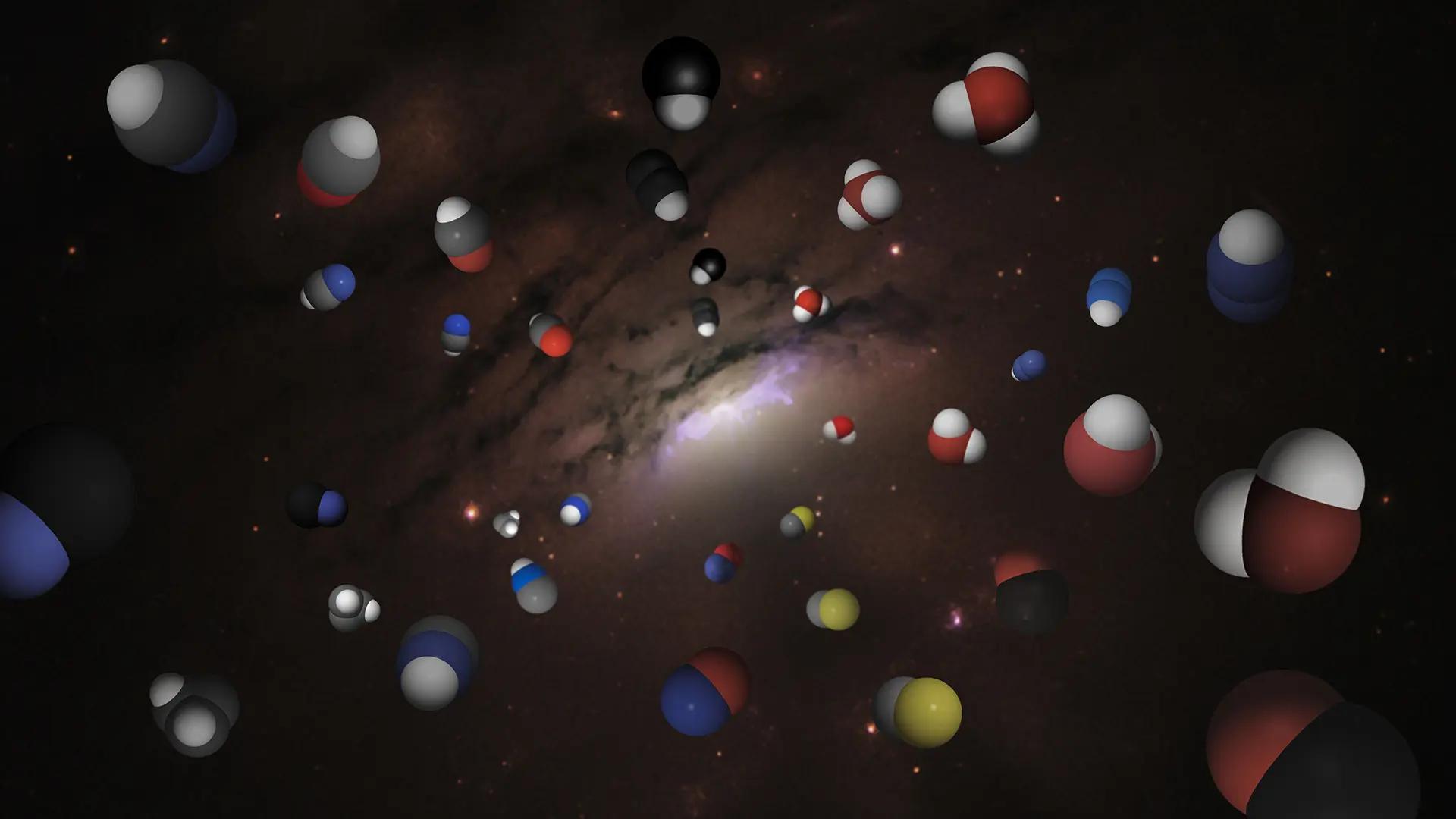
Galaxy illustration with molecules
Light from many different molecules reveals the secrets of distant star factories. This illustration shows the many molecules found in the quasar APM 08279+5255, together with a Hubble telescope image of a similar galaxy in the nearby universe, IC 5063, which also has an active supermassive black hole at its centre. Background image credits: NASA, ESA & W. P. Maksym (CfA); Jmol (molecules); R. Cumming (montage)Photographer: NASA, ESA & W. P. Maksym (CfA); Jmol (molecules); R. Cumming (montage)

Two galaxies in the early universe, which contain extremely productive star factories, have been studied by a team of scientists led by Chalmers University of Technology in Sweden...

Read More