Hubble tagged posts

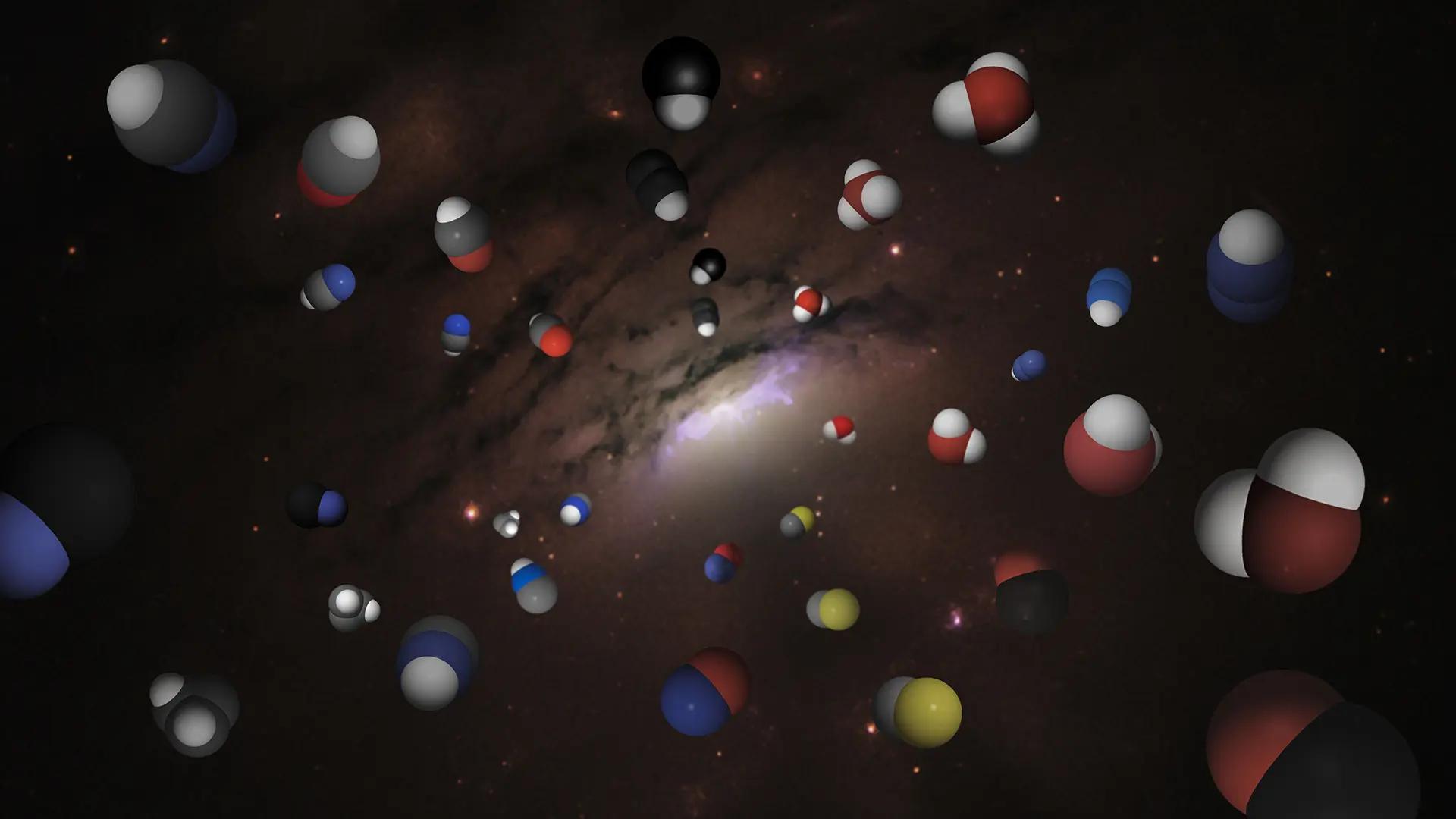
Unexpected Chemistry reveals Cosmic Star Factories´ Secrets

Galaxy illustration with molecules
Light from many different molecules reveals the secrets of distant star factories. This illustration shows the many molecules found in the quasar APM 08279+5255, together with a Hubble telescope image of a similar galaxy in the nearby universe, IC 5063, which also has an active supermassive black hole at its centre. Background image credits: NASA, ESA & W. P. Maksym (CfA); Jmol (molecules); R. Cumming (montage)Photographer: NASA, ESA & W. P. Maksym (CfA); Jmol (molecules); R. Cumming (montage)

Two galaxies in the early universe, which contain extremely productive star factories, have been studied by a team of scientists led by Chalmers University of Technology in Sweden...

Read More

Astronomers watched a Massive Star Disappear. JWST might have some answers

Illustration of how a failed supernova can become a black hole. Credit: NASA/ESA/P. Jeffries (STScI)

In 2009 a giant star 25 times more massive than the sun simply vanished. OK, it wasn’t quite that simple. It underwent a period of brightening, increasing in luminosity to a million suns, just as if it was ready to explode into a supernova. But then it faded rather than exploding. And when astronomers tried to see the star using the Large Binocular Telescope (LBT), Hubble and the Spitzer space telescope, they couldn’t see anything.

The star, known as N6946-BH1, is now considered a failed supernova. The BH1 in its name is due to the fact that astronomers think the star collapsed to become a black hole rather than triggering a supernova. But that has been conjecture...

Read More

Hubble sees Evaporating Planet getting the Hiccups

This artist’s illustration shows a planet (dark silhouette) passing in front of the red dwarf star AU Microscopii. The planet is so close to the eruptive star a ferocious blast of stellar wind and blistering ultraviolet radiation is heating the planet’s hydrogen atmosphere, causing it to escape into space. Four times Earth’s diameter, the planet is slowly evaporating its atmosphere, which stretches out linearly along its orbital path. This process may eventually leave behind a rocky core. The illustration is based on measurements made by the Hubble Space Telescope.
Credits: NASA, ESA, and Joseph Olmsted (STScI)

A young planet whirling around a petulant red dwarf star is changing in unpredictable ways orbit-by-orbit...

Read More

Hubble unexpectedly finds Double Quasar in Distant Universe

Artist concept: Two merging galaxies have a light blue glow overlaid by brownish-gold clouds set against a black, deep-space field. Two quasars are closely spaced, white objects at the merger's center: one above and to the right of the other.
This artist’s concept shows the brilliant glare of two quasars residing in the cores of two galaxies that are in the chaotic process of merging. The gravitational tug-of-war between the two galaxies ignites a firestorm of star birth. Quasars are brilliant beacons of intense light from the centers of distant galaxies. They are powered by supermassive black holes voraciously feeding on infalling matter. This feeding frenzy unleashes a torrent of radiation that can outshine the collective light of billions of stars in the host galaxy. In a few tens of millions of years, the black holes and their galaxies will merge, and so will the quasar pair, forming an even more massive black hole.
Credits: NASA, ESA, Joseph Olmsted (STScI)

The early universe was a rambunctious place where galaxies ofte...

Read More