NASA’s Hubble Space Telescope captured this image of Saturn on July 4, 2020. Two of Saturn’s icy moons are clearly visible in this exposure: Mimas at right, and Enceladus at bottom. This image is taken as part of the Outer Planets Atmospheres Legacy (OPAL) project. OPAL is helping scientists understand the atmospheric dynamics and evolution of our solar system’s gas giant planets. In Saturn’s case, astronomers continue tracking shifting weather patterns and storms. Credits: NASA, ESA, A. Simon (Goddard Space Flight Center), M.H. Wong (University of California, Berkeley), and the OPAL Team
Saturn is truly the lord of the rings in this latest snapshot from NASA’s Hubble Space Telescope, taken on July 4, 2020, when the opulent giant world was 839 million miles from Earth...
1) The “wings” of NGC 6302 are regions of gas heated to more than 36,000 degrees Fahrenheit that are tearing across space at more than 600,000 miles an hour. NGC 6302 lies between 2,500 and 3,800 light-years away in the constellation Scorpius. 2) Recently, NGC 7027’s central star was identified in a new wavelength of light — near-ultraviolet — for the first time by using Hubble’s unique capabilities Credits: NASA, ESA and J. Kastner (RIT)
As nuclear fusion engines, most stars live placid lives for hundreds of millions to billions of years. But near the end of their lives they can turn into crazy whirligigs, puffing off shells and jets of hot gas...
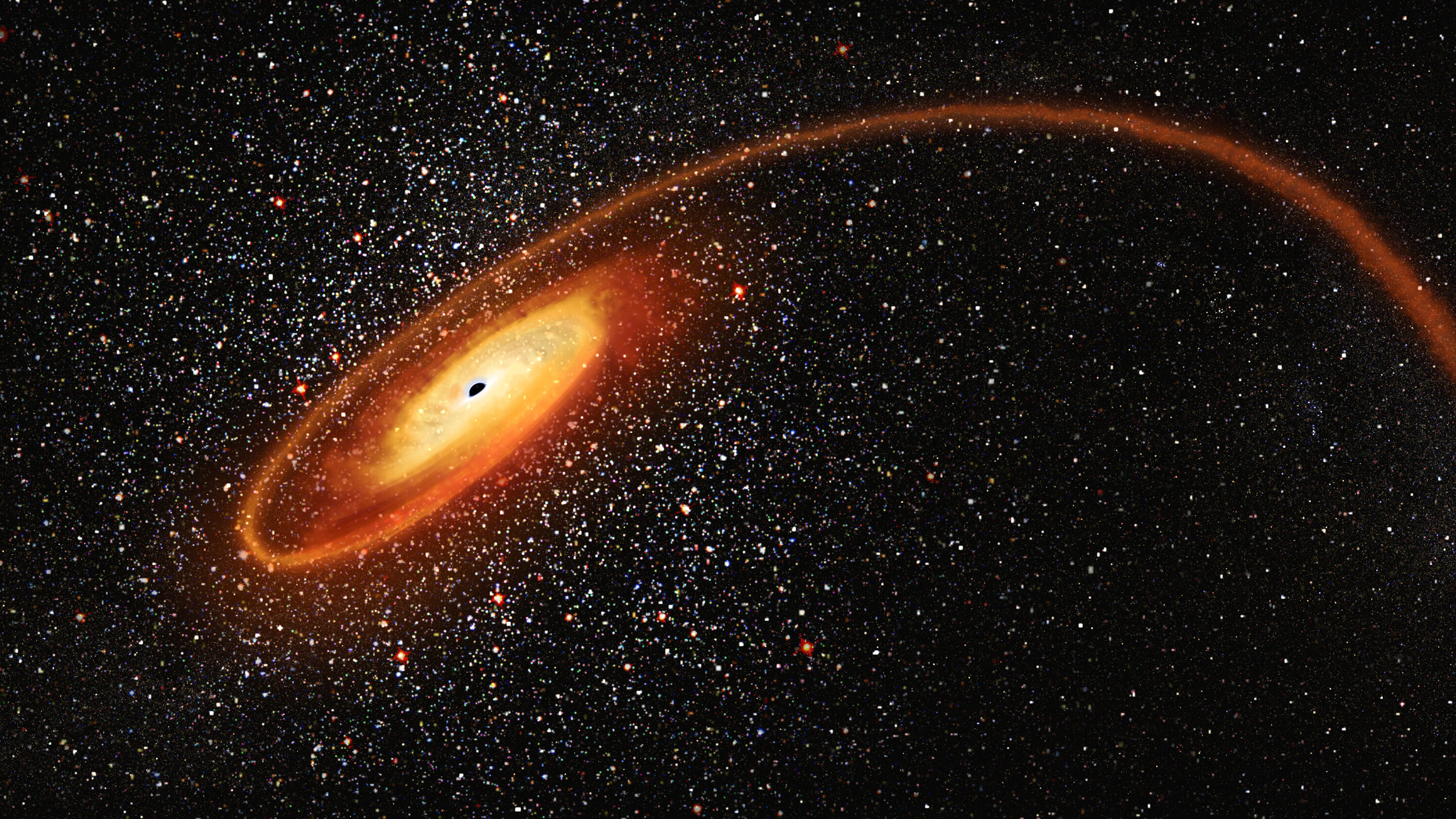
This illustration depicts a cosmic homicide in action. A wayward star is being shredded by the intense gravitational pull of a black hole that contains tens of thousands of solar masses. The stellar remains are forming an accretion disk around the black hole. Flares of X-ray light from the super-heated gas disk alerted astronomers to the black hole’s location; otherwise it lurked unknown in the dark. The elusive object is classified as an intermediate mass black hole (IMBH), as it is much less massive than the monster black holes that dwell in the centers of galaxies. Therefore, IMBHs are mostly quiescent because they do not pull in as much material, and are hard to find. Hubble observations provide evidence that the IMBH dwells inside a dense star cluster...Read More
A Hubble Space Telescope image of the spiral galaxy NGC 3147 appears next to an artist’s illustration of the supermassive black hole residing at the galaxy’s core. The Hubble image shows off the galaxy’s sweeping spiral arms, full of young blue stars, pinkish nebulas, and dust in silhouette. However, at the brilliant core of NGC 3147 lurks a monster black hole, weighing about 250 million times the mass of our Sun. Hubble observations of the black hole demonstrate two of Einstein’s theories of relativity. The reddish-yellow features swirling around the center are the glow of light from gas trapped by the hefty black hole’s powerful gravity. The black hole is embedded deep within its gravitational field, shown by the green grid that illustrates warped space...Read More






Recent Comments