

IoT tagged posts

A Universal System for Decoding any Type of Data sent across a Network

chip using novel GRAND algorithm graphic
Caption: A new silicon chip can decode any error-correcting code through the use of a novel algorithm known as Guessing Random Additive Noise Decoding (GRAND).
Credits:Image: Jose-Luis Olivares, MIT, with chip courtesy of the researchers

New chip eliminates the need for specific decoding hardware, could boost efficiency of gaming systems, 5G networks, IoT, and more. Every piece of data that travels over the internet — from paragraphs in an email to 3D graphics in a virtual reality environment — can be altered by the noise it encounters along the way, such as electromagnetic interference from a microwave or Bluetooth device. The data are coded so that when they arrive at their destination, a decoding algorithm can undo the negative effects of that noise and retrieve the original data...

Read More

System brings Deep Learning to ‘IoT’ devices

Iot devices
MIT researchers have developed a system, called MCUNet, that brings machine learning to microcontrollers. The advance could enhance the function and security of devices connected to the Internet of Things (IoT).

Advance could enable AI on household appliances while enhancing data security and energy efficiency. A new system brings machine learning to microcontrollers. The advance could enhance the function and security of devices connected to the Internet of Things (IoT).

Deep learning is everywhere. This branch of artificial intelligence curates your social media and serves your Google search results. Soon, deep learning could also check your vitals or set your thermostat...

Read More

Gearing up for 5G: A Miniature, Low-Cost Transceiver for Fast, Reliable Communications

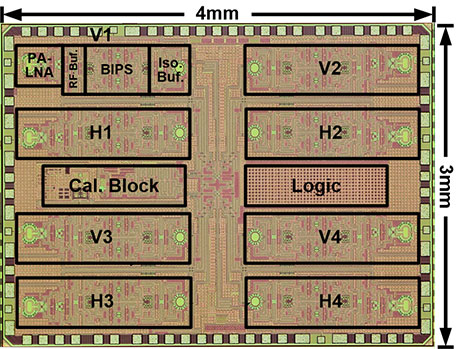
Image of the new transceiver designed for 5G

Image of the new transceiver designed for 5G
The transceiver consists of a total of four horizontal (H1–4) and four vertical (V1–4) array orientations.

Researchers at Tokyo Institute of Technology (Tokyo Tech) have designed a 28 GHz transceiver that integrates beamforming with dual-polarized multiple-input and multiple-output, MIMO technology. Measuring just 3 mm by 4 mm, this tiny transceiver could help improve performances of fifth-generation cellular network (5G) and Internet of Things (IoT) devices.

A team of researchers led by Kenichi Okada at Tokyo Tech’s Department of Electrical and Electronic Engineering has devised a strategy with a clear eye on supporting high-speed mobile data access using the millimeter-wave spectrum for 5G, the highly-anticipated wireless network o...

Read More

Flexible Thermoelectric Generator Module: A silver bullet to fix waste energy issues


Photo and schematic design of the FlexTEG module, photo of Bismuth-telluride (Bi-Te) semiconductor chips, and voltage and power as a function of the current for the FlexTEG module at different temperature gradients.
Credit: Osaka University

A team of researchers led by Osaka University developed an inexpensive large-scale flexible thermoelectric generator (FlexTEG) module with high mechanical reliability for highly efficient power generation. Through a change in direction of the top electrodes at the two sides of the module and the use of high density packaging of semiconductor chips, the FlexTEG module has more flexibility in any uniaxial direction...

Read More