ISS tagged posts

Wristwatch-like device enables assessment of health risks for astronauts on mission to the moon

Brazilian technology helps NASA assess health risks for astronauts on mission to the moon
Called an actigraph, the device resembles a wristwatch and uses accelerometers, as well as light and temperature sensors, to precisely map the user’s sleep and wake patterns. Credit: NASA

Just a few hours before the Orion spacecraft crossed the sky en route to the moon on April 1, mechatronics engineer Rodrigo Trevisan Okamoto received confirmation he had been waiting for since the Artemis 2 mission was announced in 2023. The email from NASA stated that the crew of the first crewed mission to orbit the moon in half a century would carry a device developed by Okamoto and his team at Condor Instruments, a São Paulo-based startup.

“The NASA announcement was sudden and caught us by surprise...

Read More

Space mice come home and start families

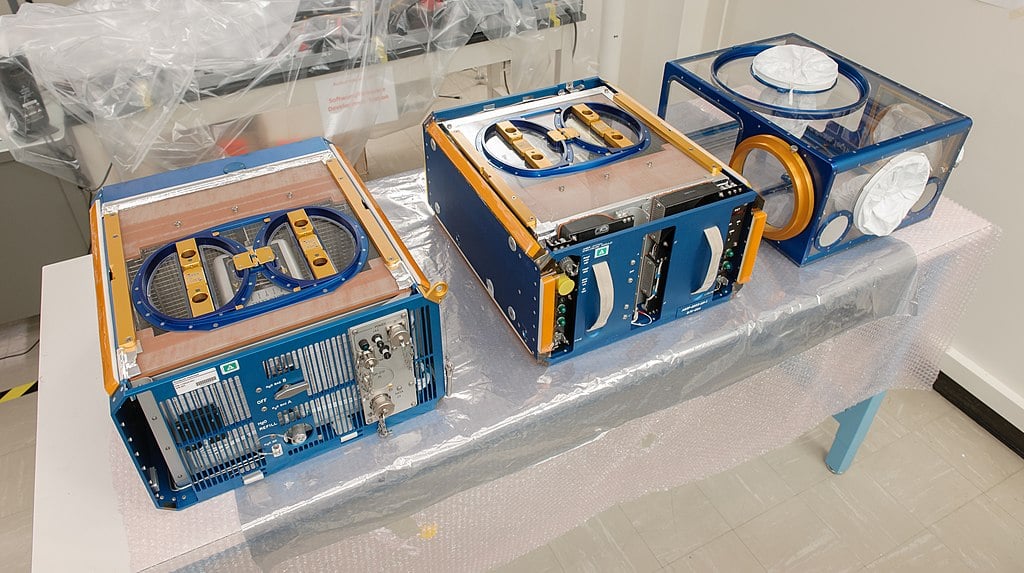
The rodent research facility for the International Space Station (Credit : NASA/Ames Research Center/Dominic Hart)

Four mice went to space as astronauts. One came back and became a mother. And that simple fact might matter more than you’d think for humanity’s future beyond Earth.

On 31 October, China launched four mice numbered 6, 98, 154, and 186, aboard the Shenzhou-21 spacecraft to the country’s space station, roughly 400 kilometers above Earth. For two weeks, the rodents lived in microgravity, exposed to space radiation and the peculiar conditions of orbital life. They returned safely on 14 November. Then, on 10 December, one of the females gave birth to nine healthy pups.

In a previous study, sperm from mice that had been in space had been used to fertilize female mice back ...

Read More

Astrobee learns to transport soft cargo: Open-source simulator models real ISS challenges

Astrobee is a free-flying robotic system developed by NASA that is made up of three distinct cube-shaped robots. This system was originally designed to help astronauts who are working at the International Space Station (ISS) by automating some of their routine manual tasks.

While Astrobee could be highly valuable for astronauts, boosting the efficiency with which they complete day-to-day operations, its object manipulation capabilities are not yet optimal. Specifically, past experiments suggest that the robot struggles when handling deformable items, including cargo bags that resemble some of those that it might be tasked to pick up on the ISS.

Researchers at Stanford University, University of Cambridge and NASA Ames recently developed Pyastrobee, a simulation environment and co...

Read More

Space: A New Frontier for Exploring Stem Cell Therapy

Stem cells grown in microgravity aboard the International Space Station (ISS) have unique qualities that could one day help accelerate new biotherapies and heal complex disease, two Mayo Clinic researchers say. The research analysis by Fay Abdul Ghani and Abba Zubair, M.D., Ph.D., published in NPJ Microgravity, finds microgravity can strengthen the regenerative potential of cells. Dr. Zubair is a laboratory medicine expert and medical director for the Center for Regenerative Biotherapeutics at Mayo Clinic in Florida. Abdul Ghani is a Mayo Clinic research technologist. Microgravity is weightlessness or near-zero gravity.

“Studying stem cells in space has uncovered cell mechanisms that would otherwise be undetected or unknown within the presence of normal gravity,” says Dr. Zubair...

Read More