Temperate exoplanet LHS 1140 b may be a world completely covered in ice (left) similar to Jupiter’s moon Europa or be an ice world with a liquid substellar ocean and a cloudy atmosphere (centre). LHS 1140 b is 1.7 times the size of our planet Earth (right) and is the most promising habitable zone exoplanet yet in our search for liquid water beyond the Solar System. Image credit: B. Gougeon/Université de Montréal
A team of astronomers has identified a temperate exoplanet as a promising super-Earth ice or water world.
The findings, led by Université de Montréal, show that the habitable zone exoplanet, LHS 1140 b, is not likely a mini-Neptune, a small so-called gas giant—large planets composed mostly of gas—with a thick hydrogen-rich atmosphere...
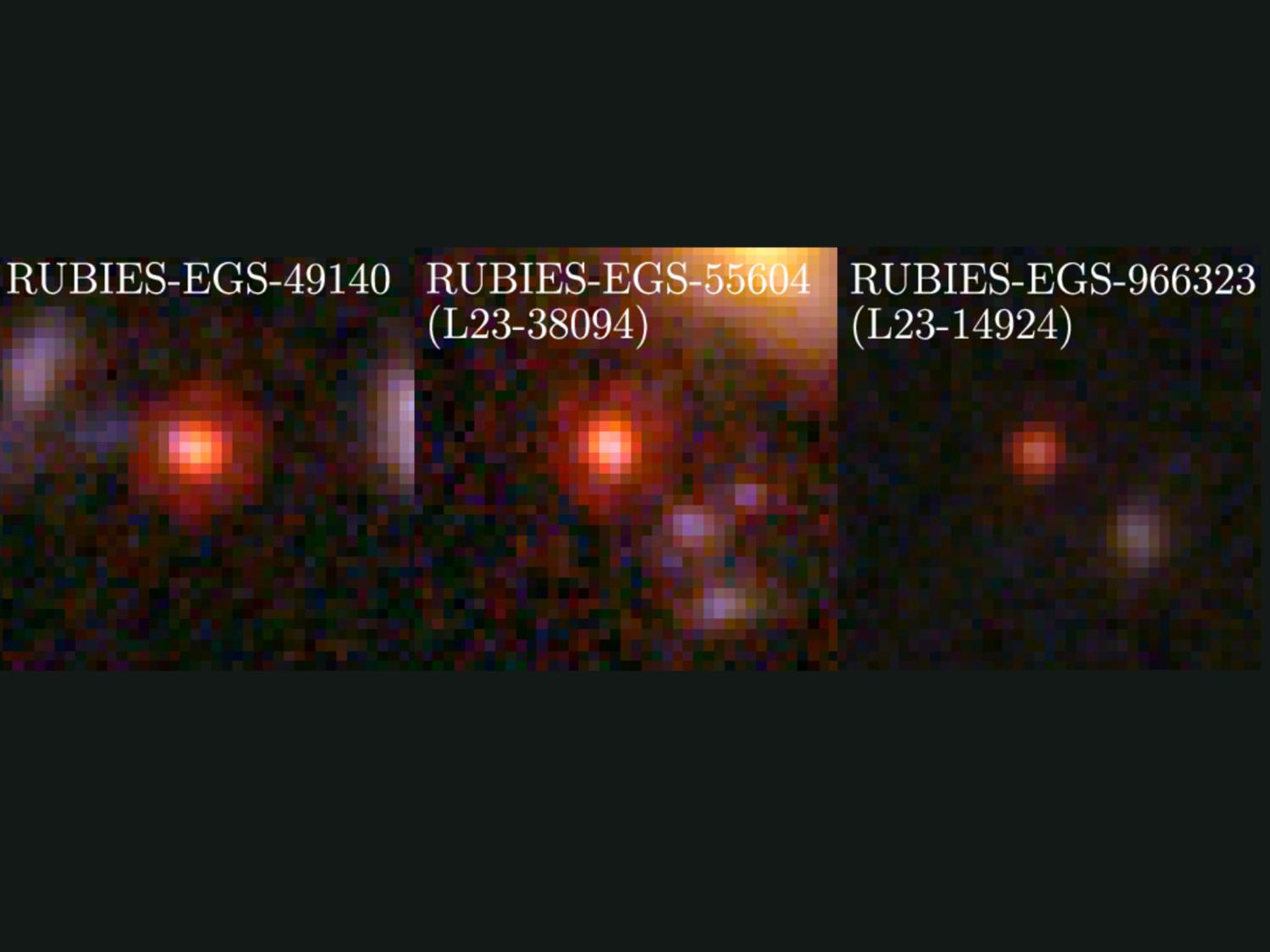
Researchers investigated three mysterious objects in the early universe. Shown here are their color images, composited from three NIRCam filter bands onboard the James Webb Space Telescope. They are remarkably compact at red wavelengths (earning them the term “little red dots”) with some evidence for spatial structure at blue wavelengths. Credit: Provided by researchers / Penn State. All Rights Reserved.
A recent discovery by NASA’s James Webb Space Telescope (JWST) confirmed that luminous, very red objects previously detected in the early universe upend conventional thinking about the origins and evolution of galaxies and their supermassive black holes.
An international team, led by Penn State researchers, using the NIRSpec instrument aboard JWST as part of the RUBIES survey...
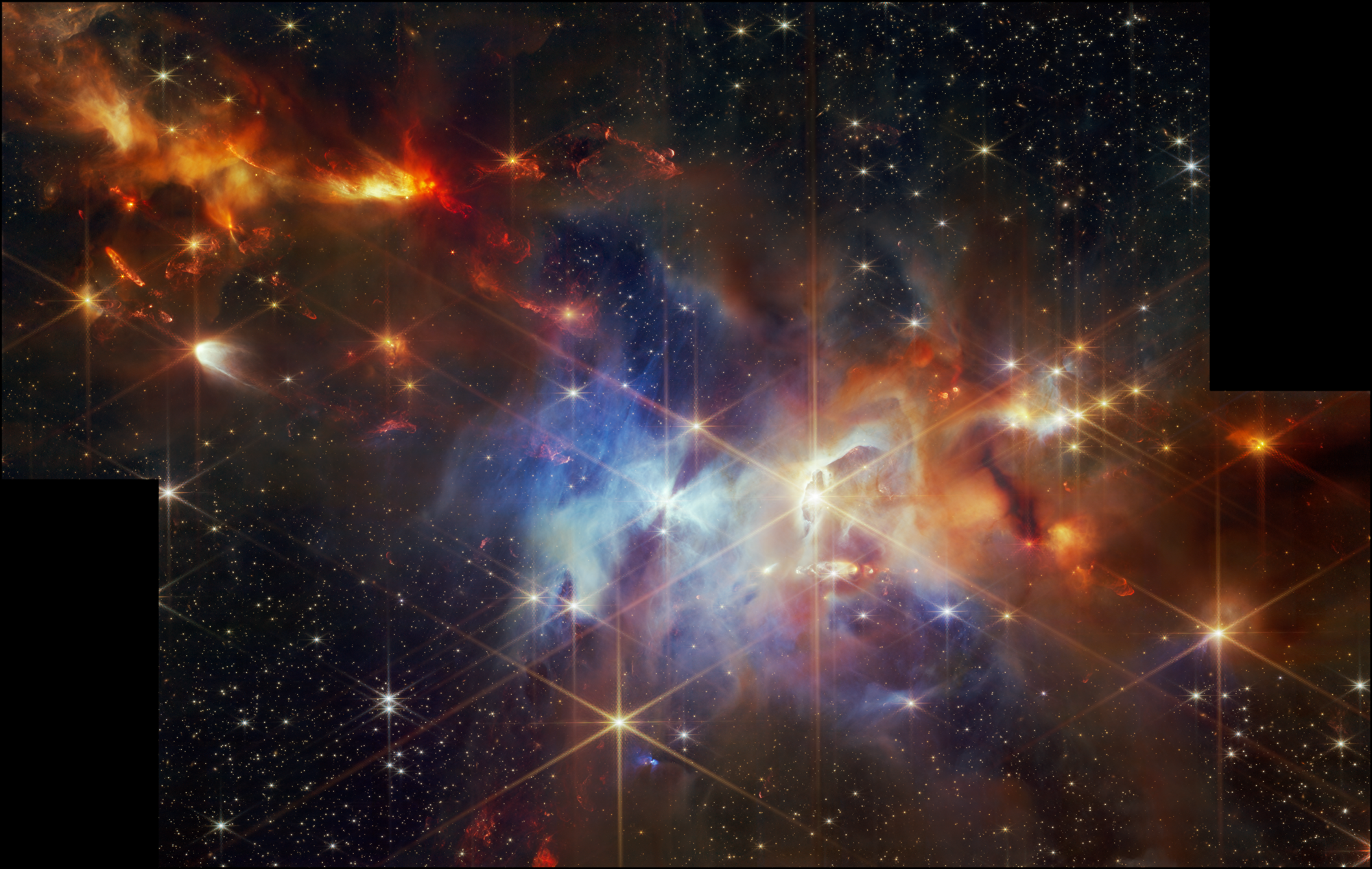
In this image of the Serpens Nebula from NASA’s James Webb Space Telescope, astronomers found a grouping of aligned protostellar outflows within one small region (the top left corner). Serpens is a reflection nebula, which means it’s a cloud of gas and dust that does not create its own light, but instead shines by reflecting the light from stars close to or within the nebula. NASA, ESA, CSA, K. Pontoppidan (NASA’s Jet Propulsion Laboratory) and J. Green (Space Telescope Science Institute).
For the first time, a phenomenon astronomers have long hoped to directly image has been captured by NASA’s James Webb Space Telescope’s Near-Infrared Camera (NIRCam)...
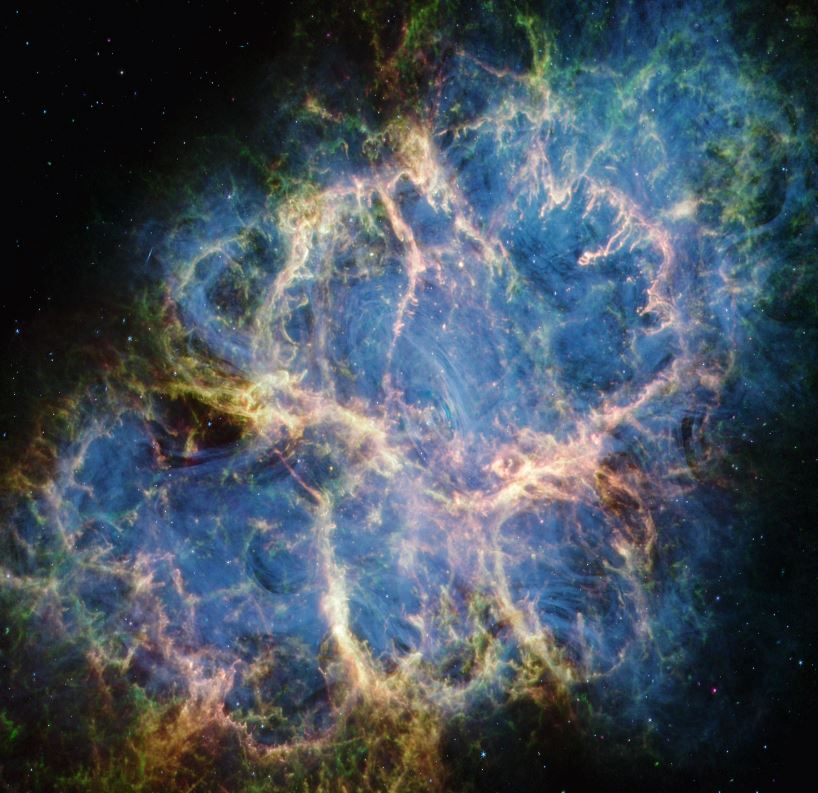
This image by NASA’s James Webb Space Telescope’s NIRCam (Near-Infrared Camera) and MIRI (Mid-Infrared Instrument) shows different structural details of the Crab Nebula. The supernova remnant is comprised of several different components, including doubly ionized sulfur (represented in green), warm dust (magenta), and synchrotron emission (blue). Yellow-white mottled filaments within the Crab’s interior represent areas where dust and doubly ionized sulfur coincide. The observations were taken as part of General Observer program 1714. : NASA, ESA, CSA, STScI, T. Temim (Princeton University)
A team of scientists used NASA’s James Webb Space Telescope to parse the composition of the Crab Nebula, a supernova remnant located 6,500 light-years away in the constellation Taurus...





Recent Comments