JWST tagged posts

James Webb Space Telescope Captures Stunning Images of the Ring Nebula

Ring Nebula

NASA’s James Webb Space Telescope (JWST) has recorded breath-taking new images of the iconic Ring Nebula, also known as Messier 57.

The images, released today by an international team of astronomers led by Professor Mike Barlow (UCL, UK) and Dr Nick Cox (ACRI-ST, France), with Professor Albert Zijlstra of The University of Manchester, showcase the nebula’s intricate and ethereal beauty in unprecedented detail, providing scientists and the public with a mesmerizing view of this celestial wonder.

For many sky enthusiasts, the Ring Nebula is a well-known object that is visible all summer long and is located in the constellation Lyra.

A small telescope will already reveal the characteristic donut-like structure of glowing gas that gave the Ring Nebula its name.

The Ring Nebula...

Read More

Webb Telescope Detects most Distant Active Supermassive Black Hole

CEERS-NIRCam-crop2400x1600
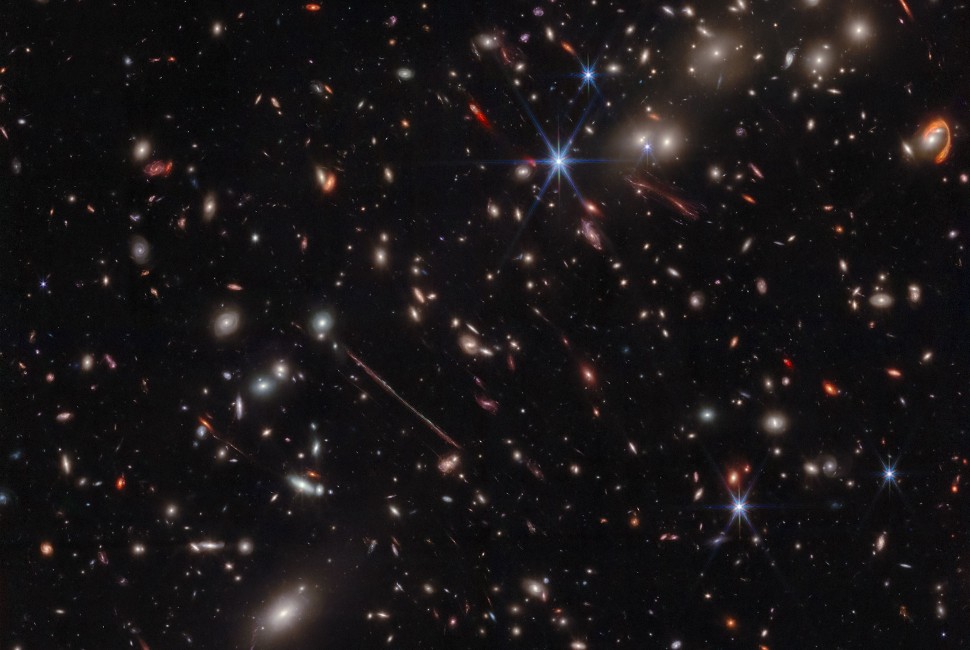
A zoomed-in view of images captured by the James Webb Space Telescope in near-infrared light for the Cosmic Evolution Early Release Science (CEERS) Survey. Image credit: NASA, ESA, CSA, Steve Finkelstein (UT Austin), Micaela Bagley (UT Austin), Rebecca Larson (UT Austin).

Researchers have discovered the most distant active supermassive black hole to date with the James Webb Space Telescope (JWST). The galaxy, CEERS 1019, existed about 570 million years after the big bang, and its black hole is less massive than any other yet identified in the early universe.

In addition to the black hole in CEERS 1019, the researchers identified two more black holes that are on the smaller side and existed 1 billion and 1.1 billion years after the big bang...

Read More

MIRI instrument on JWST detects H-alpha emission during the Epoch of Reionization for the first time

MIRI instrument on JWST detects H-alpha emission during the Epoch of Reionization for the first time

An international team of astronomers led by Pierluigi Rinaldi of the University of Groningen has detected for the first time H-alpha emission in individual galaxies during the so-called Epoch of Reionization, or cosmic dawn. To do so, they used the deepest images taken so far by the MIRI instrument on the James Webb Space Telescope. The result has been accepted for publication in The Astrophysical Journal, and is currently published on the arXiv preprint server.

Star-forming galaxies produce a large amount of UV photons, but during the Epoch of Reionization these photons are absorbed by the intergalactic medium. The best tracer to measure the level of star formation is the H-alpha emission line in the optical spectrum...

Read More

Webb Space Telescope Detects Universe’s Most Distant Complex Organic Molecules

Astronomers using the Webb telescope discovered evidence of complex organic molecules in a galaxy more than 12 billion light-years away. The galaxy lines up almost perfectly with a second galaxy only 3 billion light-years away from our perspective on Earth. In this false-color Webb image, the foreground galaxy is shown in blue, while the background galaxy is red. The organic molecules are highlighted in orange.
Graphic courtesy J. Spilker / S. Doyle, NASA, ESA, CSA

Researchers have detected complex organic molecules in a galaxy more than 12 billion light-years away from Earth — the most distant galaxy in which these molecules are now known to exist...

Read More