
JWST tagged posts

Signs of alien life may be hiding in these gases

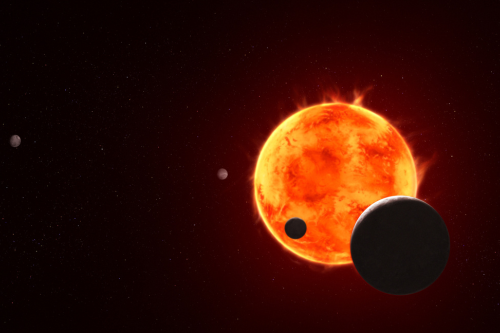
Hycean planet illustration
Artist’s illustration of a Hycean world, where methyl halide gases would be detectable in the atmosphere. (Pablo Carlos Budassi)

-Advancing the search for weird life on weird planets

Scientists have identified a promising new way to detect life on faraway planets, hinging on worlds that look nothing like Earth and gases rarely considered in the search for extraterrestrials.

In a new Astrophysical Journal Letters paper, researchers from the University of California, Riverside, describe these gases, which could be detected in the atmospheres of exoplanets – planets outside our solar system – with the James Webb Space Telescope, or JWST.

Called methyl halides, the gases comprise a methyl group, which bears a carbon and three hydrogen atoms, attached to a halogen atom such as chlo...

Read More

Phoenix galaxy cluster caught in the act of extreme cooling

Study reveals the Phoenix galaxy cluster in the act of extreme cooling
The core of the Phoenix cluster is shown across the whole electromagnetic spectrum. The bright purples represent X-rays produced by the hot gas, and the dashed purple outlines show regions where this hot gas has been pushed away by the radio jets from the supermassive black hole. The radio jets themselves are shown in red colors. The blues and yellows represent visible light emitted by cool gas and stars. The green contours show the “warm” gas that is in the process of cooling, newly measured in the MIT study with JWST. Credit: NASA

The core of a massive cluster of galaxies appears to be pumping out far more stars than it should. Now researchers at MIT and elsewhere have discovered a key ingredient within the cluster that explains the core’s prolific starburst.

In a new study publis...

Read More

First-ever Detection of a Mid-Infrared Flare in SagittariusA*, the Milky Way’s supermassive black hole

Using the MIRI instrument onboard the James Webb Space Telescope, an international team of scientists made the first-ever detection of a mid-IR flare from Sagittarius A*, the supermassive blackhole at the heart of the Milky Way. In simultaneous radio observations, the team found a radio counterpart of the flare lagging behind in time. The paper is published on the arXiv preprint server.

Scientists have been actively observing Sagittarius A* (Sgr A)—a supermassive black hole roughly 4 million times the mass of the sun— since the early 1990s. Sgr A regularly exhibits flares that can be observed in multiple wavelengths, allowing scientists to see different views of the same flare and better understand how it emits light and how the emission is generated...

Read More

Astronomers discover an Ultra-Massive Grand-Design Spiral Galaxy

Astronomers discover an ultra-massive grand-design spiral galaxy
The morphology and photometric redshift of Zhúlóng. Credit: Xiao et al., 2024.

Using the James Webb Space Telescope (JWST), an international team of astronomers has detected a new grand-design spiral galaxy as part of the PANORAMIC survey. The newfound galaxy, named Zhúlóng, is extremely massive and appears to be the most distant spiral galaxy identified so far. The finding was detailed in a paper published December 17 on the pre-print server arXiv.

Grand-design spiral galaxies are characterized by their prominent, well-defined arms, which circle outwards from a clear core. It is assumed that the arms in such galaxies are actually overdense regions of the disk which trigger star formation as incoming material is compressed in that region.

It is still not well understood when ...

Read More