
lambda cold dark matter model tagged posts

Astronomers catch massive galaxy assembling piece by piece 1.2 billion years after Big Bang

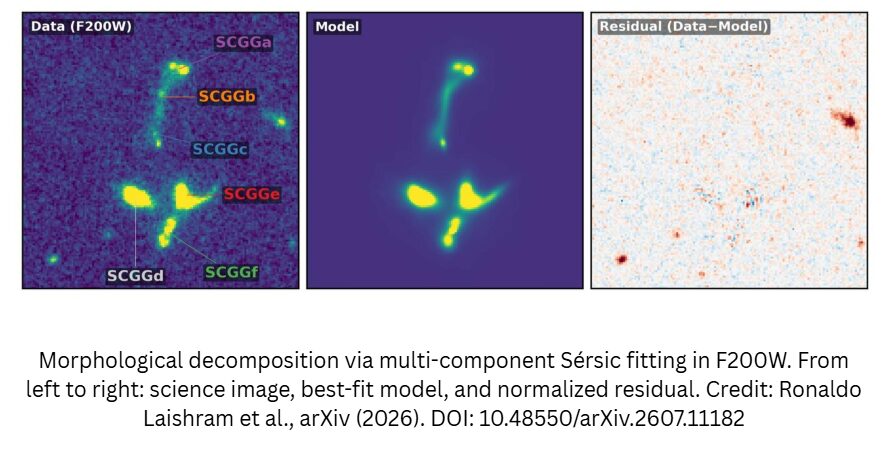
Astronomers have discovered a remarkably tiny group of six young galaxies just 1.2 billion years after the Big Bang. This may be a rare glimpse of how some of the universe’s largest galaxies formed. The paper outlining the findings was submitted to the arXiv preprint server on July 13.

Chaotic patches
The widely accepted cosmological model of the universe known as the Lambda Cold Dark Matter Model suggests that galaxies primarily form hierarchically through mergers. That means they grow piece by piece, as smaller galaxies merge over billions of years. In this context, dense regions in the early universe serve as natural laboratories to test this idea.

These dense patches, known as protoclusters and proto-groups, are young clusters of galaxies packed into a region just tens of tho...

Read More

Distant Galaxy Group Contradicts common Cosmological Models, Simulations

Centaurus A, an elliptical galaxy 13 million light-years from Earth, hosts a group of dwarf satellite galaxies co-rotating in a narrow disk, a distribution not predicted by dark-matter-influenced cosmological models. Credit: Christian Wolf and the SkyMapper team / Australian National University

Centaurus A, an elliptical galaxy 13 million light-years from Earth, hosts a group of dwarf satellite galaxies co-rotating in a narrow disk, a distribution not predicted by dark-matter-influenced cosmological models. Credit: Christian Wolf and the SkyMapper team / Australian National University

An international team has determined that Centaurus A, a massive elliptical galaxy 13 million light-years from Earth, is accompanied by a number of dwarf satellite galaxies orbiting the main body in a narrow disk. This is the first time such a galactic arrangement has been observed outside the Local Group, home to the Milky Way...

Read More