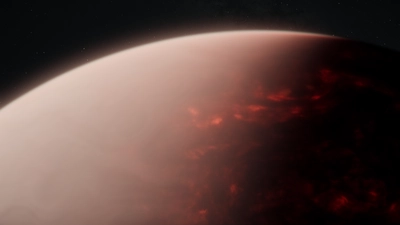
This artist’s concept shows what a thick atmosphere above a vast magma ocean on exoplanet TOI-561 b could look like. Measurements of light captured from the planet’s dayside by NASA’s James Webb Space Telescope suggest that in spite of the intense radiation it receives from its star, TOI-561 b is not a bare rock. Credit: NASA, ESA, CSA, Ralf Crawford (STScI)
A scorching “lava world” once thought barren may actually be wrapped in a thick, mysterious atmosphere. Astronomers have uncovered surprising evidence of a thick atmosphere surrounding TOI-561 b, a scorching, fast-orbiting rocky planet once thought too extreme to hold onto any gas...
This is an illustration of 55 Cancri e. Credit: NASA/JPL-Caltech
The most detailed map of a small, rocky ‘super Earth’ to date reveals a planet almost completely covered by lava, with a molten ‘hot’ side and solid ‘cool’ side. Conditions on the hot side of the planet are so extreme that it may have caused the atmosphere to evaporate, with the result that conditions on the 2 sides of the planet vary widely: temperatures on the hot side can reach 2500C, while temperatures on the cool side are around 1100C.
Using data from NASA’s Spitzer Space Telescope, the researchers examined a planet known as 55 Cancri e, which orbits a sun-like star located 40 light years away in the Cancer constellation, and have mapped how conditions on the planet change throughout a complete orbit, the first time this...
Recent Comments