
LDL tagged posts

‘Bad Fat’ Suppresses Killer T cells from Attacking Cancer

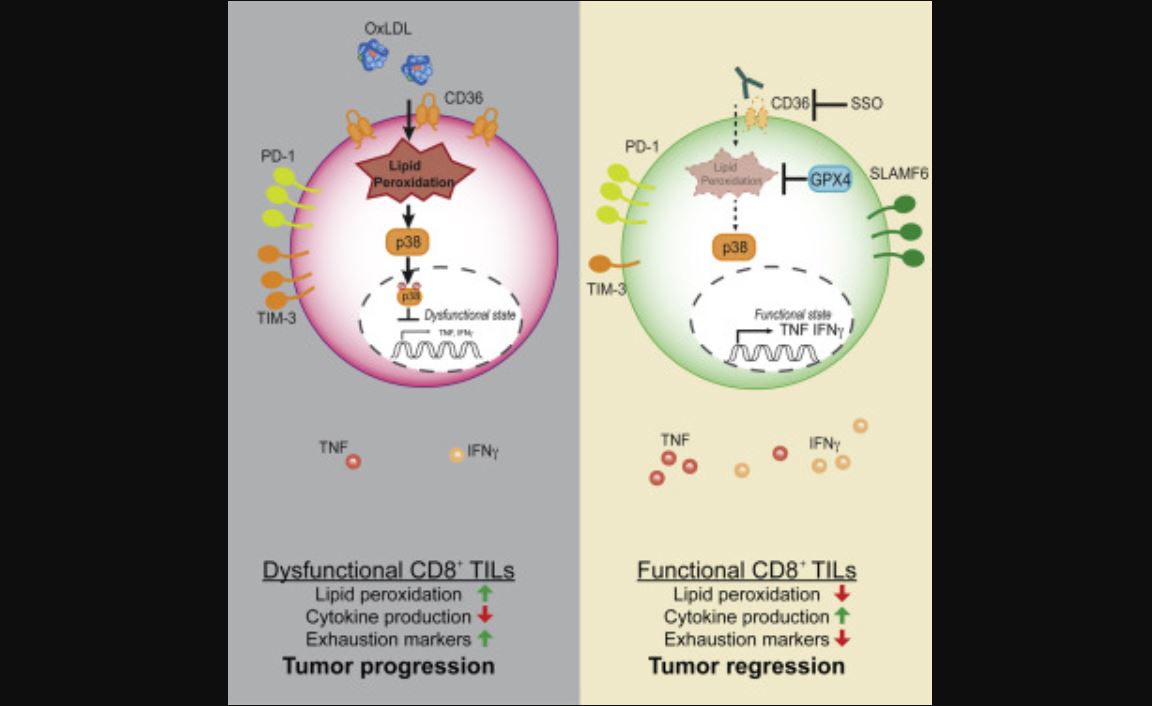
In order for cancer to grow and spread, it has to evade detection by our immune cells, particularly specialized “killer” T cells. Salk researchers led by Professor Susan Kaech have found that the environment inside tumors (the tumor microenvironment) contains an abundance of oxidized fat molecules, which, when ingested by the killer T cells, suppresses their ability to kill cancer cells. In a vicious cycle, those T cells, in need of energy, increase the level of a cellular fat transporter, CD36, that unfortunately saturates them with even more oxidized fat and further curtails their anti-tumor functions.

The discovery, published online in Immunity on June 7, 2021, suggests new pathways for safeguarding the immune system’s ability to fight cancer by reducing the oxidative lipid dama...

Read More

Protein that Blocks Body’s Ability to Clear Bad Cholesterol identified

Dawei Zhang
U of A researcher Dawei Zhang was part of an international team that identified the protein that interferes with the body’s ability to get rid of “bad” cholesterol, which could point the way to better treatments to prevent heart disease. (Photo: Faculty of Medicine & Dentistry)

Researchers are now looking to develop a drug that will boost existing statin drugs to prevent heart disease. The protein that interferes with low-density lipoprotein (LDL) receptors that clear “bad” cholesterol from the blood was identified in findings recently published in Nature Communications by Dawei Zhang, associate professor of pediatrics in the Faculty of Medicine & Dentistry. Excess LDL cholesterol can lead to atherosclerosis — a narrowing and hardening of arteries — and ultimately, heart attack.

“We...

Read More

Genes responsible for Cardiometabolic disease Risk identified

Factors Contributing to Cardiometabolic Risk

Factors Contributing to Cardiometabolic Risk

A profound new level of complexity and interaction among genes within specific tissues responsible for mediating the inherited risk for cardiometabolic diseases have been identified by researchers, including processes that lead to heart attack and stroke...

Read More

Controlling ‘Bad Cholesterol’ Production could Prevent Growth of Tumors, study finds

•Lipoprotein cholesterol supports tumor growth •Tumors increase VLDL/LDL levels •Ces3/TGH deficiency attenuates tumor-induced hyperlipidemia via inhibition of PCSK9 •Tumor growth was suppressed in Ces3/Tgh−/− mice

•Lipoprotein cholesterol supports tumor growth •Tumors increase VLDL/LDL levels •Ces3/TGH deficiency attenuates tumor-induced hyperlipidemia via inhibition of PCSK9 •Tumor growth was suppressed in Ces3/Tgh−/− mice

Several studies have recognized a link between obesity and cancer. Richard Lehner, professor of Pediatrics and investigator at the University of Alberta’s Faculty of Medicine & Dentistry, has taken his research further to understand how tumour cells grow through scavenging very low-density lipoproteins (VLDL) and low-density lipoproteins (LDL) and what mechanisms can be used to reduce the malignant cells’ growth.

The data gathered from their experiments suggest a feed-forward loop, in which tumours not only use lipids as “building blocks” to grow, but they can regulat...

Read More