
lithium-air battery tagged posts

Development of a Lithium-Air Battery with an Energy Density > 500 Wh/kg

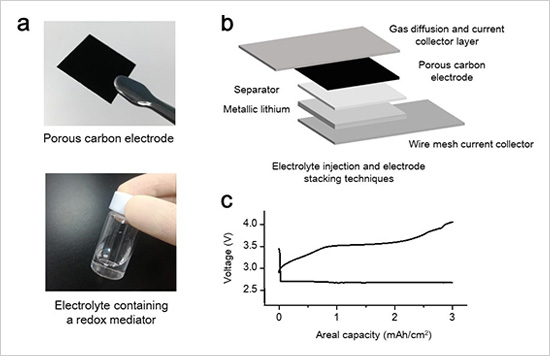
New materials for lithium-air batteries developed by ALCA-SPRING project. (b) Cell fabrication technique developed by the NIMS-SoftBank Advanced Technologies Development Center. (c) Demonstration of stable discharge/charge cycles of lithium-air batteries with energy density over 500Wh/kg operated at the room-temperature.

One of the world’s highest energy densities achieved. NIMS and Softbank Corp. have developed a lithium-air battery with an energy density over 500Wh/kg – significantly higher than currently lithium ion batteries. The research team then confirmed that this battery can be charged and discharged at room temperature. In addition, the team found that the battery developed by the team shows the highest energy densities and best cycle life performances ever achieved...

Read More

Development of Ultra-High Capacity Lithium-Air Batteries using CNT sheet Air Electrodes

Akihiro Nomura, Kimihiko Ito, Yoshimi Kubo. CNT Sheet Air Electrode for the Development of Ultra-High Cell Capacity in Lithium-Air Batteries. Scientific Reports, 2017; 7: 45596 DOI: 10.1038/srep45596

Akihiro Nomura, Kimihiko Ito, Yoshimi Kubo. CNT Sheet Air Electrode for the Development of Ultra-High Cell Capacity in Lithium-Air Batteries. Scientific Reports, 2017; 7: 45596 DOI: 10.1038/srep45596

A NIMS team led by Yoshimi Kubo and Akihiro Nomura, team leader and researcher, respectively, Lithium Air Battery Specially Promoted Research Team, C4GR-GREEN, developed lithium-air batteries with very high electric storage capacity 15X greater than the capacity of conventional lithium-ion batteries using carbon nanotubes (CNT) as an air electrode material. Demand for rechargeable batteries is expected to increase rapidly as electric vehicle power sources and joint sources of household electricity with solar cells.

The current lithium-ion batteries have advantages of being compact, producing h...

Read More

Discovery could have Cellphone and Car Batteries lasting 5X Longer

Research by Cho and Yongping Zheng (pictured) focuses on the electrolyte catalysts inside the battery, which, when combined with oxygen, create chemical reactions that create battery capacity. Credit: Image courtesy of University of Texas at Dallas

Research by Cho and Yongping Zheng (pictured) focuses on the electrolyte catalysts inside the battery, which, when combined with oxygen, create chemical reactions that create battery capacity. Credit: Image courtesy of University of Texas at Dallas

Dr. Kyeongjae Cho, professor of materials science and engineering in the Erik Jonsson School of Engineering and Computer Science, has discovered new catalyst materials for lithium-air batteries that jumpstart efforts at expanding battery capacity. Lithium-air (or lithium-oxygen) batteries “breathe” oxygen from the air to power the chemical reactions that release electricity, rather than storing an oxidizer internally like lithium-ion batteries do...

Read More