little red dots tagged posts

JWST spots a bizarre “black hole star” 100 billion times brighter than a star

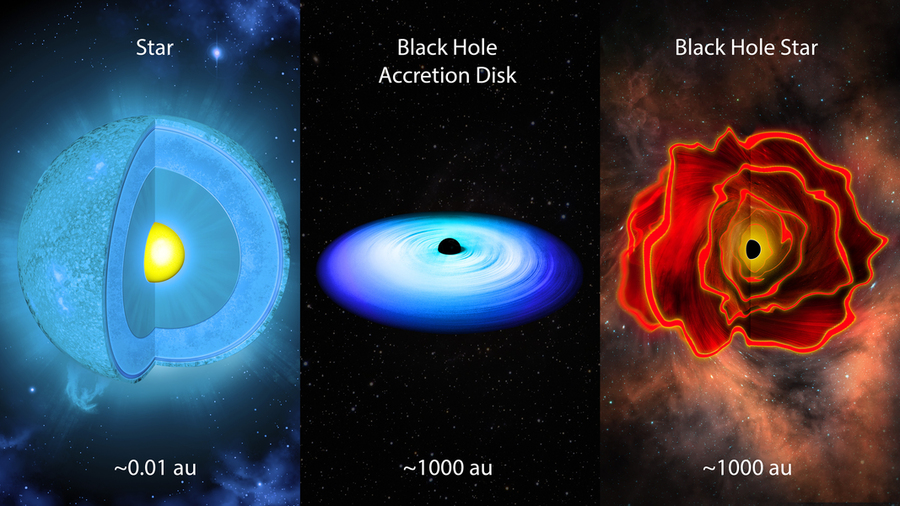
Three images show a “Star” as a cut-away sphere with a yellow core; a “Black Hole Accretion Disk” with black core and blue pancake spiral; and the “Black Hole Star,” an amorphous red cloud with a black center.
Stars (left) can be thought of as a dense ball of gas powered by nuclear fusion at their centers. Black holes (center) typically grow by consuming matter via a pancake-like accretion disk. Black hole stars (right) represent a new kind of object — nascent black holes enshrouded in dense gas such that they effectively radiate in a star-like manner. The accreting black hole, as the power source, plays the role of nuclear fusion, and the dense surrounding gas acts similarly to a pseudo-photosphere.
Image: iStock; Jose-Luis Olivares, MIT

Astronomers may have uncovered an entirely new cosmic object: a gigantic “black hole star” that could explain the mysterious red dots filling the early universe...

Read More

Dark stars could help solve three pressing puzzles of the high-redshift universe

Dark stars could help solve three pressing puzzles of the high-redshift universe
UHZ1, a record breaking galaxy 13.2 billion light-years away, seen when the universe was only 3% of its current age. UHZ1 is puzzling in view of it harboring a supermassive black hole that could not have possibly been seeded even by regular stars, in view of its mass and very little time for the BH to grow. As such, UHZ1 is believed to be evidence for supermassive stars that—upon collapse—generate the supermassive black hole powering the quasar at its center. In this study, the authors show how UHZ1 could harbor a supermassive black hole seeded by the collapse of a dark star. The mechanisms identified by the authors are not restricted to UHZ1—it provides a pathway for explaining over massive black hole galaxies, of which UHZ1 is a prominent example...
Read More