

Additive manufacturing has revolutionized manufacturing by enabling customized, cost-effective products with minimal waste. However, with the majority of 3D printers operating on open-loop systems, they are notoriously prone to failure...
Read More

February 4, 2026,
 Physics, Technology/Electronics
Additive manufacturing has revolutionized manufacturing by enabling customized, cost-effective products with minimal waste. However, with the majority of 3D printers operating on open-loop systems, they are notoriously prone to failure...
Read More
January 8, 2026,
Physics, Technology/Electronics

AI might know where you’re going before you do. Researchers at Northeastern University used large language models, the kind of advanced artificial intelligence normally designed to process and generate language, to predict human movement.
How RHYTHM predicts human movement
RHYTHM, their innovative tool, “can revolutionize the forecasting of human movements,” forecasting “where you’re going to be in the next 30 minutes or the next 25 hours,” said Ryan Wang, an associate professor and vice chair of research in civil and environmental engineering at Northeastern.
The hope is that RHYTHM will improve domains like transportation and traffic planning to make our lives easier, but in extreme cases, RHYTHM could even be deployed to respond to natural dis...
Read More
December 3, 2025,
Physics, Technology/Electronics
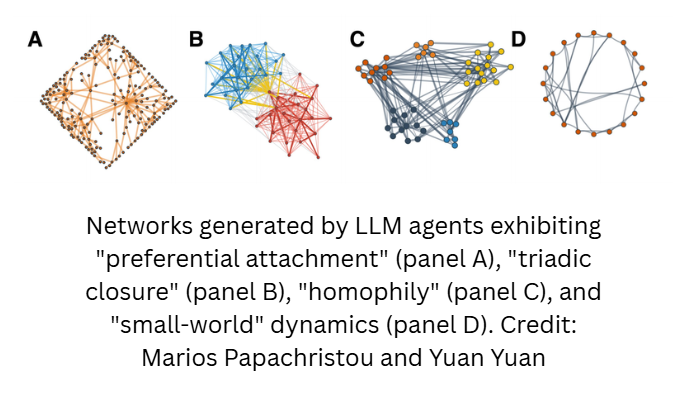
When large language models (LLMs) make decisions about networking and friendship, the models tend to act like people, across both synthetic simulations and real-world network contexts.
Marios Papachristou and Yuan Yuan developed a framework to study network formation behaviors of multiple LLM agents and compared these behaviors against human behaviors. The paper is published in the journal PNAS Nexus.
How LLMs form network connections
The authors conducted simulations using several large language models placed in a network, which were asked to choose which other nodes to connect with, given their number of connections, common neighbors, and shared attributes, like arbitrarily assigned “hobbies” or “location.”
The authors varied the network context, including simulations of fri...
Read More
November 15, 2025,
Physics, Technology/Electronics

In an MIT classroom, a professor lectures while students diligently write down notes they will reread later to study and internalize key information ahead of an exam.
Humans know how to learn new information, but large language models can’t do this in the same way. Once a fully trained LLM has been deployed, its “brain” is static and can’t permanently adapt itself to new knowledge.
This means that if a user tells an LLM something important today, it won’t remember that information the next time this person starts a new conversation with the chatbot.
Now, a new approach developed by MIT researchers enables LLMs to update themselves in a way that permanently internalizes new information...
Read More
Recent Comments