LLM tagged posts

Shrinking AI for Personal Devices: An efficient small language model that could perform better on smartphones

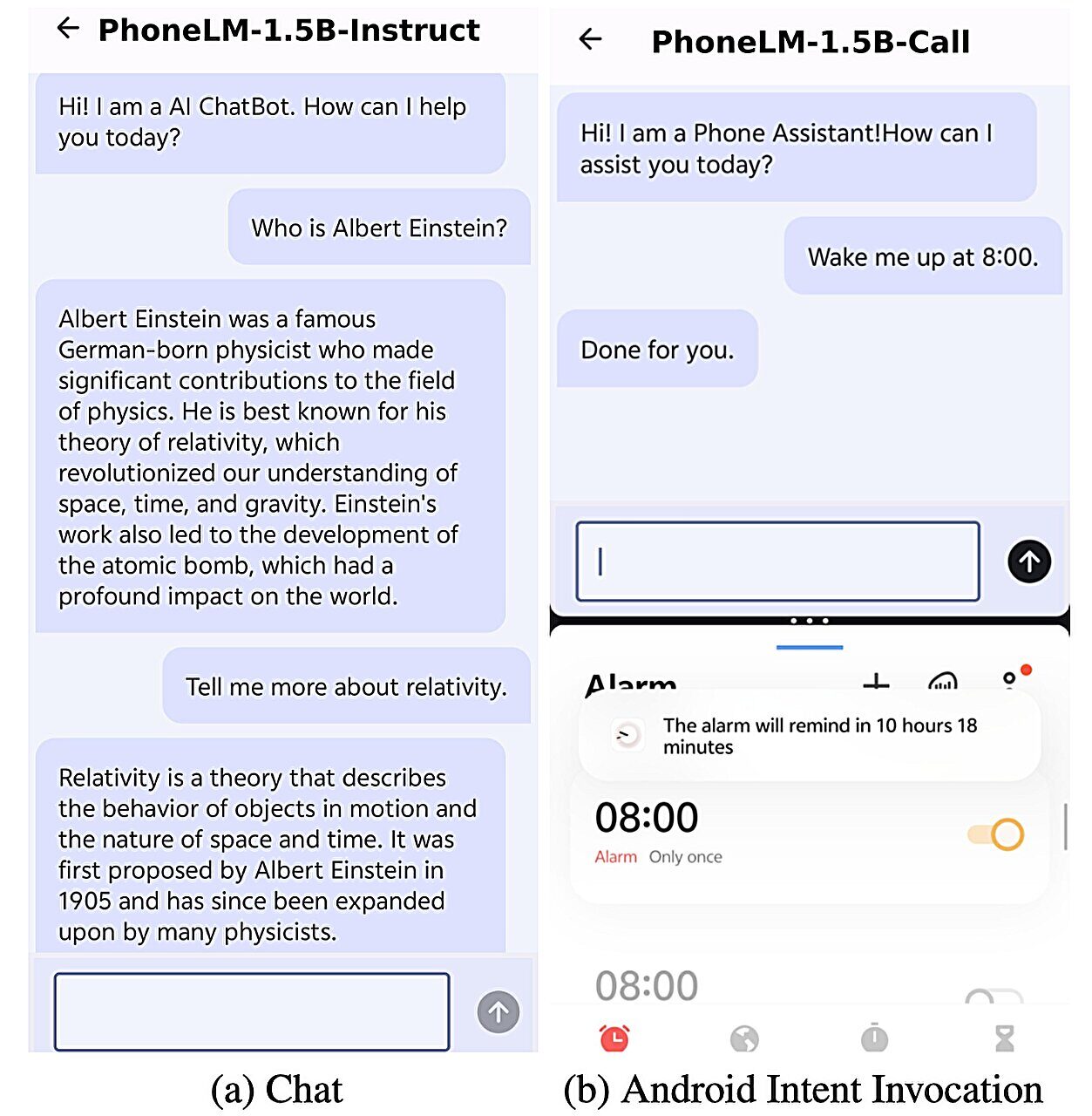
An Android demo of PhoneLM capability. (Left) Chatting; (Right) Device control through intent invocation. Demo and code are available at https://github.com/UbiquitousLearning/mllm. Credit: Yi et al.

Large language models (LLMs), such as Open AI’s renowned conversational platform ChatGPT, have recently become increasingly widespread, with many internet users relying on them to find information quickly and produce texts for various purposes. Yet most of these models perform significantly better on computers, due to the high computational demands associated with their size and data processing capabilities.

To tackle this challenge, computer scientists have also been developing small language models (SLMs), which have a similar architecture but are smaller...

Read More

Adobe announces development of SLM that can Run Locally on a Phone with No Cloud Connection

app
Credit: Pixabay/CC0 Public Domain

A small team of AI researchers at Adobe Inc., working with a colleague from Auburn University and another from Georgia Tech, has developed a small language model (SLM) that they claim can be run locally on a smart phone with no access to the cloud. The group has written a paper describing their new app, which they call SlimLM, and have posted it to the arXiv preprint server.

As LLM technology continues to mature, researchers across the globe continue to find new ways to improve it. In this new effort, the research team has found a way to cut the cord for a specific type of AI application—processing documents locally.

As LLMs such as ChatGPT become more popular, users have become more worried about privacy...

Read More

DeepMind Researchers find LLMs can Serve as Effective Mediators

DeepMind researchers find LLMs can serve as effective mediators
The Habermas Machine generates high-quality group opinion statements that are preferred to human-written group statements, and critiquing provides further improvements. Credit: Science (2024). DOI: 10.1126/science.adq2852

A team of AI researchers with Google’s DeepMind London group has found that certain large language models (LLMs) can serve as effective mediators between groups of people with differing viewpoints regarding a given topic. The work is published in the journal Science.

Over the past several decades, political divides have become common in many countries—most have been labeled as either liberal or conservative...

Read More

As LLMs Grow Bigger, they’re more likely to give Wrong Answers than Admit Ignorance

As LLMs grow bigger, they're more likely to give wrong answers than admit ignorance
Performance of a selection of GPT and LLaMA models with increasing difficulty. Credit: Nature (2024). DOI: 10.1038/s41586-024-07930-y

A team of AI researchers at Universitat Politècnica de València, in Spain, has found that as popular LLMs (Large Language Models) grow larger and more sophisticated, they become less likely to admit to a user that they do not know an answer.

In their study published in the journal Nature, the group tested the latest version of three of the most popular AI chatbots regarding their responses, accuracy, and how good users are at spotting wrong answers.

As LLMs have become mainstream, users have become accustomed to using them for writing papers, poems or songs and solving math problems and other tasks, and the issue of accuracy has become a bigger...

Read More