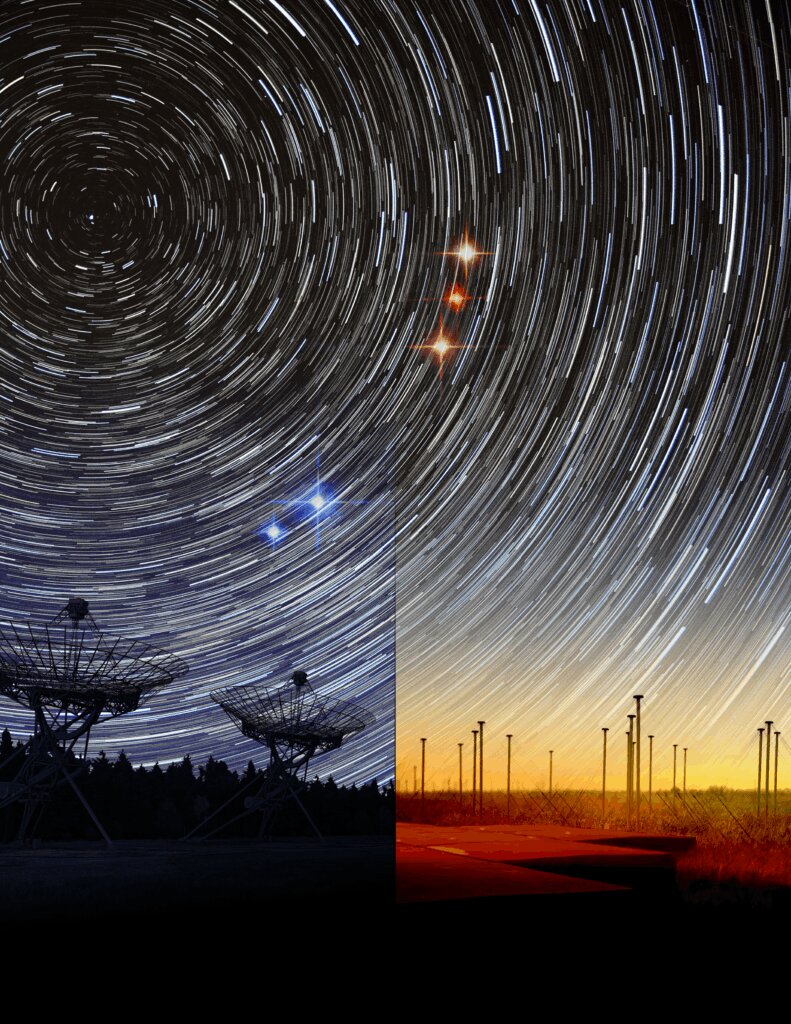
Westerbork dishes (left) detected a periodic, short fast radio burst in the blue, high-frequency radio sky. Time passed, the steady background stars turned into trails. Only much later did the same source emit in the red, low-frequency radio sky. The LOFAR telescope (right) now detected these for the first time. This chromatic behaviour shows the bursts are not periodically blocked by binary star winds. Credit: Joeri van Leeuwen
By connecting two of the biggest radio telescopes in the world, astronomers have discovered that a simple binary wind cannot cause the puzzling periodicity of a fast radio burst after all. The bursts may come from a highly magnetized, isolated neutron star...
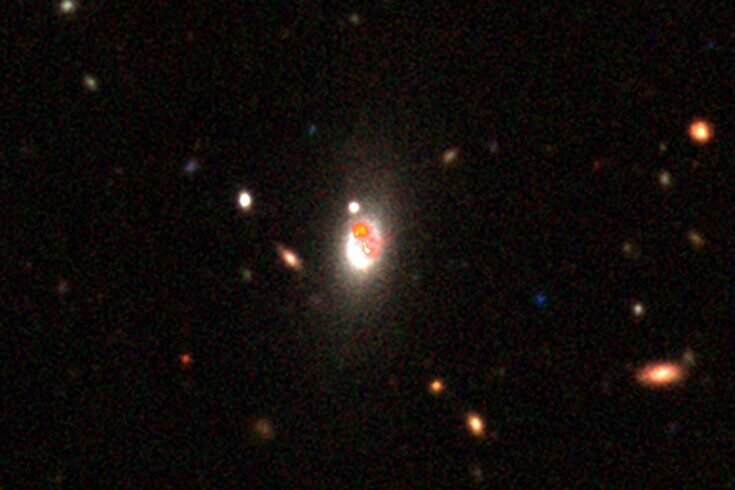
An image showing what the radio emission looks like in LOFAR’s high resolution, using a galaxy from Morabito et al. (2021). The improved resolution means we can see all the jet details. Credit: L.K. Morabito / DESI Legacy Imaging Surveys
Astronomers have published the most detailed images seen of galaxies beyond our own yet, revealing their inner workings in unprecedented detail.
The images were created from data collected by the Low Frequency Array (LOFAR), a network of more than 70,000 small antennae spread across nine European countries. The results come from the team’s years of work, led by Dr. Leah Morabito at Durham University. The team was supported in the UK by the Science and Technology Facilities Council (STFC).
As well as supporting science exploitation, STFC also fu...
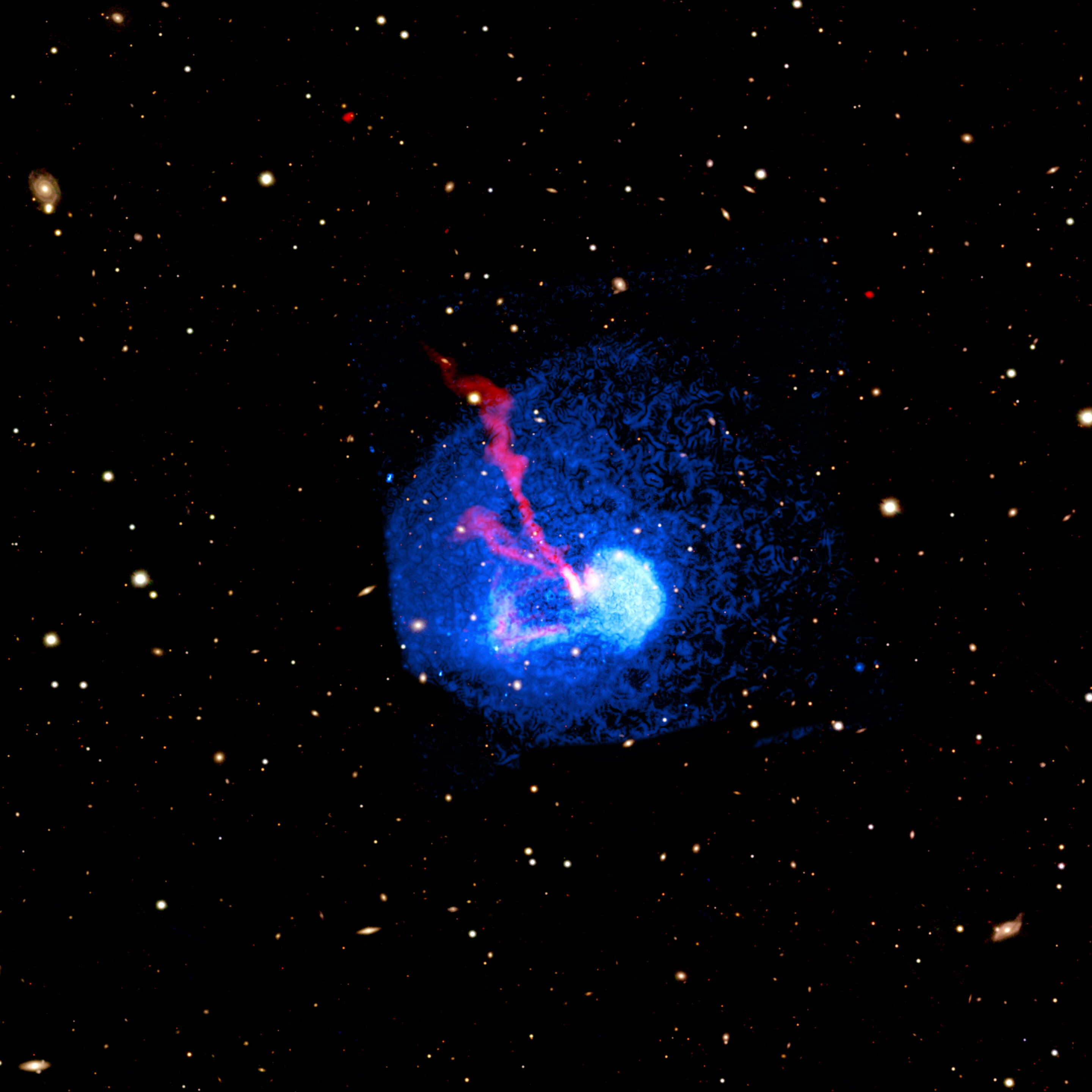
Credit: X-ray: NASA/CXC/Leiden Univ./A. Botteon et al.; Radio: LOFAR/ASTRON; Optical/IR:PanSTARRS
When the titans of space—galaxy clusters—collide, extraordinary things can happen. A new study using NASA’s Chandra X-ray Observatory examines the repercussions after two galaxy clusters clashed.
Galaxy clusters are the largest structures in the Universe held together by gravity, containing hundreds or even thousands of individual galaxies immersed in giant oceans of superheated gas. In galaxy clusters, the normal matter—like the atoms that make up the stars, planets, and everything on Earth—is primarily in the form of hot gas and stars. The mass of the hot gas between the galaxies is far greater than the mass of the stars in all of the galaxies...
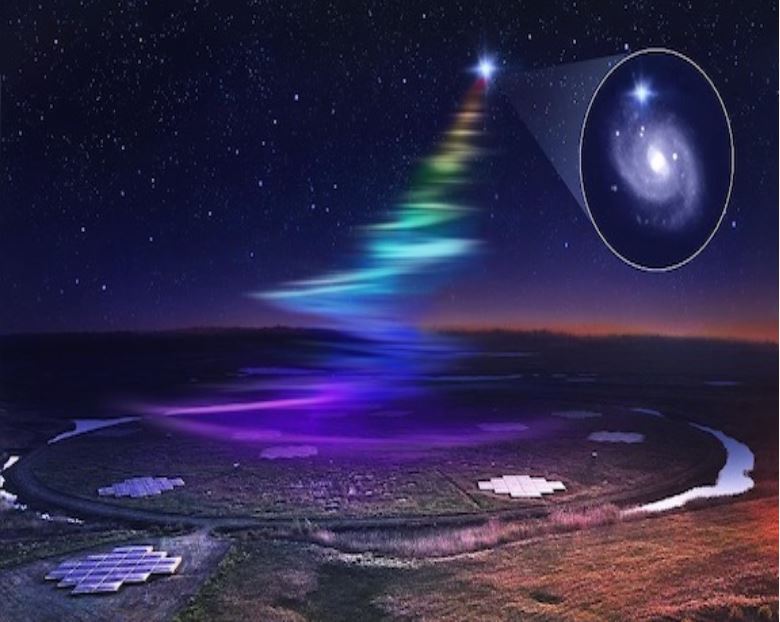
Fast radio bursts shown to include lower frequency radio waves than previously detected
A team of researchers has established that fast radio bursts (FRBs) include radio waves at frequencies lower than ever detected before, a discovery that redraws the boundaries for theoretical astrophysicists trying to put their finger on the source of FRBs.
Since fast radio bursts (FRBs) were first discovered over a decade ago, scientists have puzzled over what could be generating these intense flashes of radio waves from outside of our galaxy. In a gradual process of elimination, the field of possible explanations has narrowed as new pieces of information are gathered about FRBs — how long they last, the frequencies of the radio waves detected, and so on.





Recent Comments