longevity tagged posts

Gut Microbiome implicated in Healthy Aging and Longevity

gut
Credit: CC0 Public Domain

Data from over 9,000 people reveal a distinct gut microbiome signature that is associated with healthy aging and survival in the latest decades of life. The gut microbiome is an integral component of the body, but its importance in the human aging process is unclear. ISB researchers and their collaborators have identified distinct signatures in the gut microbiome that are associated with either healthy or unhealthy aging trajectories, which in turn predict survival in a population of older individuals. The work is set to be published in the journal Nature Metabolism.

The research team analyzed gut microbiome, phenotypic and clinical data from over 9,000 people — between the ages of 18 and 101 years old — across three independent cohorts...

Read More

Moderate Carbohydrate Intake may be best for Health, study suggests

Figure 3U-shaped association between percentage of energy from carbohydrate and all-cause mortality in the ARIC and PURE cohort studies Hide caption The reference level is 46·4% energy from carbohydrate. ARIC results are adjusted for age, sex, education, waist-to-hip ratio, smoking, physical activity, diabetes, ARIC test centre, and energy intake. PURE results are are adjusted for age, sex, education, waist-to-hip ratio, smoking, physical activity, diabetes, urban or rural location, centre, geographical regions, and energy intake.13 The mean percentage of energy from carbohydrate in ARIC is 49%, and from PURE it is 61%. ARIC=Atherosclerosis Risk in Communities. PURE=Prospective Urban Rural Epidemiology.

Figure 3U-shaped association between percentage of energy from carbohydrate and all-cause mortality in the ARIC and PURE cohort studies. The reference level is 46·4% energy from carbohydrate. ARIC results are adjusted for age, sex, education, waist-to-hip ratio, smoking, physical activity, diabetes, ARIC test centre, and energy intake. PURE results are are adjusted for age, sex, education, waist-to-hip ratio, smoking, physical activity, diabetes, urban or rural location, centre, geographical regions, and energy intake.13 The mean percentage of energy from carbohydrate in ARIC is 49%, and from PURE it is 61%. ARIC=Atherosclerosis Risk in Communities. PURE=Prospective Urban Rural Epidemiology.

Eating carbohydrates in moderation seems to be optimal for health and longevity, suggests new rese...

Read More

Secret to Longevity may Lie in the Microbiome and the Gut

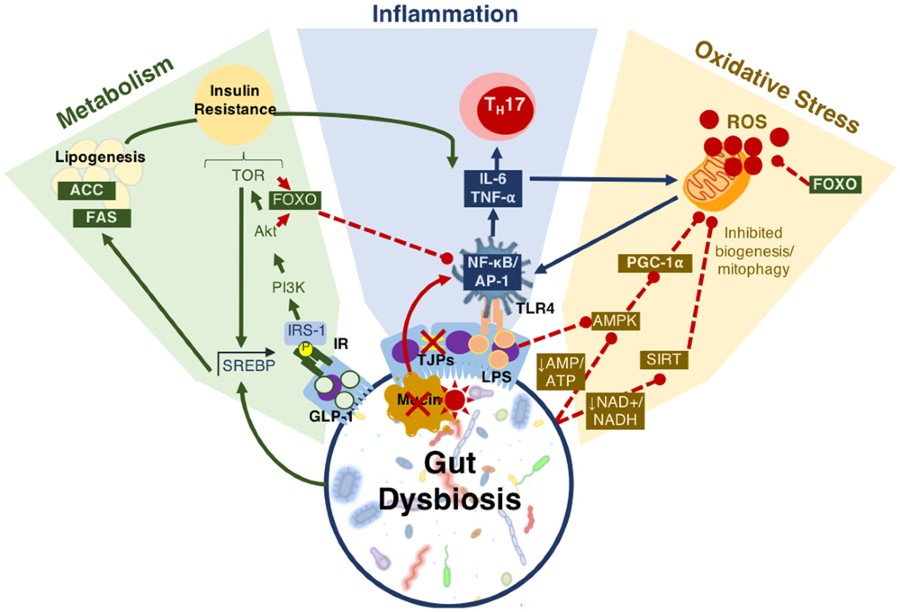
Model of mechanisms of gut microbiota-host communication influencing aging factors. The gut microbiota communicates with the metabolic, inflammatory and oxidative stress pathways via direct and indirect mechanisms. As the physiological changes in all three of these axes are cross-regulatory, the simultaneous action implemented by the gut microbiota makes it a powerful influence in aging and age-related chronic disease development. Abbreviations: glucagon-like peptide (GLP)-1, insulin receptor (IR), insulin receptor substrate (IRS)-1, phosphoinositide 3-kinase (PI3K), protein kinase B (Akt), target of rapamycin (TOR), Forkhead Box O protein (FOXO), sterol regulatory element binding protein (SREBP), acetyl CoA carboxylase (ACC), fatty acid synthase (FAS), tight junction proteins (TJPs), lipopolysaccharide (LPS), toll-like receptor (TLR)4, nuclear factor kappa-light-chain enhancer of activated B cells (NF-kB), activator protein (AP)-1, tumor necrosis factor (TNF)-α, interleukin (IL)-6, T helper (Th)17, AMP-activated protein kinase (AMPK), peroxisome proliferator-activated receptor gamma coactivator (PGC)-1α, sirtuin (SIRT), reactive oxygen species (ROS).

Model of mechanisms of gut microbiota-host communication influencing aging factors. The gut microbiota communicates with the metabolic, inflammatory and oxidative stress pathways via direct and indirect mechanisms. As the physiological changes in all three of these axes are cross-regulatory, the simultaneous action implemented by the gut microbiota makes it a powerful influence in aging and age-related chronic disease development...


Read More

Genetic influence on Aging into the 90s but not beyond

The role of FoxO3 in longevity may involve upregulation of target genes involved in stress resistance, metabolism, cell cycle arrest, and apoptosis. Effective control of FoxO3 in response to environmental stimuli is likely critical to prevent ageing and age-related diseases including cardiovascular disease, type 2 diabetes, cancer and neurodegenerative diseases. The diagram shows how the well-known longevity-associated intervention of caloric restriction helps to maintain the redox state of the cell by cycling calories through the mitochondria so as to restore NAD+. Caloric restriction results in activation of sirtuins, leading to activation of FoxOs, improved autophagy, amino acid recycling via inhibition of mTOR activity, and other mechanisms leading to a healthy ageing phenotype. On the other hand, excess calories, particularly from carbohydrates, increase the NADH/NAD+ ratio and leads to lipogenesis, overproduction of ROS by mitochondria, poor autophagy and activation of mTOR as a result of an excess of protein intake. AKT1 is a term derived from the ‘Ak' mouse strain that develops spontaneous thymic lymphomas (AKT1 is also known as protein kinase B). CAD = Coronary artery disease; HNF4a = hepatocyte nuclear factor 4α; GCN1l1 = general control of amino acid synthesis 1-like 1; O-GlcNAc = O-linked N-acetylglucosamine; OXPHOS = oxidative phosphorylation; PPARγC1α = peroxisome proliferator-activated receptor-γ coactivator 1α; TCA = tricarboxylic acid.

The role of FoxO3 in longevity may involve upregulation of target genes involved in stress resistance, metabolism, cell cycle arrest, and apoptosis. Effective control of FoxO3 in response to environmental stimuli is likely critical to prevent ageing and age-related diseases including cardiovascular disease, type 2 diabetes, cancer and neurodegenerative diseases. The diagram shows how the well-known longevity-associated intervention of caloric restriction helps to maintain the redox state of the cell by cycling calories through the mitochondria so as to restore NAD+. Caloric restriction results in activation of sirtuins, leading to activation of FoxOs, improved autophagy, amino acid recycling via inhibition of mTOR activity, and other mechanisms leading to a healthy ageing phenotype...

Read More