
M-dwarf star tagged posts

TESS discovers an Earth-sized planet orbiting nearby M-dwarf star

TESS discovers a new Earth-sized planet orbiting nearby star
Target Pixel File (TPF) of TOI-4616 from TESS Sector 17. Credit: arXiv (2026). DOI: 10.48550/arxiv.2603.10905

Using NASA’s Transiting Exoplanet Survey Satellite (TESS), an international team of astronomers has discovered an extrasolar planet orbiting TOI-4616—a nearby M-dwarf star. The newfound alien world, which received designation TOI-4616 b, is slightly larger than Earth. The finding was reported in a research paper published March 11 on the arXiv pre-print server.

Launched in 2018, TESS is in the process of scanning about 200,000 of the brightest stars near the sun, searching for potential transiting exoplanets. To date, it has identified more than 7,900 candidate exoplanets (TESS Objects of Interest, or TOI), of which 760 have been confirmed.

Nearby M dwarf draws attent...

Read More
TOI-1685 b is a Hot and Rocky Super-Earth Exoplanet, Observations find

TOI-1685 b is a hot and rocky super-Earth exoplanet, observations find
Best fit SED for TOI-1685 from VOSA. Colored points are photometric magnitudes from the Gaia, 2Mass, and WISE surveys, and magnitudes synthesized from spectrophotometrically calibrated Gaia DR3 Bp/Rp spectra into the photometric system of the OAJ JPAS and JPLUS surveys. Gray line depicts the model flux measurements. Credit: arXiv (2024). DOI: 10.48550/arxiv.2405.14895

An international team of astronomers has performed follow-up observations of a nearby alien world known as TOI-1685 b. Results of the observations, published May 21 on the pre-print server arXiv, indicate that TOI-1685 b is a hot and rocky alien world with an Earth-like density.

The so-called “super-Earths” are planets more massive than Earth but not exceeding the mass of Neptune...

Read More

Possible Atmospheric Destruction of a potentially Habitable Exoplanet

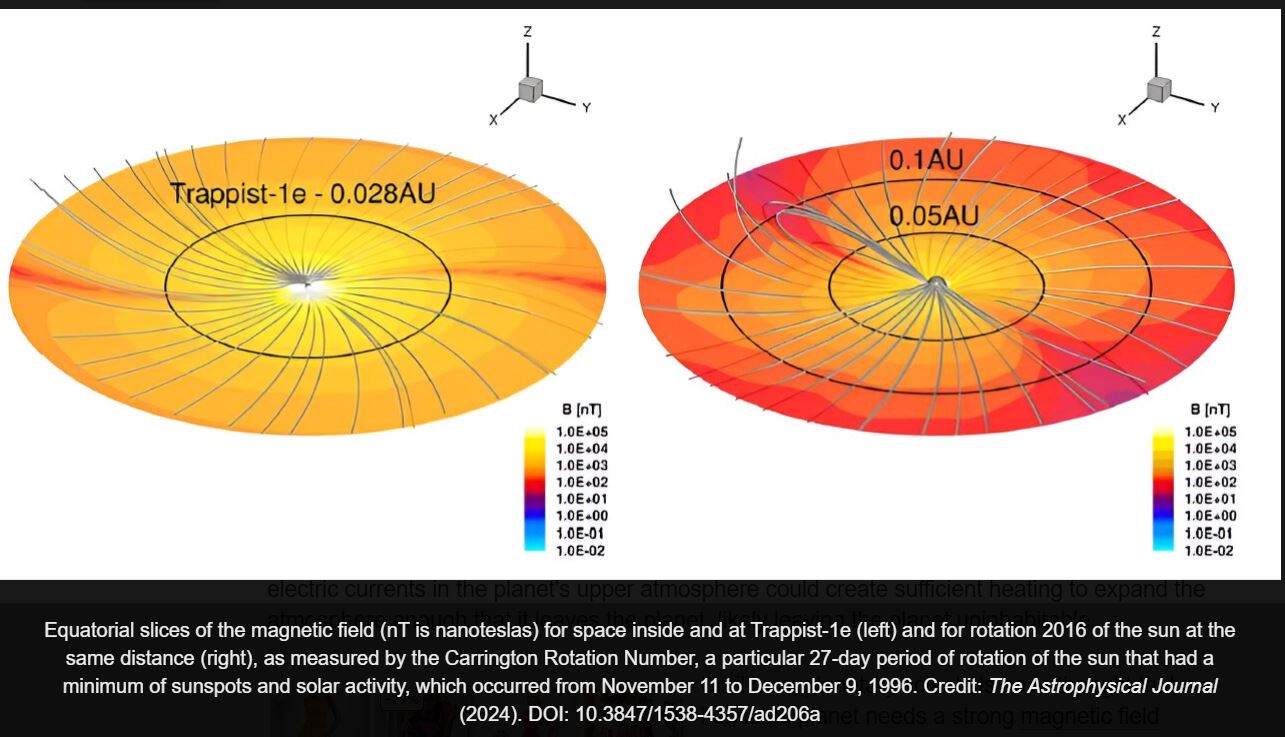
Astrophysicists studying a popular exoplanet in its star’s habitable zone have found that electric currents in the planet’s upper atmosphere could create sufficient heating to expand the atmosphere enough that it leaves the planet, likely leaving the planet uninhabitable.

Until now, planetary scientists have thought that a habitable planet needs a strong magnetic field surrounding it to act as a shield, directing ionized particles, X-rays and ultraviolet radiation in the stellar wind around and away from its atmosphere.
That’s what happens on Earth, preventing dangerous radiation from reaching life on the surface, and what does not occur on Mars, which now lacks a global magnetic field, meaning any initial inhabitants of the red planet will probably need to live in underground caves...

Read More