M dwarf tagged posts

Nearby red dwarf star hosts at least four planets—with one in the habitable zone

Nearby red dwarf star hosts at least four planets—with one in the habitable zone
sBGLS periodograms of all planet candidates and the rotation period of the star. The apparent fringe pattern in all panels is caused by the sampling of the data in two chunks separated by approximately 13 y. Credit: Astronomy & Astrophysics (2026). DOI: 10.1051/0004-6361/202554984

In 2020, a study confirmed that two planets orbited the nearby red dwarf, GJ 887. Now, astronomers have confirmed the existence of two additional planets orbiting GJ 887 in a new study published in Astronomy and Astrophysics. The new study suggests that one of these newly confirmed planets is in the habitable zone.

The GJ 887 red dwarf system
GJ 887 is a bright red dwarf star about 10.7 light years away from our solar system—a relatively short distance compared to other star systems...

Read More

Plasma rings around M dwarf stars offer new clues to planetary habitability

Naturally occurring
Artist’s rendition of the space weather around M dwarf TIC 141146667. The torus of ionized gas is sculpted by the star’s magnetic field and rotation, with two pinched, dense clumps present on opposing sides of the star. Credit:Navid Marvi, Carnegie Science.

How does a star affect the makeup of its planets? And what does this mean for the habitability of distant worlds? Carnegie’s Luke Bouma is exploring a new way to probe this critical question—using naturally occurring space weather stations that orbit at least 10% of M dwarf stars during their early lives. He is presenting his work at the 247th American Astronomical Society meeting.

The paper is also published in The Astrophysical Journal Letters.

We know that most M dwarf stars—which are smaller, cooler, and dimmer than our ...

Read More

TESS discovers a Planet the size of Mars but with the Makeup of Mercury

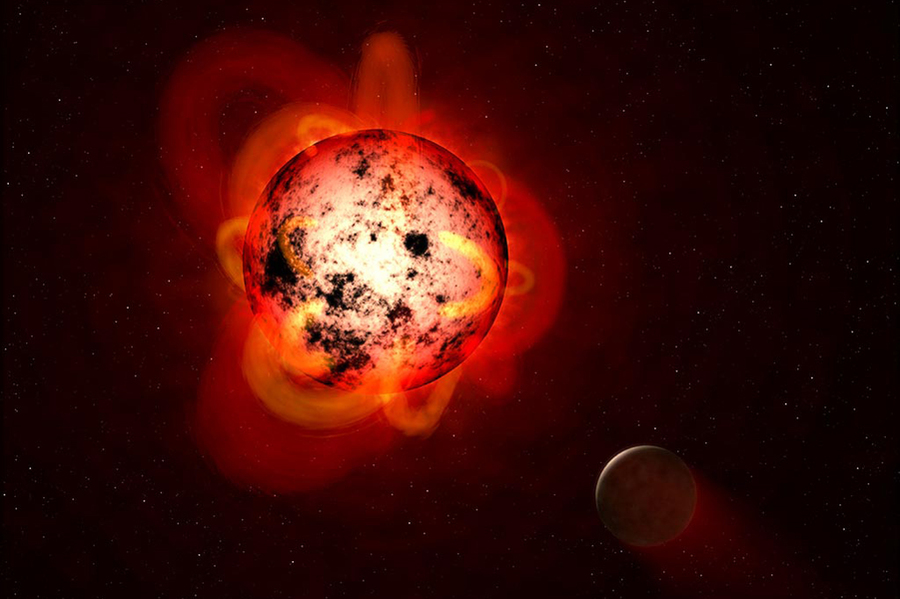
Caption:An illustration of a red dwarf star orbited by an exoplanet.
Credits:Credit: NASA/ESA/G. Bacon (STScI)

The boiling new world, which zips around its star at ultraclose range, is among the lightest exoplanets found to date. The TESS mission has discovered an ultra-short-period planet (USP) that is also super light. The planet is named GJ 367 b, and it orbits its star in just eight hours. The planet is about the size of Mars, and half as massive as the Earth, making it one of the lightest planets discovered to date.

Ultra-short-period planets are small, compact worlds that whip around their stars at close range, completing an orbit — and a single, scorching year — in less than 24 hours...

Read More

A Warm Jupiter Orbiting a Cool Star

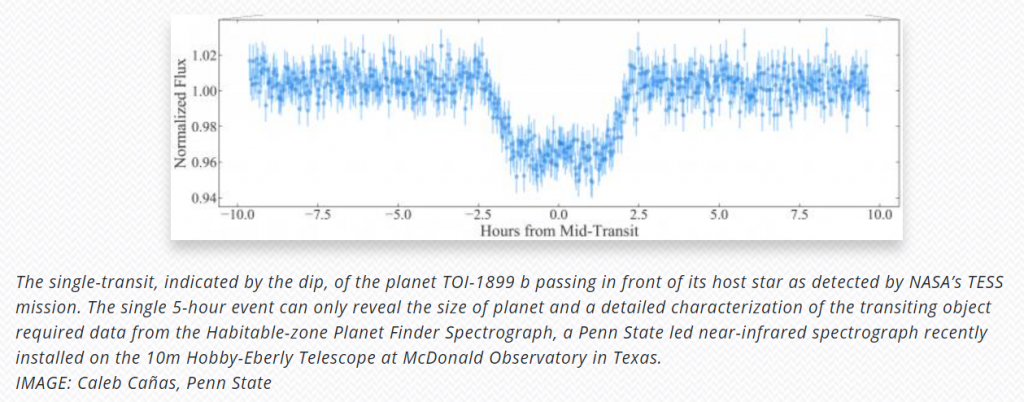
A planet observed crossing in front of, or transiting, a low-mass star has been determined to be about the size of Jupiter. While hundreds of Jupiter-sized planets have been discovered orbiting larger sun-like stars, it is rare to see these planets orbiting low-mass host stars and the discovery could help astronomers to better understand how these giant planets form.

“This is only the fifth Jupiter-sized planet transiting a low-mass star that has been observed and the first with such a long orbital period, which makes this discovery really exciting,” said Caleb Cañas, lead author of the paper and a Ph.D. student at Penn State and NASA Earth and Space Science Fellow.

Originally detected by NASA’s Transiting Exoplanet Survey Satellite (TESS) spacecraft, astronomers characterized ...

Read More