Machine learning tagged posts

Developing Smarter, Faster Machine Intelligence with Light

Massively parallel amplitude-only Fourier neural network
A massively parallel amplitude-only Fourier neural network

Researchers at the George Washington University, together with researchers at the University of California, Los Angeles, and the deep-tech venture startup Optelligence LLC, have developed an optical convolutional neural network accelerator capable of processing large amounts of information, on the order of petabytes, per second. This innovation, which harnesses the massive parallelism of light, heralds a new era of optical signal processing for machine learning with numerous applications, including in self-driving cars, 5G networks, data-centers, biomedical diagnostics, data-security and more.

Global demand for machine learning hardware is dramatically outpacing current computing power supplies...

Read More

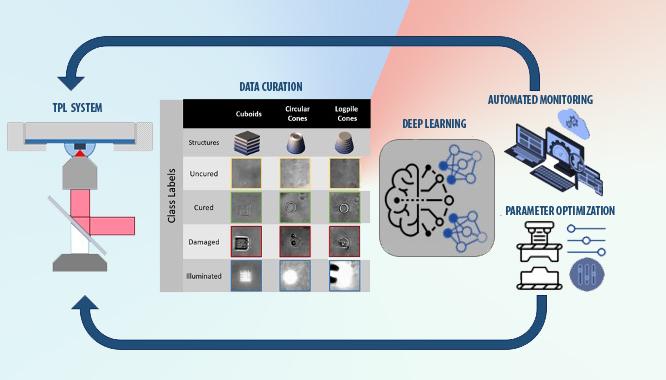
Machine Learning Model may Perfect 3D Nanoprinting

deep learning
Lawrence Livermore National Laboratory scientists and collaborators are using machine learning to address two key barriers to industrialization of two-photon lithography (TPL): monitoring of part quality during printing and determining the right light dosage for a given material. The team developed a machine learning algorithm trained on thousands of video images of TPL builds to identify the optimal parameters for settings such as exposure and laser intensity and to automatically detect part quality at high accuracy.

Two-photon lithography (TPL)—a widely used 3-D nanoprinting technique that uses laser light to create 3-D objects—has shown promise in research applications but has yet to achieve widespread industry acceptance due to limitations on large-scale part production and time-in...

Read More

Machine Learning Shapes Microwaves for a Computer’s Eyes

Two swirling patterns, one of grey and black on the left, the other of yellow and purple on the right
An example of a wave pattern (right) and its intensity levels (left) developed by the machine learning algorithm to best illuminate the most important features of an object being identified.

Engineers from Duke University and the Institut de Physique de Nice in France have developed a new method to identify objects using microwaves that improves accuracy while reducing the associated computing time and power requirements.

The system could provide a boost to object identification and speed in fields where both are critical, such as autonomous vehicles, security screening and motion sensing.

The new machine-learning approach cuts out the middleman, skipping the step of creating an image for analysis by a human and instead analyzes the pure data directly...

Read More

AI can predict Premature Death, study finds

Top 15 risk factor variables for predicting mortality listed in descending order of “importance” by algorithm derived from the training cohort of 376,971 patients.

Computers which are capable of teaching themselves to predict premature death could greatly improve preventative healthcare in the future, suggests a new study by experts at the University of Nottingham. The team of healthcare data scientists and doctors have developed and tested a system of computer-based ‘machine learning’ algorithms to predict the risk of early death due to chronic disease in a large middle-aged population.

They found this AI system was very accurate in its predictions and performed better than the current standard approach to prediction developed by human experts...

Read More