
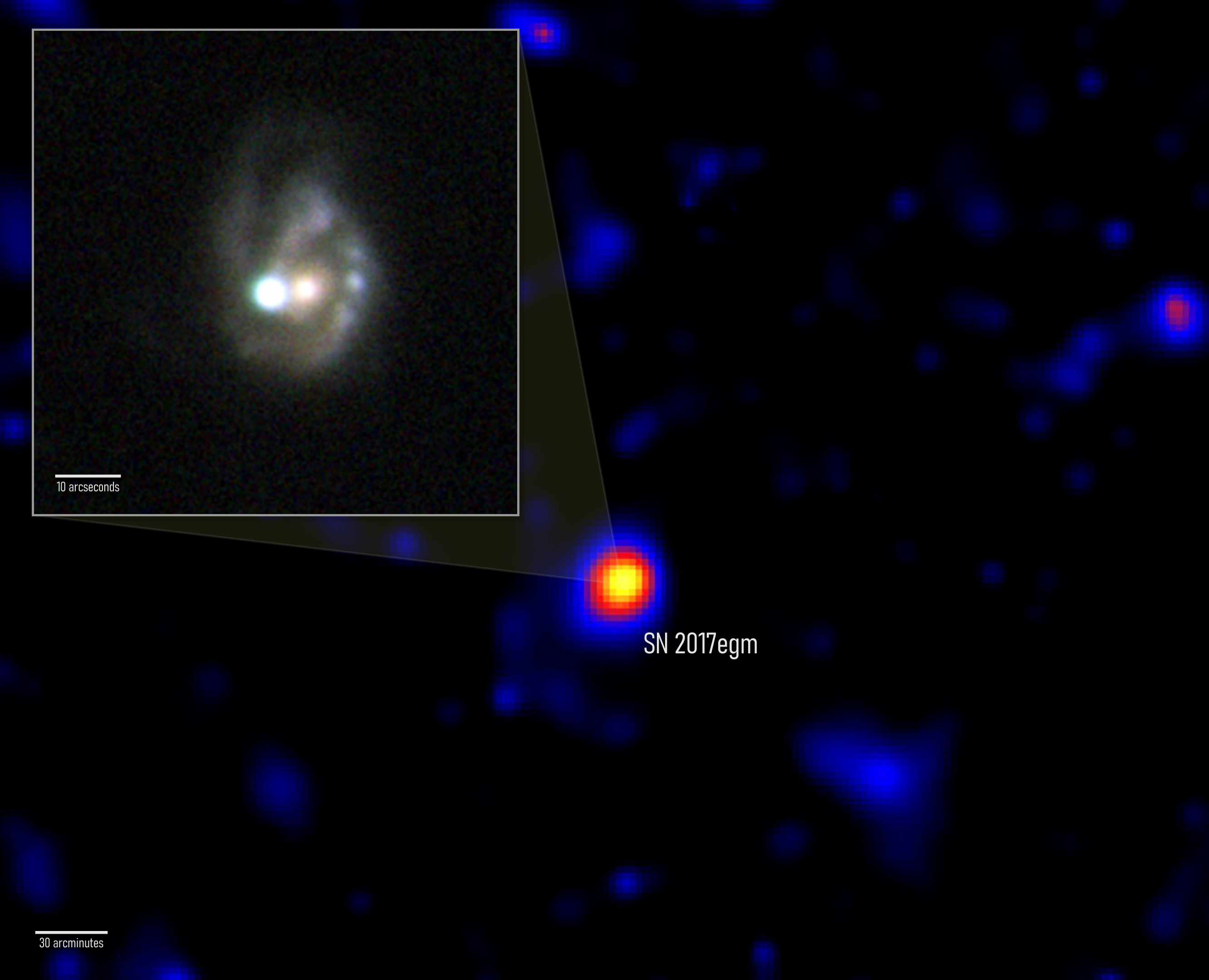
Background, NASA/DOE/Fermi LAT Collaboration and Acero et. al. 2026; inset, NOT+ALFSOC/Bose et al. 2020
NASA’s Fermi telescope has detected what may be the first confirmed gamma-ray signal from a superluminous su...
Read More

May 28, 2026,
 Astronomy/Space
NASA’s Fermi telescope has detected what may be the first confirmed gamma-ray signal from a superluminous su...
Read More
January 27, 2025,
Astronomy/Space

Astronomer Calvin Leung was excited last summer to crunch data from a newly commissioned radio telescope to precisely pinpoint the origin of repeated bursts of intense radio waves—so-called fast radio bursts (FRBs)—emanating from somewhere in the northern constellation Ursa Minor.
Leung, a Miller Postdoctoral Fellowship recipient at the University of California, Berkeley, hopes eventually to understand the origins of these mysterious bursts and use them as probes to trace the large-scale structure of the universe, a key to its origin and evolution...
Read More
February 25, 2022,
Astronomy/Space
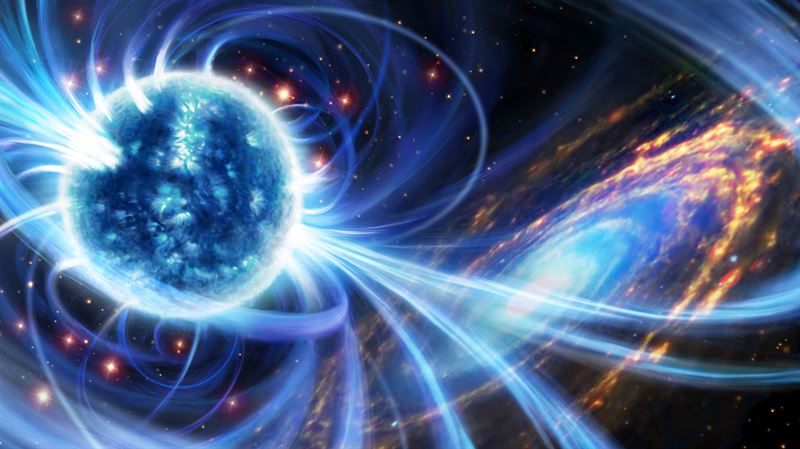
Astronomers have been surprised by the closest source of mysterious flashes in the sky called fast radio bursts. Precision measurements with radio telescopes reveal that the bursts are made among old stars, and in a way that no one was expecting. The source of the flashes, in nearby spiral galaxy M81, is the closest of its kind to Earth.
Fast radio bursts are unpredictable, extremely short flashes of light from space. Astronomers have struggled to understand them ever since they were first discovered in 2007. So far, they have only ever been seen by radio telescopes.
Each flash lasts only thousandths of a second. Yet each one sends out as much energy as the Sun gives out in a day. Several hundred flashes go off every day, and they have been seen all over the sky...
Read More
January 11, 2021,
Astronomy/Space

In 2020, astronomers added a new member to an exclusive family of exotic objects with the discovery of a magnetar. New observations from NASA’s Chandra X-ray Observatory help support the idea that it is also a pulsar, meaning it emits regular pulses of light.
Magnetars are a type of neutron star, an incredibly dense object mainly made up of tightly packed neutron, which forms from the collapsed core of a massive star during a supernova.
What sets magnetars apart from other neutron stars is that they also have the most powerful known magnetic fields in the universe. For context, the strength of our planet’s magnetic field has a value of about one Gauss, while a refrigerator magnet measures about 100 Gauss...
Read More
Recent Comments